INTERNATIONAL
INFORMATION AND ANALYTICAL
COMMUNITY


+ Join
Support INTERNATIONAL



Danylo Moskalenko, junior Analyst at the Resurgam Center for Asia-Pacific Affairs
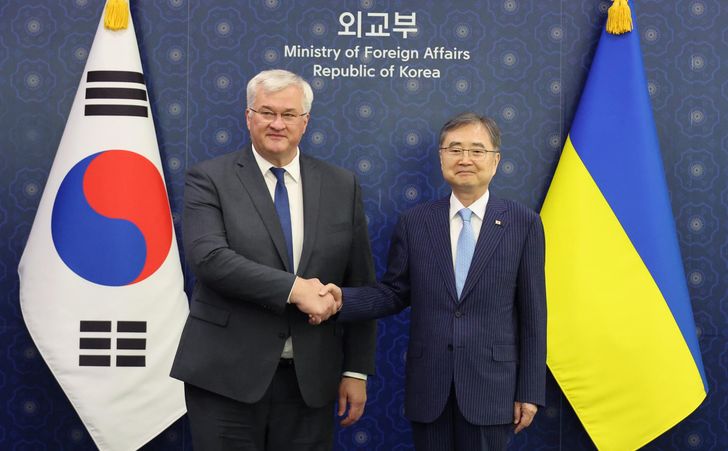 South Korean Foreign Minister Cho Hyun and Ukrainian Foreign Minister Andrii Sybiha, June 30. Source
What are the reasons behind this policy, and what consequences does it have for security on the Korean Peninsula?
On April 11, 2022, one of the first documented cases of South Korea officially refusing to provide weapons took place. During a phone call, South Korean Defense Minister Suh Wook told his Ukrainian counterpart at the time, Oleksii Reznikov, that Seoul faced “limitations” on supplying weapons to Ukraine. Reznikov had requested anti-aircraft weapons, but Seoul stressed that its position was driven by its own security situation and the potential impact on the country’s combat readiness.
Later, in November of the same year, reports emerged of US attempts to negotiate the purchase of South Korean ammunition for Ukraine. Washington intended to purchase around 100,000 155 mm artillery shells, but South Korea’s Ministry of National Defense made clear that Seoul’s policy of not providing lethal assistance remained unchanged, and that the talks were being held only on the condition that the United States would be the sole end user of the ammunition.
In April 2023, reports emerged of a compromise reached by Seoul, which agreed to provide the United States with 500,000 155 mm artillery shells in the form of a “loan.” This arrangement, rather than an outright sale, was chosen specifically to minimize the likelihood of South Korean ammunition being used directly in combat operations in Ukraine, as senior South Korean officials feared that their shells could be transferred even through a third country.
Neither NATO Secretary General Jens Stoltenberg’s call during his visit to South Korea nor pressure from Western countries to review its policy and provide direct military support to Ukraine changed the country’s position.
The situation changed sharply in the summer of 2024, when Seoul for the first time stated that it intended to reconsider its position on supplying weapons to Ukraine. The decision came in response to the signing of the Comprehensive Strategic Partnership and Mutual Defense Treaty between Russia and North Korea. South Korea subsequently officially stated that, in response to the deployment of North Korean troops to support Russia, it was considering phased measures that could include the direct provision of both defensive and offensive lethal weapons to Ukraine if military cooperation between Moscow and Pyongyang went too far. However, the matter went no further than public statements.
In November 2024, a Ukrainian delegation led by Defense Minister Rustem Umerov arrived in Seoul to formally request the provision of weapons, including air defense systems and artillery shells. Although the dialogue took place, the meeting did not result in a decision to supply weapons to Ukraine. And in August 2026, South Korea’s Ministry of Foreign Affairs reiterated that the export of defense materials is strictly regulated by domestic law, while its current assistance to Ukraine remains focused exclusively on civilian and non-lethal areas.
These refusals are driven by several factors.
The Foreign Trade Act imposes strict restrictions on the export of goods and technologies in order to safeguard national and international security. In particular, the Minister of Trade, Industry and Energy has the authority to restrict or prohibit the export of goods if war, civil unrest, or a natural disaster occurs in the Republic of Korea or a partner country, as well as when such measures are necessary to maintain international peace and security in accordance with international agreements. Thus, the law prohibits the supply of weapons to countries where active hostilities are taking place.
The law also requires export permits for “strategic goods” and so-called “situational permits” for goods that could be used to develop or manufacture weapons of mass destruction or missile delivery systems. Such exports are subject to strict controls: product classifications are carefully reviewed, and penalties for violations are being increased. These rules were introduced to prevent military and dual-use goods from reaching third countries without proper controls.
Another important restriction is set out in the Defense Acquisition Program Act, which regulates the procurement and export of military technologies and provides for strict government control over the end use of South Korean weapons through end-user certification. This provision legally prohibits the re-export or transfer of weapons to third parties without the prior written consent of the South Korean government. This, in turn, makes it impossible to transfer South Korean weapons to Ukraine through third countries.
Despite the increasingly close ties between North Korea and Russia, South Korea, by contrast, is not seeking to deepen its ties with Ukraine under the policy of the current president, Lee Jae-myung, the Democratic Party candidate who won the snap presidential election in June 2025. His predecessor, conservative Yoon Suk Yeol of the People Power Party, made an unsuccessful attempt to impose martial law in December 2024, which led to his impeachment and defeat in the presidential election.
While Yoon Suk Yeol and his People Power Party, which is currently in opposition in parliament, advocate maximum strengthening of the military-strategic alliance with the United States, normalization of relations with Japan, and an uncompromising line toward North Korea and China, Lee Jae-myung has positioned his foreign policy as “pragmatic diplomacy based on national interests.” With regard to Pyongyang, the new president insists on reducing military tensions, returning to the 2018 Inter-Korean Military Agreement (which was intended to halt all hostile acts against each other), easing tensions along the border, and resuming dialogue for peaceful coexistence. He has also warned of the risk of being sidelined if the United States under Donald Trump’s administration begins direct dialogue with North Korea. He previously advocated transferring wartime operational control (OPCON) from the United States to South Korea’s own armed forces.
In his relations with the West, Lee Jae-myung views the alliance with Washington as the strategic foundation of South Korea’s security and reaffirms the importance of trilateral cooperation between the United States, South Korea, and Japan. At the same time, he stresses that South Korea should not become entangled in other countries’ conflicts or automatically regard its neighbors as adversaries. With Japan, he seeks closer economic cooperation, including joint efforts to address international trade tariffs, while maintaining a firm position on historical disputes and Tokyo’s territorial claims. By contrast, toward Russia and China, Lee Jae-myung advocates restoring pragmatic and friendly relations, pointing to geographical proximity and economic interdependence. He has also expressed criticism of proposals for South Korea to provide lethal weapons to Ukraine.
In fact, his strategy of “peaceful coexistence” with North Korea has a significant impact on Seoul’s position on supporting Ukraine.
The key instrument of this policy is the “END” initiative (Exchange, Normalization, Denuclearization), which Lee Jae-myung presented at the UN General Assembly in September 2025. It calls for abandoning the policy of “unification through absorption” and restoring humanitarian assistance as well as economic and cultural exchanges. It also envisages gradually moving toward mutual recognition and developing diplomatic ties not only between Seoul and Pyongyang, but also by encouraging dialogue between North Korea and other actors, including the United States. To make the policy more acceptable to Pyongyang, which strongly resists demands for unilateral disarmament, Lee Jae-myung has also replaced the term “denuclearization of North Korea” with the more neutral “nuclear-free Korean Peninsula.” The wording suggests that both sides would have commitments to fulfill, thereby removing a psychological obstacle to Pyongyang’s return to negotiations. More recently, Lee Jae-myung has urged for renewed negotiations on establishing a permanent peace regime to replace the current armistice.
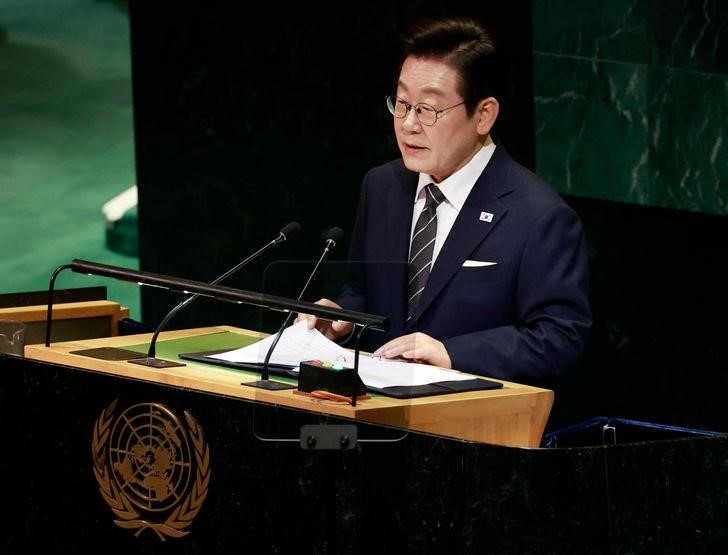 President Lee Jae-myung in the United Nations General Assembly Hall in New York on September 23, 2025. Source
The influence of third parties on inter-Korean relations also plays an important role in South Korea’s approach. China and Russia are currently North Korea’s closest partners and have direct influence over Pyongyang. Seoul would like to make use of that influence. In early 2026, during a meeting between the South Korean and Chinese leaders, Lee Jae-myung asked President Xi Jinping to act as a mediator in Seoul’s efforts to engage with North Korea.
Russia has also signed a strategic partnership treaty with North Korea that obliges both sides to provide military assistance if either party comes under armed attack. Knowing that Pyongyang has a country with the world’s largest nuclear arsenal and still considerable conventional military capabilities standing behind it, Seoul may hesitate to provoke Moscow by supplying weapons to Ukraine. Concerns that Russia could interpret such a move as direct involvement in the Russia-Ukraine war and respond by significantly stepping up the supply of weapons and military technology to North Korea are keeping the current administration from providing even defensive equipment such as Patriot systems.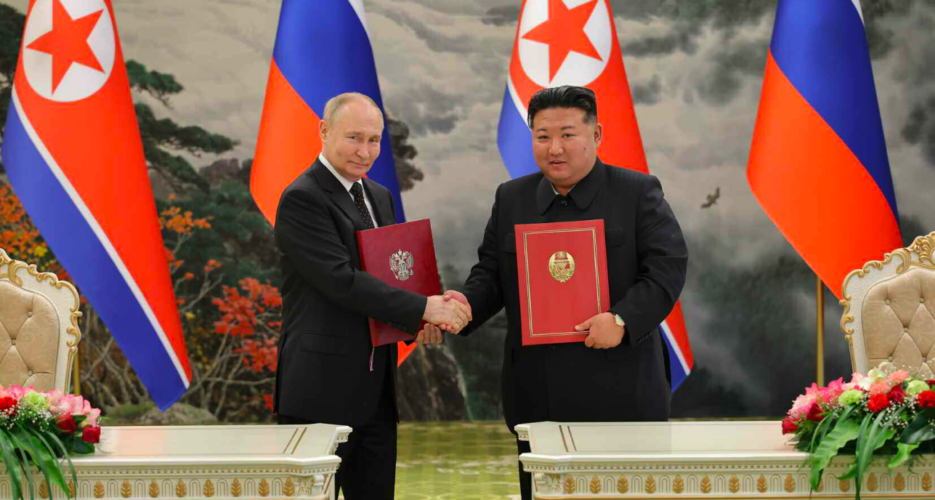 Vladimir Putin and Kim Jong Un after signing the Treaty on Comprehensive Strategic Partnership on June 19, 2024. Source
In electoral democracies, public sentiment plays a significant role in shaping politicians’ decisions. Public opinion in South Korea shows strong opposition to the idea of directly supplying weapons to Ukraine. According to a Gallup Korea poll conducted in October 2024, around 82% of respondents opposed providing direct military assistance to Kyiv, including the supply of lethal weapons. This strong opposition persists even though a majority of South Koreans perceive the strengthening of military ties between North Korea and Russia as a serious threat. Under these circumstances, the current administration is unlikely to have the political will to make decisions that are unpopular with the public.
Despite Seoul’s more conciliatory policy, Pyongyang has shown no reciprocal interest in normalizing relations. In 2024, North Korean leader Kim Jong Un declared that inter-Korean relations had become “relations between two hostile states” and that North Korea would no longer seek reunification with South Korea. In May 2026, the country amended its constitution to define its territory as bordering South Korea and removed references to reunification. While the leaders of both Koreas are gradually moving away from the goal of reunifying the Korean Peninsula, North Korea is instead pursuing a confrontational course, unlike South Korea, which is seeking reconciliation.
In her first official statement on the new South Korean administration, Kim Yo Jong, the North Korean leader’s influential sister, made clear that Pyongyang had no interest in reconciliation. She dismissed Seoul’s recent steps, arguing that suspending the loudspeaker broadcasts was merely an attempt to undo something the South should never have done. She even went so far as to urge for the abolition of South Korea’s Ministry of Unification. North Korea also rejected Lee’s call for a comprehensive peace regime, instead focusing on strengthening its front line and criticizing Seoul’s plans for nuclear-powered submarines, as well as the joint military exercises conducted by the United States and South Korea. Kim Jong Un has also rejected any phased approach to denuclearization and ruled out dialogue with Seoul, saying that he would never give up North Korea’s nuclear weapons in exchange for lifting sanctions. At the same time, North Korea continues to conduct regular missile tests, including launches toward South Korea, particularly into the Yellow Sea.
At the same time, North Korea is actively helping Russia in its war against Ukraine, providing millions of artillery and mortar shells, ballistic missiles, long-range artillery pieces, and multiple-launch rocket systems, while also sending thousands of its troops, missile units, sappers, and military engineers to the front. In return, North Korea receives foreign currency, energy supplies, food, and other forms of economic support, as well as access to Russian military technologies, including nuclear and space technologies, and combat experience for its armed forces.
Russia is also seeking to institutionalize military cooperation by proposing a military cooperation plan for 2027–2031 covering joint exercises, technology exchanges, weapon supplies, and personnel exchanges. Russia is also blocking resolutions concerning North Korea’s nuclear program, helping Pyongyang feel more secure on the international stage.
Thus, despite South Korea’s softer rhetoric and readiness for dialogue, North Korea ignores these signals and steps up its hostile rhetoric toward its southern neighbor. At the same time, the Russia–North Korea alliance is gradually becoming institutionalized, effectively making Moscow a direct ally of Pyongyang in its conflict with Seoul. Under these circumstances, South Korea’s caution over supplying weapons to Ukraine appears overly cautious, since its northern neighbor is already developing increasingly close ties with Russia and actively studying the experience of modern warfare. This gives Kim Jong Un’s regime additional advantages, particularly in its confrontation with Seoul.
At the same time, South Korea is missing an opportunity to gain the experience of modern warfare by declining to cooperate with Ukraine. Moreover, the country’s passive stance significantly undermines its international standing as part of the Western world. Although there was a case in which South Korean K2 tanks were supplied to Poland, effectively replacing the Soviet-era Polish tanks that Warsaw had transferred to Ukraine, it is difficult to regard this as assistance to Kyiv itself. It should rather be perceived as a commercial contract unrelated to any effort to strengthen Ukraine’s defense capabilities.
As discussions continue over expanding the G7 into a G7+ format that may include South Korea, Seoul’s limited support for Ukraine in its war against Russia may work against its ambitions to join the group. Support for Ukraine is regularly discussed at G7 summits, and a more substantial South Korean contribution to Ukraine’s defense could strengthen Seoul’s position as an international player and give it a greater role in shaping the discussion on global security.
You may be interested