


 INTERNATIONAL
INFORMATION AND ANALYTICAL
COMMUNITY


+ Join
Support INTERNATIONAL



Oleksiі Jasko, founder of the In Factum community
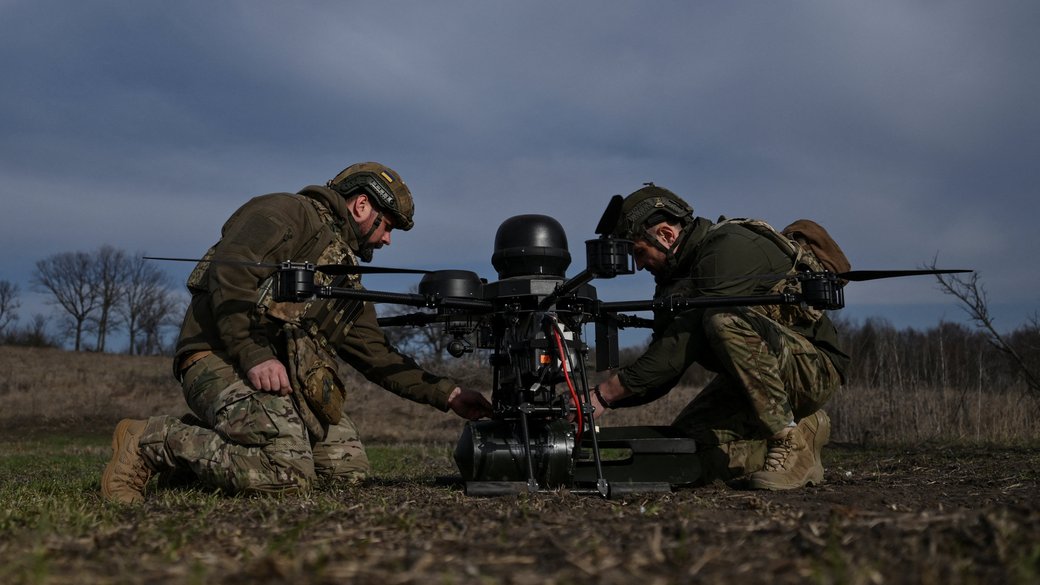 Servicemen of the 422nd Regiment of Unmanned Systems attach ammunition to a heavy attack drone before a test flight at a training ground in the Zaporizhzhia region, Ukraine, March 23, 2026. Photo: REUTERS/Stringer
This analytical brief examines the transformation of assault tactics within Ukraine's Defence Forces through the emergence of drone-assault units (DAUs) - a new organisational-combat model that has developed in response to a radical shift in the nature of the battlefield. This is not simply a matter of fielding more drones; it is the formation of a new doctrine, one in which drones, infantry, artillery, armoured vehicles, ground-based robotic systems, reconnaissance assets, and electronic warfare are integrated into a single integrated strike-assault framework.
These units grew out of the mass use of drones by both sides. The saturation of the front with strike and reconnaissance UAVs, loitering munitions, and stand-off kill systems has made conventional open movement of infantry and vehicles extraordinarily costly. Under these conditions, the drone-assault model transforms the very logic of the assault: rather than infantry entering the most dangerous zone first, unmanned systems assume the functions of detection, attrition, suppression, and disorganisation of the enemy. Infantry does not disappear from the battlefield but its role shifts toward clearing, physical control, and consolidation of positions that have already been prepared or partially neutralised.
The first notable cases of this approach in practice were the actions of the 475th Separate Assault Regiment “CODE 9.2” on the Kupyansk axis; combined search-and-strike operations near Lyman involving reconnaissance personnel of the 53rd Mechanised Brigade and drone operators from the “Signum” unmanned systems battalion; and the subsequent deployment of drone-assault units on the Oleksandrivka and Hulyaipilske axes. The emphasis placed on this direction by Ukraine's Ministry of Defence under Mykhailo Fedorov, and Germany's engagement in the DAU development project, signal a transition from localised innovation to an element of an emerging tactical military doctrine.
The formation of drone-assault units is among the most telling indicators of the war's transition into a new technological phase. Early in the full-scale war, unmanned systems performed reconnaissance, artillery correction, and precision strikes on individual targets. Today, they increasingly serve as the central element of the combat architecture. In the DAU model, the drone is no longer an auxiliary tool in support of infantry - on the contrary, infantry operates within a drone-strike framework.
The essence of the new tactic is that an assault begins not with the advance of personnel, but with the deployment of a reconnaissance-strike system. First, a picture of the battlefield is established: enemy positions, movement routes, firing points, shelter, communications nodes, logistics elements, and the locations of enemy drone operators are identified. The drone component then works to attrit and disorganise the adversary. Only then does infantry engage - not to force a frontal breakthrough under maximum fire, but to physically confirm control, clear, and consolidate terrain that has already been prepared or partially neutralised.
In this way, DAUs alter the sequencing of applied force. In the classical assault model, infantry is the primary carrier of combat: it advances on enemy positions under cover of artillery, armour, and other supporting elements. In the drone-assault model, infantry becomes the concluding element of the operation. The primary burden of the first phase shifts onto unmanned systems, which detect, correct, strike, and force the enemy to react before the assault group ever comes into close proximity. This shift is precisely what enables a significant reduction in the time that personnel spend under direct enemy fire.
The fundamental distinction between DAUs and conventional UAV units lies not merely in the number of drones. Standard unmanned systems units generally function as a reconnaissance or fire component supporting the actions of other elements. Drone-assault units operate under a different logic: the drone operator, the reconnaissance specialist, the infantryman, the artilleryman, the combat engineer, the electronic warfare specialist, and the group commander function as elements of a single strike-and-manoeuvre system.
At the same time, the new tactic does not entail the abandonment of infantry, artillery, or armour. This is an important point, since it might otherwise give rise to the mistaken impression that future war is exclusively a war of drones. As the commander of the 225th Separate Assault Regiment, Major Oleh Shiryaev, has rightly noted in an interview, increasing the drone component should reduce the presence of infantry in the most dangerous areas but it cannot fully replace the infantryman. The enduring principle holds: the boundary of control passes where the soldier's boot stands. A drone can detect, strike, force the enemy to withdraw, or break their cohesion but tactical and physical control of terrain is established by infantry.
DAUs should therefore be understood not as a replacement for the classical combat model, but as its evolutionary complement. Artillery remains critical for deeper fire effect; armour retains its role in specific conditions of manoeuvre and support; engineering assets are essential for overcoming obstacles; and electronic warfare and counter-drone systems are necessary for the survival of the drone-assault groups themselves. It is telling that in January 2026, when Minister Fedorov presented the DAU concept to German Defence Minister Boris Pistorius, he also specifically emphasised the importance of long-range artillery munitions for suppressing targets within the drone kill-zone. This confirms the integrated character of the new doctrine.
The emergence of DAUs is a direct consequence of total drone saturation of the battlefield. Strike drones have extended the kill-zone along the line of contact, with Commander-in-Chief Syrskyi reporting in October 2025 that it already extended to 10 kilometres. This means the zone of constant risk for infantry, logistics, evacuation, and armour has grown considerably. By April 2026, assessments of the kill-zone on certain sectors had reached 15 kilometres - further reinforcing the conclusion that the classical model of concentrating force on a narrow sector is becoming increasingly untenable.
In these conditions, drone-assault tactics transform one of the principal threats of the modern battlefield into an advantage. Rather than attempting simply to “hide” infantry from enemy drones, the Defence Forces push their own unmanned systems forward, forcing the adversary to respond to persistent drone pressure. The enemy loses freedom of manoeuvre; the effectiveness of its firing positions degrades; logistics are disrupted; and infantry gains the ability to operate under conditions of significantly reduced uncertainty.
A distinct element of the new model is combined search-and-strike interaction - the pairing of reconnaissance personnel and drone operators into integrated groups capable of rapidly locating the enemy, transmitting targeting data, correcting strikes, and accompanying infantry operations. A clear illustration is the clearing of the eastern outskirts of Lyman by reconnaissance assets of the 53rd Mechanised Brigade and “Signum” battalion drone operators in January-February 2026. This format demonstrates that DAUs are not purely a technical phenomenon - they also represent a new culture of small-unit command, in which the speed of information exchange becomes as important as raw firepower.
The first and most illustrative case of drone-assault logic in practice was the Kupyansk counter-offensive operation in autumn 2025. The 475th Separate Assault Regiment “CODE 9.2” is identified as the pioneer of the new approach. The unit evolved from a strike UAV company within the 92nd Brigade into a separate assault formation with an expanded combat structure. According to ArmyInform, in January 2025 the formation of the 475th Separate Assault Battalion with its own assault companies, reinforced artillery and tank assets, and air defence means began on the basis of the “CODE 9.2” company.
The significance of the Kupyansk case extends beyond the mere employment of drones within a new concept. It lies in its demonstration of a new way of fighting in conditions where the adversary actively employs infiltration, small-group tactics, shelter, drones, and an extensive observation network. This type of combat is poorly suited to the classical frontal assault but fits the logic of DAUs precisely: detect, isolate, strike, deprive the enemy of organisational coherence - and only then introduce infantry rapidly for clearing and consolidation. It was the effectiveness of the new approach on the Kupyansk axis that provided the impetus for extending the experience to other units along other sectors of the frontline.
The second case is the Lyman axis. Here, the drone-assault model manifests not as a large, purpose-built regiment but as coordination between different units - reconnaissance, drone operators, and assault groups. This points to a gradual shift from an experimental format toward a wider practice that different elements can adapt according to terrain, mission, and available resources.
The third dimension is the southern axes, specifically Oleksandrivka and Hulyaipilske. Since February 2026, the 1st Separate Assault, 475th Assault “CODE 9.2”, and 225th Assault Regiments have been operating in these areas within an integrated drone-infantry framework. This is significant because the south presents different terrain, different shelter density, and greater open space, and thus different vulnerabilities to drone observation and strike. If DAUs demonstrate effectiveness under these conditions as well, it would strengthen the case for their universality as a model rather than a situational solution for a particular sector of the front.
The institutional dimension is no less significant than the tactical. Defence Minister Mykhailo Fedorov has publicly identified the development of drone-assault units as a priority. Discussions with German Defence Minister Boris Pistorius explored German participation in this innovation project. Ukraine is ready to share practical experience with German military personnel, and Germany regards participation in DAU development as part of a broader defence cooperation framework.
German resource support has the potential to elevate DAUs from a battlefield innovation to a scalable, prospective doctrine. It is for this reason that within Germany's assistance package for Ukraine in 2026, Berlin has allocated funding for drone procurement, air defence development, and support for the drone-assault unit project. This signals that Ukraine's practical experience is already being perceived by partners not merely as a local adaptation, but as a potentially new standard for combat in a drone-saturated environment.
At the same time, scaling DAUs creates a number of systemic challenges. The first is personnel. This model requires not simply large numbers of drone operators, but operators with tactical acuity - individuals capable of functioning within a unified framework alongside infantry, artillery, reconnaissance, and electronic warfare assets. The second is technical: a stable and continuous supply of diverse drone types, ground-based robotic platforms, communications equipment, batteries, signal repeaters, protective systems, and repair capacity is essential. The third is doctrinal: standardised procedures for training, coordination, and command are needed so that DAUs do not remain a collection of strong practices confined to individual units, but become a replicable model for the Defence Forces as a whole.
The fourth challenge is adversary adaptation. Russia is also expanding its own unmanned systems forces, intensifying the use of FPV drones, reconnaissance UAVs, fibre-optic drones, and electronic warfare assets. In April 2026, it was reported that the Russian army had grown its unmanned systems personnel to 101.000 and plans further expansion. DAUs will not operate in a vacuum. The adversary will adapt, copy individual solutions, intensify electronic warfare, develop counter-drone capabilities, and seek new methods of locating Ukrainian operators.
Accordingly, drone-assault doctrine cannot remain static. Its effectiveness will depend on the continuous updating of tactics, the speed of new technology adoption, the adaptability of commanders, and the capacity of frontline experience to travel rapidly from individual units to systemic practice. In this context, Ukraine's advantage lies not merely in the possession of drones, but in a culture of rapid adaptation, decentralised decision-making, and close collaboration between military personnel, volunteers, manufacturers, and the state.
The formation of drone-assault units represents one stage in the military transformation of Ukraine's Defence Forces under conditions of protracted attritional warfare. The new tactic emerged not as a theoretical construct but as a practical response to a concrete problem: classical assault operations had become excessively costly in the face of mass drone employment, an expanding kill-zone, persistent surveillance, and the rapid engagement of any movement on the battlefield.
DAUs alter the very philosophy of the assault. The infantryman remains the central figure of the war but is no longer unnecessarily committed to the most dangerous phase of the engagement. Drones assume the functions of first contact, reconnaissance, attrition, suppression, and disorganisation of the adversary. Infantry enters when risks have been reduced, and the task becomes not a frontal assault but a controlled occupation, clearing, and holding of a position.
In the near term, further scaling of DAUs is to be expected on axes where the adversary actively employs small groups, infiltration, drone surveillance, and dense fire systems. The most promising terrain remains areas characterised by difficult topography, urban zones, tree lines, and logistically vulnerable sectors.
In the medium term, DAUs may form the foundation of a new Ukrainian offensive doctrine of limited, precise, and technologically prepared manoeuvre. This is not a return to large-scale mechanised breakthroughs in the classical sense, but rather a series of localised, carefully prepared actions in which the adversary first loses observation, logistics, operators, firing points, and the capacity for organised response, and only then loses the position physically.
In the long term, drone-assault units may become one of the foundational elements of a new type of Defence Force. Their emergence demonstrates that the army of the future will not simply be “more drone-heavy”. It will be built around human-machine interaction, in which infantry, drones, artillery, armour, electronic warfare, ground-based robots, and digital command function not as separate layers but as a single combat organism.
The success of this model is not, however, guaranteed automatically. It depends on Ukraine's capacity to conduct mass operator training, standardise coordination procedures across units, stabilise supply chains for unmanned systems, develop counter-drone protection, and adapt rapidly to adversary countermeasures. The speed of learning and tactical renewal will be the decisive condition for maintaining the advantage.
Drone-assault units are therefore not simply a new type of unit, and not simply a response to personnel shortfalls. They are a manifestation of a deeper change in the character of warfare. Ukraine is, in effect, constructing a new model of combat - one in which technology operates not in place of the human being, but in service of preserving human lives and enhancing human effectiveness. It is for this reason that DAUs should be regarded as one of the most promising directions in the development of the Defence Forces under conditions of total drone warfare.