 INTERNATIONAL
INFORMATION AND ANALYTICAL
COMMUNITY


+ Join
Support INTERNATIONAL



Vladyslava Vasylieva, junior Analyst at the “Resurgam” Analytical Center, Europe direction. Specialization: France.
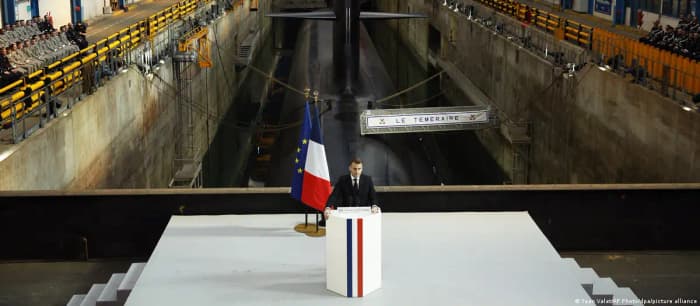 Photo: Yoan Valat/AP Photo/dpa/picture alliance
France's nuclear doctrine was forged during the Cold War and rests on four foundational principles: national independence and sovereignty guarantee, a strictly defensive character, sufficiency paired with responsibility, and credibility of deterrence. Paris controls all components of its nuclear deterrent entirely autonomously, without any collective decision-making mechanism. Since 1958, French nuclear policy has maintained a limited arsenal designed solely to deter aggression through the threat of a retaliatory strike and to protect the country's vital national interests. Structurally, the deterrent comprises two legs: a naval component built around strategic submarines and an airborne component consisting of nuclear-armed aircraft. France maintains 280 thermonuclear warheads and operates four Le Triomphant-class submarines - Le Triomphant, Le Téméraire, Le Vigilant, and Le Terrible, armed with submarine-launched ballistic missiles with a range of up to 10.000 km. Together, these capabilities ensure both operational flexibility and permanent combat readiness.
French doctrine has always balanced strategic autonomy with a declared commitment to the collective defence of European allies. France is notably absent from NATO's Nuclear Planning Group - a deliberate choice that underscores the independence of its nuclear posture. Yet Paris has never been entirely indifferent to the European dimension. Since 2020, Macron has repeatedly invoked the framework of a “strategic dialogue” with European partners - signalling an openness to broadening the conversation about France's nuclear role in continental defence. In the current climate, this creates concrete conditions for a reassessment of doctrinal parameters and a genuine debate about whether French deterrence can serve as a wider European guarantee.
To understand the evolution of French nuclear doctrine, it is important to identify the key drivers currently shaping it. Recent developments, specifically the doctrine review of March 2026, represent a direct response to the sharp deterioration of the political and security environment in Europe and beyond.
Several main drivers can be identified. The primary one is Russia's full-scale war against Ukraine. A compounding factor is Russia's 2024 revision of its own nuclear doctrine, which expanded the scenarios under which nuclear weapons could be used and effectively lowered the threshold for their deployment, significantly increasing the level of strategic uncertainty across Europe. As analyst Artur Kacprzyk notes, these changes constitute a deliberate strategy of intimidating the West, and can thus be understood as a component of political pressure.
A second driver is the strategic posture of the Trump administration - its open skepticism toward allied commitments and criticism of NATO partners which has forced EU capitals, and Paris above all, to question the durability of traditional security guarantees and accelerate work on autonomous deterrence. Third, the events of February 28, the launch of a large-scale US-Israeli military operation against Iran, triggered a new wave of global escalation and sharp tensions across the Middle East. According to the Institute for the Study of War (ISW), this was among the most significant US military operations in the region in over a decade, adding further momentum to Europe's strategic rethink.
Turning to the core principles of the updated doctrine, its defining feature is the preservation of traditional national nuclear deterrence principles, coupled with a deepened and expanded French influence on the European dimension. In his address at the Île Longue naval base, Macron announced the introduction of the concept of so-called forward deterrence - a framework that envisages closer coordination with European allies, joint exercises, and the potential temporary deployment of French strategic assets on the territory of partner states. It was emphasized that control over the use of nuclear weapons remains exclusively within the competence of the French President, and that the new strategy is designed to alternatively strengthen the continent amid growing global political instability. On the resource side, Defence Minister Catherine Vautrin indicated that nuclear deterrence spending is set to rise sharply, with the 2026 budget for this component potentially reaching approximately €57.1 billion - a figure that speaks to the seriousness of the commitment.
This model carries both potential advantages and certain risks. On one hand, the approach is intended to complicate the strategic calculations of potential adversaries, as distributing deterrence elements across the continent makes them less predictable. Beyond that, it could strengthen Europe's strategic autonomy and reduce dependence on American nuclear guarantees - at a moment when those guarantees feel less than certain. Deeper coordination between France, the United Kingdom, Denmark, Poland, and other countries could create a more resilient deterrence framework capable of responding to emerging threats.
At the same time, critics point out that expanding the role of France's nuclear capabilities could generate political tensions within the European Union, as such a system operates outside the NATO framework and would require new institutional arrangements and additional coordination. And regardless of how deep the cooperation runs, the final trigger remains in Paris: a structural constraint that limits allied buy-in. As a result, this doctrine may hold limited appeal for other EU member states, given the absence of a collective control mechanism and the primacy of French sovereign decision-making.
There is also harder arithmetic at work. France's arsenal of fewer than 300 warheads is a fraction of the strategic stockpiles held by the United States or Russia. Extending that deterrent credibly across the entire European space would require not only political and coordination breakthroughs, but potentially a significant expansion of French capabilities - costly in both time and money.
It is equally important to examine the Russian narratives of alleged “nuclear escalation” - narratives that are actively deployed in Moscow's propaganda campaigns. Such claims are designed to discredit France as a nuclear power, weaken support for Ukraine, and generate fear of escalation across European societies. This discourse has acquired particular relevance in the context of France's updated nuclear doctrine, as Moscow seeks to exploit nuclear themes as a tool of pressure and as an element of a broader hybrid strategy aimed at shaping public opinion in Europe.
The most striking recent example came in February 2026, when Russia's Foreign Intelligence Service (SVR) publicly alleged that France and the United Kingdom were planning to transfer a nuclear weapon to Ukraine. No evidence was offered. The claim was immediately amplified across Russian state media and social networks - the standard conveyor belt of Kremlin disinformation. European governments immediately dismissed the allegations as baseless and contrary to international law, including the Treaty on the Non-Proliferation of Nuclear Weapons.
The timing of this narrative was not coincidental, aligning with several significant political developments. First, the SVR claims surfaced during active peace negotiations - with the transparent aim of sabotaging them. Second, the information campaign coincided with the fourth anniversary of Russia's full-scale invasion of Ukraine, a moment of heightened international focus on the war and its consequences. In this context, the circulation of “nuclear escalation” claims allows the Kremlin to simultaneously create an atmosphere of fear around potential conflict escalation, discredit Western support for Ukraine, undermine the credibility of Paris and London, worsen US attitudes toward Ukraine, and justify its own rhetoric.
Further information manipulation can be identified in this space. One of the central recurring claims is the assertion that it is the West that is allegedly preparing a “nuclear escalation” against Russia. Western military assistance to Ukraine is systematically reframed in Russian state media as a slide toward direct NATO-Russia confrontation - reinforced by selective focus on weapons systems that could theoretically carry nuclear components or hold strategic significance. The Kremlin deploys this rhetoric to cast the West as a party consciously escalating the risk of global conflict. Nuclear themes are regularly employed by Russian propaganda precisely during periods of rising international tensions, given their strong psychological effect and capacity to amplify fear within European societies.
The accusation levelled at France that Paris is dragging Europe into nuclear confrontation with Russia follows the same pattern. French proposals for expanded allied participation in strategic consultations have been immediately labelled “destabilizing” and characterized as a de facto expansion of NATO's nuclear footprint. The effect is to reframe French initiative as aggression - with the downstream goal of feeding scepticism in parts of European public opinion about continued support for Ukraine.
From this analysis, it is also possible to identify the target audiences of the “nuclear narrative” - which in turn allows for a more precise mapping of the strategic objectives of this information campaign. European publics, particularly in EU and NATO member states, are the primary audience. For them, such messaging is designed to heighten fear of potential nuclear escalation and create the impression that continued support for Ukraine could draw Europe into direct conflict with Russia. The use of nuclear themes carries a powerful psychological and manipulative effect, as it appeals to fundamental fears. The result may be a broader shift toward more critical public opinion regarding assistance to Ukraine.
EU political elites are a second target. The goal here is to generate friction within the Western coalition. By framing France as a state allegedly provoking nuclear escalation or attempting to impose its vision of European deterrence, Russian rhetoric aims to erode trust among allies. This approach constructs an image of France as an actor whose initiatives may pose risks to continental stability - potentially diminishing allied support for its strategic proposals.
Russia's domestic audience is the third. Here, the nuclear escalation narrative performs a different function: it legitimizes the Kremlin's own posture by constructing an image of an aggressive, nuclear-threatening West that Russia is compelled to counter. This sustains the mobilization logic within Russian society and provides political cover for the continuation of the war.
Taken together, these messaging tracks allow Moscow to pursue several strategic objectives simultaneously: undermining international support for Ukraine, inflating fear of escalation, and neutralizing France as a credible European security actor.
The emergence of a new European deterrence architecture carries real strategic consequences for Ukraine - both positive and negative. First and foremost, this involves a shift in Europe's overall security architecture, in which the role of nuclear states, primarily France and its allies, is set to grow. Should EU member states more actively integrate their defence strategies around nuclear deterrence, this could enhance the overall level of strategic stability on the continent and raise the cost of any further Russian escalation. For Ukraine, such a development would mean a strengthening of the security environment: a more consolidated European deterrence system could constrain Moscow's ability to use nuclear threats as an instrument of political pressure in the war.
At the same time, the growing role of the nuclear factor in European security generates certain political risks for Ukraine. One of the primary risks, as analysed above, is the continued information pressure Russia exerts through media narratives which can sustain and manipulate public opinion at a psychological level. Additionally, in strategic discussions about deterrence, allies' attention may partly shift from immediate military support for Ukraine toward the broader question of long-term stability and escalation risk management. Within this logic, some states may prioritize deterrence policy over a rapid resolution of the war in Ukraine's favour.
Yet the same shift also opens new doors. Even without any formal role in nuclear mechanisms, Ukraine could progressively integrate into wider formats of strategic dialogue, intelligence sharing, and joint defence planning with European partners. Over time, this trajectory deepens Ukraine's incorporation into the European security architecture moving it from the position of a supported party to that of a genuine contributor to continental stability.
In the longer view, Europe's emerging deterrence architecture will produce a more integrated collective security space within the EU - a strategic “umbrella” for its member states. This raises a significant question for Ukraine's future: if and when Ukraine joins the EU, it will enter a security environment in which the nuclear factor is already part of the deterrence landscape. Ukraine is unlikely to gain any formal role in France's nuclear decision-making - that remains exclusively a French sovereign prerogative. But integration into the EU would mean integration into Europe's wider strategic deterrence system, where nuclear capability provides the security backdrop and Ukraine's primary contribution lies in reinforcing conventional deterrence - a domain in which its battlefield experience already makes it one of the most capable actors on the continent.
The debate over French nuclear deterrence and the Kremlin's information response to it makes one thing clear: the nuclear factor has returned to the centre of European strategic thinking. On one hand, the growing role of nuclear states in European defence architecture is a response to rising geopolitical instability and the need to build more autonomous deterrence mechanisms. On the other hand, these processes are accompanied by active information campaigns aimed at eroding trust among allies and framing the West as a source of escalation. For Ukraine, these dynamics mean that its security environment is increasingly shaped by the wider transformation of Europe's strategic architecture. Ukraine is no longer simply a recipient of Western support. Its military experience, its demonstrated capacity to fight, and its role as Europe's frontline against Russian aggression are making it an organic element of the continent's deterrence and stability. The task ahead is not only to preserve that support - but to shape, from within, Europe's new security order.
You may be interested