


 INTERNATIONAL
INFORMATION AND ANALYTICAL
COMMUNITY


+ Join
Support INTERNATIONAL


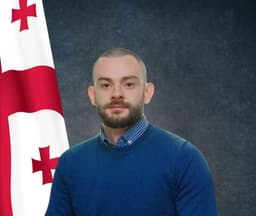
David Janjalia, Security analyst and geopolitical strategist specializing in hybrid warfare, Black Sea security, and Euro-Atlantic defense policy.
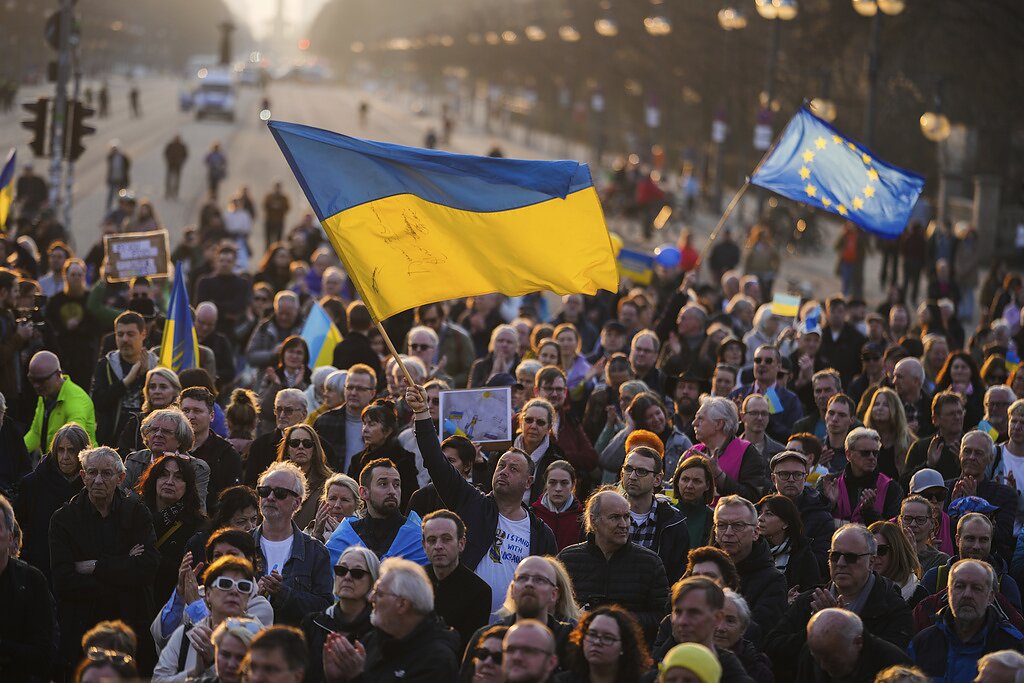 Photo: Getty Images
People were getting out. Others who had been walking along the street stopped where they were. Then they lowered their heads and knelt.
A funeral procession was passing.
I stopped the car, got out and stood with them.
For those few minutes, whatever I had been thinking about before disappeared. People who had been driving somewhere, working, walking, living their ordinary lives were suddenly sharing the same moment.
I knew none of them.
But calling them strangers would be wrong.
In that moment, there were no strangers.
We were there for the same reason.
And then there was the song.
I did not understand every word. I didn't need to. You could feel what it carried before knowing its meaning. Later, learning that it was a sorrowful dialogue between a mother and her son leaving his home, his family and his homeland, knowing that he may not return, made the moment even heavier.
I witnessed scenes like this more than once in Ukraine.
And each time, something struck me about the act itself.
I saw Ukrainians kneel many times. But never in surrender.
They knelt for their fallen.
There is a danger in writing about Ukrainian resilience from a distance.
The word has been repeated so often that it can begin to sound almost effortless; as if people somehow become accustomed to missiles, funerals, separation and death. Standing beside that road, I understood something different. Resilience has a cost. And in Ukraine, you can see it everywhere. Every morning at 9:00, the country observes a minute of silence for those killed as a result of Russian aggression. I knew about the ritual before travelling there. Experiencing it was different.
No matter where I went, it was there.
Traffic stopped. People stood. For one minute, ordinary life gave way to memory.
Then Ukraine started moving again.
That sequence stayed with me: stop, remember, continue. Grief is given its place. But it is not given control over what happens next.
During one of my security-related missions, I met a Ukrainian veteran who had served in the Armed Forces for more than thirty years.
War had left him with a serious combat-related injury. He was no longer permitted to return to the frontline.
That was what frustrated him.
Not what had happened to him. The fact that he could no longer go back.
His children were serving now, including his daughter.
I remember listening to him and thinking about what makes responsibility pass from one generation to another like that.
It would be easy to describe this simply as courage. But courage alone does not explain what I kept encountering.
People are afraid. People are exhausted. People are grieving. To pretend otherwise would be to romanticize a reality that has already demanded far too much from them.
Resilience is not the absence of fear, grief or exhaustion. It is the collective ability to absorb them without allowing them to determine what happens next.
Another conversation made me understand this differently.
Ukraine was under heavy Russian attack. I told a Ukrainian man that they needed to remain alert about what Russia might do next.
His response stayed with me.
In essence, he told me: We are not thinking about what else they can do to us. They should be thinking about what all of this will bring back to them.
It was not a claim that Russia could no longer hurt Ukraine. Russia has demonstrated repeatedly, and brutally, that it can.
What struck me was the reversal.
He refused to think of Ukrainians only as the recipients of somebody else's violence. His attention was already on the response.
Fear may have been present. But fear did not determine his understanding of what happened next.
This is where resilience becomes more than endurance.
A society cannot win a war simply by becoming better at suffering.
It has to adapt.
Ukraine has done so at remarkable speed. Faced with an adversary possessing far greater conventional resources, it has developed a large domestic drone ecosystem and new ways of fighting. Small unmanned systems have transformed battlefield observation and strikes. Longer-range systems have given Ukraine an expanding capacity to target logistics, airfields and infrastructure supporting Russia's war effort far beyond the frontline. In the Black Sea, maritime drones and missiles have imposed significant costs on Russia's fleet despite Ukraine lacking a comparable conventional navy.
The technologies will continue to change. The principle is more important.
Resilience is not simply the ability to endure pressure. It is the ability to adapt faster than the pressure can break you.
And adaptation is not confined to the battlefield.
Children still go to school.
Often, the school has to go underground with them.
Russian missile and drone attacks have forced communities to move lessons into shelters and underground classrooms so that education can continue even when something as ordinary as a school day becomes a security problem.
There is nothing normal about that.
Normal life during war does not mean that war has become normal. It means people are fighting to preserve normal life despite it.
A country fighting for survival must somehow do three things at once: remember its dead, defend its present and build its future.
Ukraine is trying to do all three.
Perhaps the scenes of people kneeling affected me so deeply because, as a Georgian, the gesture was not entirely unfamiliar to me.
I have seen Georgians gather along the road from the airport to honor our soldiers brought home from Ukraine. They came specifically to meet them. As the fallen passed, people knelt.
What I encountered in Ukraine was different.
There, amid the scale and constancy of war, remembrance could suddenly enter an ordinary street and draw whoever happened to be there into the moment. Again and again, I saw people interrupt their own lives to acknowledge someone else's sacrifice.
The circumstances were different. The emotion was familiar.
And perhaps that is also why Russia's war against Ukraine has never felt like an abstract geopolitical subject to me.
As a Georgian, I come from a country still living with the consequences of Russian occupation. We know what it means when a larger neighbor treats the sovereignty of a smaller nation as conditional; when it claims the right to determine somebody else's future.
The longer I thought about my experiences in Ukraine, the less I understood resilience simply as endurance.
I began thinking about something else.
Agency.
Aggression does not only seek to destroy military capability or seize territory. It also seeks to reduce the adversary's ability to make meaningful choices about its own future.
At the individual level, war intrudes into the most basic decisions. Someone else tries to determine whether your electricity works tonight. Whether your home survives. Whether your children can safely attend school. Whether you can sleep. Whether you remain on your land.
At the national level, the same logic becomes strategic. Russia seeks to deny Ukraine the ability to determine its own security arrangements, political orientation and geopolitical future.
In that sense, resilience is not merely the capacity to absorb damage.
It is the preservation of agency under sustained coercion.
Ukraine made me think about sovereignty in more human terms.
Sovereignty exists on maps, in constitutions, treaties and institutions. But beneath all of them is something more fundamental: a society that continues to believe its future belongs to it.
That is why the veteran mattered.
That is why children continuing to learn mattered.
That is why the man speaking to me during Russian attacks mattered.
And that is why the people kneeling as their fallen passed mattered.
Different people. Different circumstances. But each, in their own way, reflected the same refusal: to surrender the power to decide what happens next.
None of this means determination alone is enough.
Weapons matter. Resources matter. Institutions matter. Allies matter. Strategy matters. Ukraine's survival has depended on all of them, and will continue to.
Good does not prevail simply because it is good.
Freedom survives because people choose to defend it, and because that choice is given the strength required to survive.
There is one final moment from Ukraine that has never left me.
We were leaving the country after one of our missions.
At the border, we put our fists to our hearts and called out:
“Slava Ukraini!”
A senior Ukrainian serviceman looked at us, put his fist to his own heart and answered:
“Heroiam Slava!”
Then he raised his fist into the air as we drove away.
I remember the expression on his face: pride, energy, perhaps some surprise and happiness at the exchange.
We were leaving Ukraine.
He was staying.
I have thought about that moment many times since.
I also think about the people whose graves and memorials I still hope to visit. Oleksii “Tykhyi” Naida is one of them. Roman Kosenko, known as “Yashka Tsygankov,” is another.
And there are many more Ukrainian, Georgian and international. Different nationalities. Different lives. Different stories. Connected by the choice to stand when looking away would have been easier.
I think of them as heroes of light.
But remembrance should never turn sacrifice into something romantic.
Resilience has a cost.
It has empty chairs at family tables. It has veterans carrying injuries long after battles end. It has classrooms underground. It has mothers burying sons. It has funeral songs that you can feel before you understand a single word.
It has people kneeling beside roads.
And then, somehow, standing again.
An aggressor can destroy a building. It can interrupt sleep, work and ordinary life. It can force a classroom underground. It can take people who should still be alive. It can inflict grief that remains long after the sound of an explosion disappears.
What it cannot so easily control is what people decide to do the morning after.
That may be what cannot be taken.
The power to remember without allowing grief to dictate the future.
The power to stand again.
And the conviction that the future is still yours to determine.