


 INTERNATIONAL
INFORMATION AND ANALYTICAL
COMMUNITY


+ Join
Support INTERNATIONAL



David Janjalia, Security analyst and geopolitical strategist specializing in hybrid warfare, Black Sea security, and Euro-Atlantic defense policy.
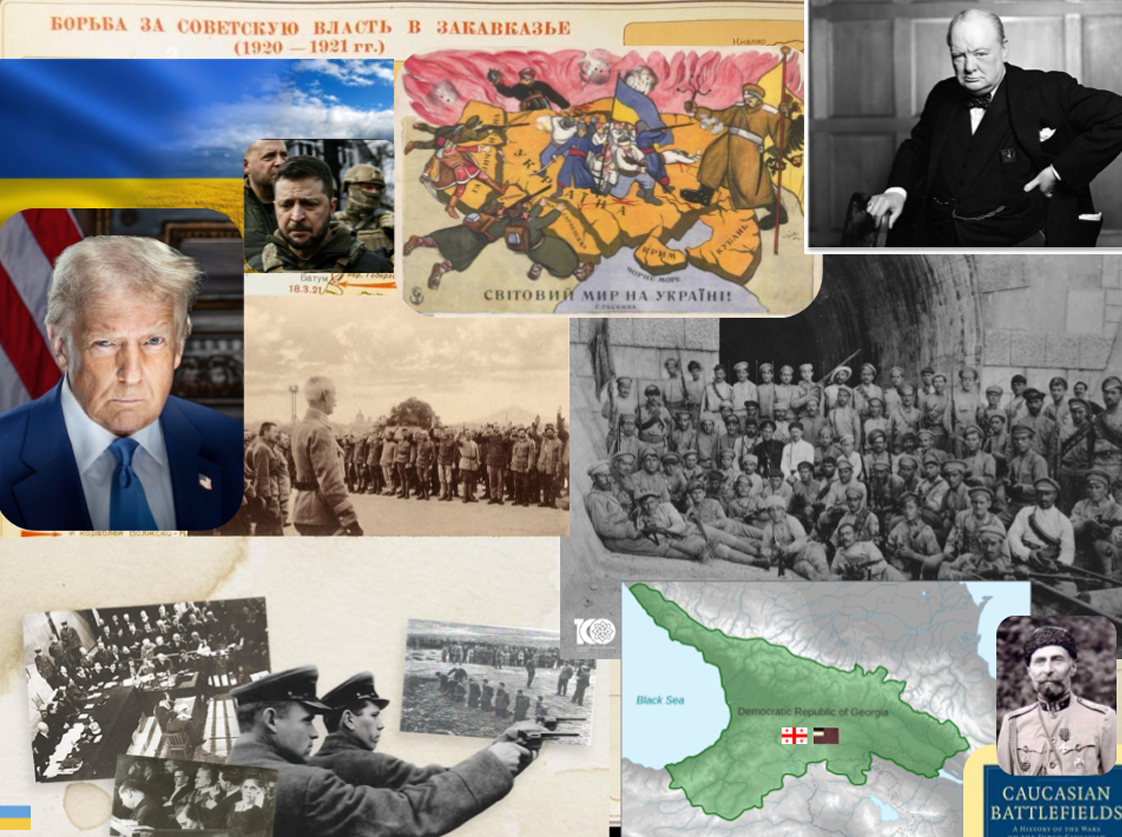 The cost of strategic weakness is rarely paid immediately. And almost never by those who initially choose it.
In 1920, Winston Churchill served as Britain's Secretary of State for War. A committed imperialist and fierce opponent of Bolshevism, he understood the dangers of Soviet expansion.
Yet Britain, exhausted by the First World War and constrained by competing strategic interests, was withdrawing from the Caucasus.
Churchill did not single-handedly determine that decision. Yet Britain's withdrawal reduced the external support available to the newly independent Caucasian republics at a critical moment in their struggle against Bolshevik expansion.
Azerbaijan fell to the Bolsheviks in 1920, followed by Armenia later that year and Georgia in 1921. Ukraine's struggle for independence also ended in defeat, followed by its incorporation into the Soviet Union in 1922.
What followed was not stability.
It was decades of repression, destroyed institutions, forced Sovietization, and, in Ukraine, the Holodomor.
In 1938, European powers accepted the dismemberment of Czechoslovakia through the Munich Agreement, hoping to avoid another war.
They did not prevent one.
In 1956 and 1968, Soviet interventions in Hungary and Czechoslovakia demonstrated how Moscow could use military force to preserve its sphere of influence while Western powers avoided direct confrontation.
These events occurred under different circumstances. But they reveal a recurring strategic problem.
The immediate cost of resistance is calculated carefully. The long-term cost of inaction is repeatedly underestimated.
Churchill himself later became one of the most influential voices warning about Soviet expansion. His 1946 Iron Curtain speech reflected a strategic reality that Europe could no longer afford to ignore.
Today, Washington and European capitals face another consequential choice.
There is a persistent belief that Russia's expansionist ambitions can be contained through negotiations, economic incentives, and political concessions.
History provides little justification for such confidence.
The 1994 Budapest Memorandum did not prevent Russian aggression against Ukraine. The 2008 ceasefire agreement did not restore Georgia's territorial integrity. The Minsk agreements failed to produce a durable settlement. The problem is not diplomacy itself. It is the belief that diplomacy can substitute for credible military power and enforceable consequences.
An agreement without deterrence does not necessarily end a threat. It may simply give that threat time to recover.
But an even more dangerous misconception persists.
That Ukraine's survival is primarily Ukraine's problem.
That Georgia's sovereignty is primarily Georgia's problem.
That defending these countries is a moral obligation rather than a strategic necessity.
It is not.
Every successful act of territorial aggression alters the security calculations of other states.
Every failure to enforce commitments weakens confidence in future guarantees. Every concession made without sufficient leverage risks encouraging further demands.
The consequences do not remain confined to Kyiv or Tbilisi.
They reach Warsaw, Berlin, Paris, London, and Washington through increased defence expenditures, economic disruption, weakened deterrence, and growing instability across the international security system.
And the longer credible resistance is postponed, the more expensive restoring the strategic balance may become.
Supporting Ukraine is not an act of charity. It is an investment in Western security.
This is not simply about protecting another nation's sovereignty. It is about preventing the emergence of a security environment in which Western nations themselves face greater threats, fewer strategic options, and significantly higher costs.
The choice is not between helping Ukraine and protecting Western prosperity.
It is between confronting aggression while the strategic balance remains manageable and confronting a more dangerous security environment after that balance has deteriorated.
History does not suggest that every compromise leads to catastrophe. But it repeatedly demonstrates that concessions unsupported by credible deterrence can carry consequences far beyond their immediate beneficiaries and victims.
The most expensive strategic illusion is believing that another nation's loss of sovereignty can permanently purchase your own security.