


 INTERNATIONAL
INFORMATION AND ANALYTICAL
COMMUNITY


+ Join
Support INTERNATIONAL


Vadym Kovalenko, Analyst. Philosopher. Lawyer. News commentator. PhD at Taras Shevchenko National University of Kyiv.
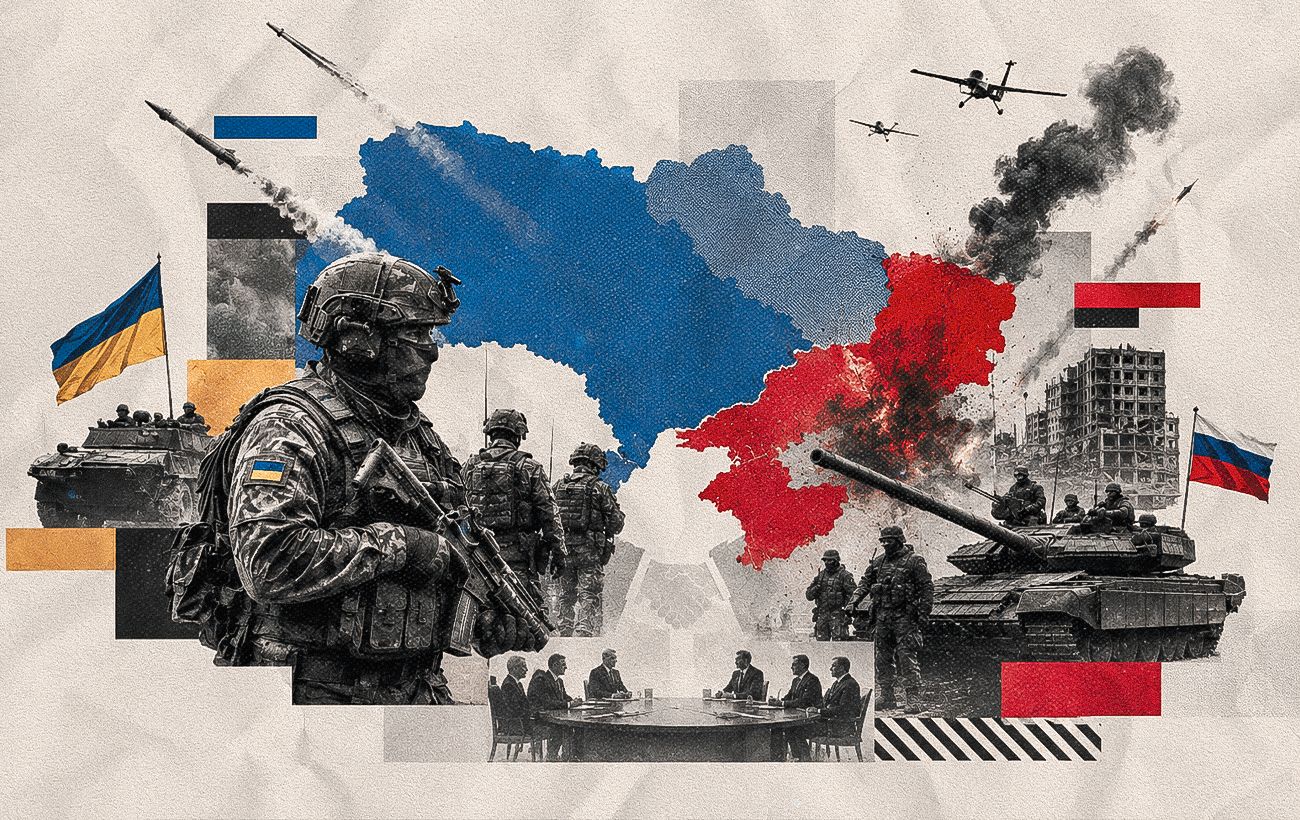 Collage: RBC-Ukraine
Russian society is entering a new phase of the war with Ukraine. In fact, even the word “war” can no longer be described as something that is in any way prohibited. It is openly used on television, at forums, and by politicians, governors, and military personnel at back-to-school assemblies.
The main trend of the past six months, however, has been the narrowing of the asymmetry in the consequences inflicted by the war. Images of burning oil refineries continue to appear in reports. The ports of the Sea of Azov and the Black Sea are almost paralyzed. And the severity of electricity-use restrictions in the occupied territories has already reached the level of those imposed in Ukraine last year, although for now they remain sporadic within Russia itself.
This means that, among all groups in Russian society, the war is gradually ceasing to be perceived as “colonial” — that is, as something being fought somewhere far away and serving the population merely as a source of income, rather than as something driven by political expediency or, even more so, an existential purpose.
Broadly speaking, we can identify the emergence of a new phase in the social contract between the Kremlin and society — a state of “New Abnormality.” Of course, this phase is not about any new qualitative change. Rather, it is an acknowledgment by both sides of the degradation of the social contract as a whole. Putin himself acknowledges this degradation. Hence his attempts to protect his position by shifting from authoritarianism toward latent totalitarianism, but that is not the subject of this article.
The war has significantly changed the conditions underpinning the loyalty of different groups to the authorities. For many years, Putin kept these groups within the framework of one broad political arrangement. He guaranteed regional and national elites a place within the system and access to resources. For big business, he guaranteed the ability to preserve its assets and make money even under sanctions and isolation. For the population, he guaranteed security, social stability, and the prospect of a strong historical state. Fatigue, uncertainty, and growing expectations for the future are building up, although this does not yet mean that these groups are ready to abandon Putin’s model.
This arrangement is still working, but the actions of Ukraine and its allies, as well as the Kremlin’s mistakes, have thrown it critically out of balance. Let me put it in very simple terms: a state of imbalance is one in which the system’s resources do not match its goals — or the goals of its individual elements, if we are talking about the constituent entities of the Russian Federation.
And this is where Putin’s main personal problem comes into focus. It is the critical loss of support for his ideas. This needs to be understood correctly. He is still an absolute authority within the system, particularly taking into account the introduction of totalitarian practices. But that is only in terms of his functional role. As a source and guarantor of a new political proposition, however, he has dramatically outlived his usefulness. His central idea — a strong, traditional state that protects its citizens, ensures stability, and restores Russia’s greatness — has remained virtually unchanged for many years and, more recently, has also become ineffective, outdated, irrelevant, and irritating. What is missing instead is a vision of what this state can offer after the war and what Russia will be like once the war ceases to be the “answer to all problems.”
This is precisely where a window of opportunity for Ukraine emerges in the communications space. This does not mean that such communication should seek to convince Russians to accept Ukraine’s vision of the future. Its task is much simpler: to make Russians think about their own future beyond the political framework in which war is the universal answer to every question.
At this point, Ukraine has all the external and internal conditions needed for a systematic information counteroffensive — seizing the initiative, identifying priority targets, and concentrating communications resources on them. This approach would allow Ukraine to avoid playing on a field defined by the Kremlin. Instead, it creates an opportunity to establish its own direction for an information offensive and systematically occupy the space between the Kremlin’s communication signals and the future of Russian society, which the Kremlin cannot clearly describe.
The three most obvious communication targets are big business, national and regional actors, and Russian society itself. Each has its own place within the system of arrangements with the Kremlin and, therefore, its own points of vulnerability and its own questions about Russia’s future.
In 2026, Russia’s regional budgets are indeed under unprecedented pressure. Even according to Russia’s Finance Ministry, the combined regional deficit could reach 2 trillion rubles. At the same time, war-related expenditures — including payments to contract soldiers and their families — fall directly on regional budgets. Meanwhile, it is becoming increasingly difficult for the federal center to compensate the regions for their financial problems, as the federal budget deficit is already expected to reach 7 trillion rubles by the end of 2026.
The original arrangement between the Kremlin and the regional elites was simple: loyalty in exchange for resources and the ability to retain their own sphere of governance. This is particularly evident in the case of Tatarstan. In 1994, Moscow and Kazan concluded an agreement on the division of powers that granted Tatarstan the right to exercise the full extent of state authority outside the areas of federal and joint jurisdiction, independently regulate its budgetary, tax, economic, investment, and other policies, and even participate in international relations. In 2007, a new agreement was concluded, but it was much narrower in scope, and in 2017 it expired without a new agreement being concluded. As part of the federal reform, the Constitutional Court of Tatarstan was also abolished.
But the erosion of regional autonomy goes beyond finances and political institutions. The republics’ cultural distinctiveness has also come under pressure. Following amendments to federal legislation in 2018, teaching the republics’ official languages in schools became optional rather than mandatory.
Before the war, national elites could still view this arrangement as a minimally acceptable compromise. The war has now stripped away even that benefit. In Dagestan, Bashkortostan, Buryatia, and other regions with large numbers of men serving under military contracts, the war is not simply a matter of direct financial payments. It takes men out of the regional workforce, placing additional pressure on families and local social services. But for small ethnic groups, the most important consequence is that the war is eroding their distinctiveness.
Thus, the war has changed the very price of regional loyalty. The Kremlin is no longer simply taking away some of the regions’ resources and powers — it is shifting the cost of the war onto them without offering in return either a clear model of federal development or even a vaguely articulated vision of regional development. And the system itself leaves them no legal way to distance themselves from the war.
This is precisely where Ukraine could use the vacuum to make its own move in the information space. It could offer the regions a political option that the Kremlin denies them: reducing or ending their own involvement in the war in exchange for reciprocal guarantees from Ukraine. The idea would be to establish separate hybrid regional ceasefire arrangements that would, of course, remain informal, since there is no legal way to formalize them. The terms may differ depending on what each Russian region is capable of. The basic arrangement would rest on mutual commitments.
The region, for its part, would undertake to halt mobilization efforts and stop funding the formation of new military units for the war; refrain from deploying additional military, missile, aviation, drone, or other strike capabilities; and stop producing components and weapons for missiles, drones, and bombs that could be used against civilians. It would also agree not to allow its territory to be used to launch strikes or carry out military operations against Ukraine.
Ukraine, in turn, could impose a moratorium on strikes and special operations in the territory of such a region. Another potentially important incentive would be an offer to lobby diplomatically for the lifting of sanctions against the region. The proposal could also include a cultural component: helping the regions publish school textbooks in their national languages, digitize their cultural heritage and national libraries, and establish reciprocal cultural ties.
This model is fundamentally different from a simple emotional appeal to “stop sending people to war.” Instead, the region is offered a concrete set of “activating” measures that it can pursue to build its own development model.
Such a scheme may seem unrealistic right now. But its value lies elsewhere. The discourse generated by it, built around predefined and guaranteed conditions for exiting the war, would create an even wider gap between the regions and the center. However you look at it, such a “peace” proposal would give Russia’s regional elites an option. It may be an unlikely option, but it is an option nonetheless. The Kremlin, by contrast, offers the regions no alternative but to submit and endure. By the laws of the physical world, excessive pressure will sooner or later find a crack through which to escape. If relations between the center and the regions develop into an open political conflict, such an option would have a real prospect of becoming viable.
The room for maneuver for Russian businesses is also shrinking rapidly. Between January and August 2026, the Russian authorities seized assets worth around 980 billion rubles from private owners. At the same time, the state is expanding the scope for placing privately owned critical infrastructure under temporary state management on the grounds of inadequate security. And although the Kremlin formally denies any connection between this mechanism and nationalization, for an owner, the very existence of such an instrument means an additional—and practically guaranteed—risk of losing control over the asset.
Ukraine’s proposal to big business may be even simpler and more audacious than its approach to the regions. In essence, it would amount to covert blackmail: either publicly declare that continuing the war is unacceptable, or confidentially agree to withdraw from military supply chains, in exchange for taking such companies off Ukraine’s target list and easing sanctions.
First and foremost, this message would be directed at oil refineries. With gasoline in short supply, such a public appeal would create additional pressure and a certain sense of “waiting and watching” among the public and the elites. Industry experts already note in informal conversations that some Russian refineries are deliberately slowing the repair of damaged facilities because of the high risk of further strikes. If they had the freedom to choose, some companies would probably prefer to postpone full restoration until the war is over.
As with the regions, whether such an offer is realistic at the outset is not what matters most. The fact that an alternative exists already gives these actors more room to act than a system in which there is no alternative at all. That said, anonymous communication of this kind is entirely feasible.
For regional elites and big business, this kind of communication would be a one-off signal. For Russian society, however, it would need to happen regularly — roughly once a month. The aim is to create an information ritual of its own, one that could eventually “drown out” the Kremlin’s traditional addresses to the public.
This kind of communication does not need appeals to people’s conscience, nor should it contain threats or jokes. It should instead be built around the Ukrainian president speaking plainly and laying out the facts: “We are compelled to do this for these reasons”; “this and that will happen in the near future”; “these will be the consequences”; “I am receiving these kinds of questions from people in Russia.”
For Russians, the main value of this kind of communication would lie in its predictability and in the ability to verify what is being said. In effect, Russian society would have a regular source of information about the next stage of the war and its possible consequences.
A monthly address by the Ukrainian president to the Russian people would break the Kremlin’s monopoly over the narrative of the war and Russia’s place in the world. More importantly, it would expose the Kremlin’s lack of any vision for Russia’s future. Its political imagination remains trapped in a world of hussars, trenches, past victories, and USSR slogans. The goal should be to make Russian society increasingly alienated from that worldview, to the point of critical irritation.
Ultimately, this is not about separate communication campaigns aimed at the regions, big business, or Russian society. It is about systematically occupying the information space between Putin’s vague messaging about the war and Russia’s place in the world and a Russian society that is being offered no clear vision for the country’s future.
For Russian society and the elites, two simple questions should become the central focus of this communication: Do you want to see yourselves outside the war at all? And what will happen after the war? These questions concern everyday life, the economy, the country’s future political system, and Russia’s place in the world. Today, Putin has no convincing answer to either of them.
The task of such an information initiative, therefore, is to remove Putin from the circle of those who unilaterally determine the possible ways in which the war could end on behalf of Russia. It is also to invite all segments of Russian society to take part in this discussion — once again, without Putin’s permission.