


 INTERNATIONAL
INFORMATION AND ANALYTICAL
COMMUNITY


+ Join
Support INTERNATIONAL



Vladyslava Vasylieva, junior Analyst at the “Resurgam” Analytical Center, Europe direction. Specialization: France.

Babych Oleksandra, student at Taras Shevchenko National University of Kyiv (KNU), Faculty of Philosophy, majoring in Political Science.
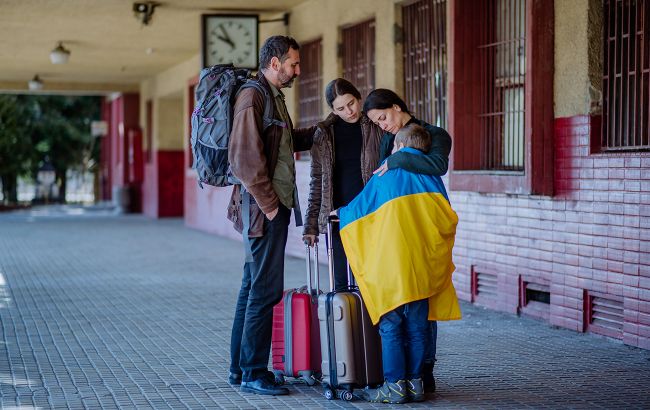 Photo: Getty Images
Russia’s invasion of Ukraine in 2022 led to the the largest forced displacement of population in Europe in recent decades. According to 2026 data, more than 4 million Ukrainians are under temporary protection in European Union Member States. However, amid ongoing debates regarding the termination of this protection status, the question of their long-term future and prospects for integration has become increasingly relevant. Equally important is the challenge of finding a balance between ensuring the stability of Ukrainians’ residence in EU countries and creating conditions that facilitate their reintegration and eventual return to Ukraine.
This paper offers recommendations for the development of migration policy concerning Ukrainians residing in Germany and France. The study provides an analysis of the current legal frameworks and integration policies in both countries. Particular attention is given to the challenges arising from the protracted nature of forced displacement. The paper recommends updating the existing policy model by establishing a stable legal framework for residence (either through temporary protection or a protection status valid for 4–5 years), developing mechanisms for circular mobility, supporting cross-border activities and preserving the social and professional ties of Ukrainians with Ukraine.
In response to the migration crisis caused by Russia’s full-scale invasion of Ukraine, the European Union activated, for the first time, the temporary protection mechanism established under Council Directive 2001/55/EC. This enabled Ukrainian refugees to obtain the right of residence, unrestricted access to the labour market, education and a wide range of social services in EU Member States.
As of 2026, millions of Ukrainian citizens remain under this legal regime across various European countries, including Germany and France. At the same time, the temporary nature of this status creates fundamental uncertainty regarding the future of Ukrainians in Europe, including their continued residence and the prospects for their return to Ukraine.
This gives rise to a key policy question: how should European states shape their migration policies toward Ukrainians given the inherent instability of the temporary protection mechanism? Should they pursue long-term integration or encourage return to Ukraine? This is a complex and multidimensional issue, as it involves not only fundamental values and human rights but also the interests of host countries alongside the strategic interests of Ukraine itself.
On the one hand, at the outset of the full-scale invasion, host countries allocated approximately EUR 17 billion to support the integration of Ukrainians, particularly by facilitating access to the labour market, education, and social infrastructure. On the other hand, long-term integration could have significant demographic and economic consequences for Ukraine, especially in the context of post-war reconstruction. At the same time, the situation places Ukrainians before a difficult choice between adapting to life in EU Member States and returning to a country that remains either at war or in the process of post-war recovery.
Thus, the problem consists of several key components: the ambiguity of legal status; the nature of integration in host countries; and the absence of effective return and reintegration policies.
The principal stakeholders include the Government of Ukraine, the governments of EU Member States, EU institutions, international and non-governmental organizations, as well as Ukrainians themselves, who are the primary subjects affected by these policy decisions.
The central analytical question arising from this issue is whether it is possible to reconcile integration and return within a single policy framework that simultaneously ensures stable living conditions abroad while preserving incentives for eventual return. A major challenge is that the existing approaches to integration and return to Ukraine are generally treated as mutually exclusive. Integration policies are primarily designed to facilitate long-term inclusion in the institutions and society of the host country, whereas return policies focus on encouraging repatriation. This dichotomy is inherently limiting and deprives individuals of meaningful choice.
This research advances the argument that policies concerning Ukrainians in EU Member States should be based on an approach that establishes a stable legal status for Ukrainians while combining integration mechanisms with measures that maintain ties to Ukraine and create conditions conducive to voluntary return. Such an approach avoids forcing individuals into a rigid choice and instead offers a flexible policy model.
The objective of this paper is to examine how different countries, specifically France and Germany, address the issues of stable legal status, integration, and the return of Ukrainians to Ukraine, and to develop practical recommendations for shaping the migration policies of these countries.
The structure of the research is organized as follows. The Background of the Problem section examines the context in which temporary protection was introduced and outlines its main components. The Country Analysis section analyzes the policies of France and Germany, with particular emphasis on their migration policies concerning Ukrainians. The following section explores possible policy options regarding the legal status of Ukrainians and their future integration in these two countries. The Recommendations section proposes specific policy measures and mechanisms for their implementation. Finally, the Conclusions section summarizes the main findings of the study and discusses their broader implications.
The activation of Council Directive 2001/55/EC constituted a historic precedent: the Directive had never previously been invoked, not even during the 2015–2016 migration crisis or the events of the 2010 Arab Spring. The first reason was the lack of political will, as both the European Commission and the Council deliberately refrained from activating it. The second reason lay in the Directive’s own legal ambiguity, particularly the absence of a quantitative threshold for defining a “mass influx.” In the case of Ukraine, the decision was adopted unanimously by the Member States, representing an exception to the general practice.
The activation of the Directive was therefore driven by a unique convergence of political circumstances: the unprecedented scale of displacement, Ukraine’s European integration trajectory, and the solidarity of EU Member States in response to Russian aggression. The Directive granted access to the fundamental rights established within its provisions, including access to the labour market without the need for a separate work permit, access to national education systems for children and vocational retraining opportunities for adults, as well as the right to healthcare and social assistance on an equal basis with nationals of the Member States. Articles 12–14 formally enshrined these guarantees, while Article 9 required Member States to provide documentation in a language understandable to beneficiaries of temporary protection. As a result, Ukrainian-language information platforms, service centres, and specialized employment portals were established across the EU.
A key advantage of the temporary protection mechanism, compared with refugee status, was the speed of its implementation. This was possible because temporary protection is granted on a collective basis. Under the circumstances of 2022, processing refugee status applications—which require individual assessment and extensive supporting documentation—would have created a severe administrative and organizational burden.
However, the principal weakness of the mechanism lies in its temporal nature. Under Chapter II of Council Directive 2001/55/EC, temporary protection is granted for an initial period of one year. The Council of the European Union has extended this status for Ukrainians on four separate occasions. Consequently, what was originally conceived as an emergency response instrument has, in practice, evolved into a long-term protection framework that extends beyond its original legal purpose.
In France, temporary protection for Ukrainian nationals was introduced in accordance with the EU-wide framework following the activation of the Directive, granting beneficiaries the right to legal residence, access to the labour market, education and social services. Ukrainians currently retain the right to reside in France under temporary protection. However, because the continuation of this status depends on political decisions at the EU level regarding its extension or termination, it creates an element of legal uncertainty concerning the future. As of May 2026, fewer than 50,000 Ukrainians were under temporary protection in France, significantly fewer than in countries such as Germany, Poland, and Spain, reflecting the relatively limited scale of the Ukrainian presence in France within this protection framework. From a social perspective, France provides a relatively well-developed integration support infrastructure, including access to social assistance. However, the effectiveness of access to these services may vary depending on the region. In economic terms, Ukrainians are gradually integrating into the labour market; however, a significant proportion are employed in sectors that do not correspond to their qualifications, which complicates their long-term economic integration. From a political perspective, the issue of Ukrainian nationals in France is addressed as part of the country's broader migration policy, without preserving distinct identities or taking into account their specific circumstances, as French policy is based on the model of republican universalism. Overall, the issue remains unresolved due to the absence of a clearly defined long-term legal status and a structured pathway for transitioning to ordinary residence statuses (such as residence permits), thereby sustaining uncertainty regarding the future legal and socio-economic trajectories of Ukrainians.
In Germany, temporary protection for Ukrainian nationals has been implemented through Section 24 of the Residence Act (Aufenthaltsgesetz), which provides the right to legal residence, access to the labour market, education, and social benefits. Temporary protection has been extended until 4 March 2027. As of the end of 2025, approximately 1.2 million Ukrainians were under temporary protection in Germany, accounting for 28.7% of the total European figure, making Germany the leading EU host country for Ukrainian beneficiaries of temporary protection. From a social perspective, Germany provides access to housing, integration and language courses, as well as financial assistance. However, similarly to the situation in France, access to these services varies depending on the federal state and administrative allocation procedures. In economic terms, the employment rate among Ukrainians in Germany stood at approximately 51% at the end of 2025. From a political perspective, the issue of Ukrainian nationals in Germany has become increasingly incorporated into domestic political debates concerning the balance between integration efforts and the costs of social support. The future of the temporary protection mechanism after 2027 remains an open question both at the national and European levels.
Since the automatic extension mechanism for temporary protection has been exhausted, and representatives of the European Commission have stated that maintaining this status in its current form will not be possible, Germany’s legal framework is undergoing changes.
Berlin’s official position is to refrain from creating an exclusive legal status for Ukrainians after March 2027. Germany’s strategy involves the gradual phase-out of the temporary protection regime and the transition of migrants to Germany’s general migration law framework: work visas for qualified specialists (Sections 18a and 18b of the AufenthG), the EU Blue Card (§ 18g), residence permits for educational purposes (§ 16b) or for self-employment (§ 21).
The conducted interviews demonstrate that respondents remain relatively calm regarding future developments. For example, respondent Anatolii (54 years old, a forcibly displaced person from Odesa, currently residing in Schwäbisch Hall, Baden-Württemberg) states:
Regarding the situation after 2027, I do not have any particular concerns. In my opinion, the German system is very stable and well-designed, so I do not think there will be any sudden or critical changes for Ukrainians who have already integrated well into society.
The economic dimension of Ukrainians’ residence in Germany during 2025–2026 underwent reforms aimed at reducing pressure on the federal budget. The key change was the abolition of full unemployment benefit eligibility (Bürgergeld) for individuals who arrived in the country after 1 April 2025. This category of migrants was transferred to the support system established under the Asylum Seekers Benefits Act (Asylbewerberleistungsgesetz — AsylbLG). According to the edited version of the AsylbLG dated 29 April 2026, the scope of eligible persons, the structure of benefits and conditions for restricting rights were defined. Under § 1, benefits are available to foreign nationals who are physically present in Germany and hold a residence permit due to war in their country of origin, as well as individuals with a tolerated stay status (“Duldung” under § 60a). Sections § 3 and § 3a distinguish between benefits for essential needs (food, clothing, and housing) and personal daily needs, establishing a monthly personal expenditure allowance for a single adult living in accommodation at EUR 162 (or EUR 146 in reception facilities/camps). These services may be provided through a payment card system (Bezahlkarte). At the same time, respondents report that the implementation of payment cards varies significantly across regions, and those who have already lived in Germany for an extended period continue to use standard bank accounts and do not experience critical everyday difficulties. In the area of healthcare, regulated under § 4, funding is provided for the treatment of acute illnesses, pain-related conditions, pregnancy and childbirth.
In the field of employment, the central role is played by the government initiative “Job-Turbo.” It was announced by the government in autumn 2023 with the aim of accelerating migrants’ entry into the labour market. However, in 2025–2026, against the backdrop of a shift in political direction and the signing of the Merz coalition agreement, the programme acquired an imperative character, meaning that participation in it ceased to be voluntary. This shift was reinforced through the introduction of mandatory “integration agreements” between migrants and employment agencies regarding integration and employment, based on § 44a AufenthG, as well as through the strengthening of enforcement mechanisms for non-compliance with the conditions of integration agreements, as established under § 31a of the Second Book of the German Social Code (SGB II). This eliminated the previous practice of requiring migrants to complete mandatory B1/B2-level language courses before entering the labour market. At the legislative level, refusal to cooperate with the Jobcenter or unjustified rejection of offered employment opportunities results in a gradual reduction of benefits: for the first missed appointment without a valid reason, payments are reduced by 10%; for a repeated violation, by 20%. If an employable person demonstrates systematic avoidance of employment or training, the law allows the application of the maximum sanction in the form of a 30% reduction of the basic financial benefit for a period of three months.
The cases of respondents demonstrate that the system operates with a certain degree of flexibility. Respondent Oksana (46 years old, from Odesa) states:
In Ukraine, I worked in the beauty industry, and here in Germany I was able to continue developing in the same field and even open my own salon. For me, the system here is clear and structured, particularly the business registration process and all official procedures... Among the people around me, I have not heard about increased control or any real cases of benefit reductions; everything is happening quite calmly.
This confirms that, for the motivated segment of displaced persons, German migration policy creates opportunities for legal integration through self-employment and entrepreneurship.
The current situation in 2026 is characterized by attempts to implement “dual-intent” instruments. A practical manifestation of this approach was the opening of the first Ukrainian Unity Centre in Berlin on 15 April 2026. The hub was established to maintain connections with Ukraine and provide consultations regarding return, while simultaneously offering services of the Pension Fund of Ukraine, as well as educational and cultural programmes.
Since 2022, France, like other EU Member States, has applied the EU Temporary Protection Directive for Ukrainians, which guarantees their right to legal residence and access to key areas such as the labour market and social assistance. The administrative form through which this regime is implemented is the temporary residence permit (Autorisation Provisoire de Séjour — APS), issued by migration offices of prefectures and extended in accordance with EU-level decisions. Since 2022, approximately 118,800 people have received temporary protection in France, according to data from the French migration authorities.
At the same time, an increasingly visible trend is the transition of some Ukrainians from temporary protection to other legal residence regimes. The most common among them include:
Subsidiary protection. According to Eurostat data, at the end of 2025, France had 25,780 Ukrainian citizens who had received international protection. The transition to subsidiary protection is often driven by the desire to obtain a more stable and long-term legal status due to the limitations of temporary protection.
Titre de séjour de droit commun (ordinary residence permits), including: student residence permits; temporary residence permits for employees; temporary residence permits for private and family life; temporary residence permits under the “Talent Passport” scheme.
Student and employment visas.
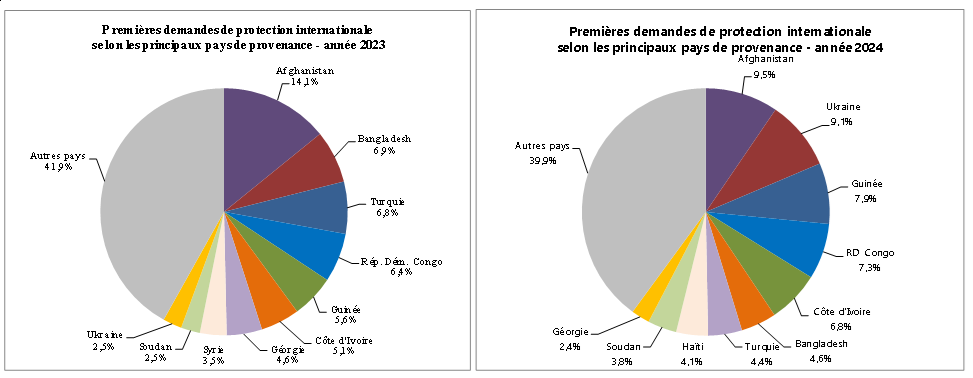 Ukraine ranks second in terms of the number of applications submitted for refugee status. Source
employment;
state vocational retraining programmes;
the healthcare system;
educational institutions.
At the same time, the key challenges remain access to stable housing and long-term administrative uncertainty, as the APS requires regular renewal. As a result, there has been a growing number of Ukrainians transitioning to asylum procedures or subsidiary protection. This is linked to the perception that temporary protection is becoming insufficiently stable from a long-term perspective. At this stage, migration policy toward Ukrainians is accompanied by a reduction in housing and financial assistance programmes, as well as a reorientation of state policy toward the “normalisation” of Ukrainians’ residence status.
For example, in the city of Reims, cases of reductions in temporary accommodation programmes and housing assistance have been recorded. This demonstrates the growing dependence of social stability on administrative status.
The results of the conducted interviews also indicate the diversity of Ukrainians’ strategies in France. Thus, Kateryna Sirri, originally from the Kharkiv region and currently residing in Reims, stated during an interview that she decided to transition from temporary protection to subsidiary protection due to the impossibility of returning to her home region and her desire to integrate more deeply into French society. According to her, France provided her with the opportunity to undergo professional retraining: after working as a cosmetologist in Ukraine, she is currently studying to become a hairdresser and plans to open her own business in the future. This example demonstrates that, for a part of the Ukrainian population, the issue of legal status is gradually becoming associated not only with protection but also with long-term life strategies and professional development.
One of the most widely discussed approaches to the integration of Ukrainians is the concept of “dual intent integration” proposed by the Organisation for Economic Co-operation and Development (OECD) in 2023. Its core idea lies in combining the integration of Ukrainians into host countries while simultaneously preserving conditions for their future return to Ukraine. Unlike traditional integration models, this approach takes into account the specific nature of Ukrainians’ displacement. At the same time, it is becoming increasingly evident that the initial OECD approach requires adaptation to the new realities of prolonged displacement. After several years of residence in EU countries, Ukrainians are becoming increasingly integrated into local societies; however, uncertainty regarding their future legal status is simultaneously growing due to the temporary nature of their protection. In France, alternative forms of protection, particularly subsidiary protection, do not fully correspond to the specific circumstances of Ukrainians, as they may restrict mobility and complicate the maintenance of ties with the country of origin. Furthermore, a significant proportion of Ukrainians maintain active social, economic, and family connections with Ukraine. As a result, a situation is emerging in which Ukrainians exist between two spaces: the host country and the country of origin.
In this context, this study proposes not a gradual abandonment of the temporary protection mechanism, but rather its modernization and stabilization in accordance with the new realities of Ukrainians’ prolonged displacement. Instead of annual extensions of temporary protection, France and Germany could consider implementing a multi-level long-term protection system that would ensure stability and integration without requiring individuals to make a final choice between two countries: the host country and the country of origin.
Such a model can be divided into several interconnected levels.
The objective of this level is to provide Ukrainians with a long-term legal status instead of relying on annual decisions regarding the extension of temporary protection. This would reduce the level of legal uncertainty, which represents one of the key challenges faced by Ukrainians in the EU.
It is recommended to move away from traditional integration approaches based on adapting migrants to the labour markets of host countries. In the case of Ukrainians, acquired skills should be considered as a resource simultaneously benefiting two parties: the host country and Ukraine.
The idea is to create mechanisms that support professional connections between Ukrainian specialists in France and Germany and Ukrainian institutions. This, in turn, would reduce the risk of skills degradation among Ukrainians, which is important both for host countries and for Ukraine in the event of citizens’ return.
In the case of Ukrainians, complete assimilation is not an optimal policy when return remains a realistic possibility. Therefore, supporting Ukrainian education, cultural initiatives, and connections with local Ukrainian communities should not be viewed as an obstacle to integration, but rather as a tool for maintaining long-term readiness for return.
Similar discussions are also taking place in Ireland, where, after several years of implementing the temporary protection regime, debates have emerged regarding the need to move from short-term crisis response toward long-term management of Ukrainians’ residence. According to Halpin’s review “Oireachtas Spotlight” (2022), the continued implementation of the Temporary Protection Directive without defining further prospects creates additional uncertainty both for Ukrainians themselves and for state institutions.
Thus, the proposed approach involves a transition from a temporary mechanism toward a stable long-term status, aimed at ensuring the sustainable integration of Ukrainians while preserving the possibility of future return to their country of origin. This approach takes into account both the interests of host countries, which are interested in the socio-economic integration of Ukrainians, and the needs of Ukraine, for which the future return of citizens remains one of the key issues in the process of post-war reconstruction.
The approach to migration policy toward Ukrainians in France and Germany proposed in this study is based on a transition from the logic of temporary residence toward a model of stable, organized, two-way mobility between host countries and Ukraine. Within this framework, integration and return are not considered mutually exclusive trajectories, but rather mutually reinforcing processes. Therefore, policy should simultaneously ensure the stability of Ukrainians’ lives in France and Germany while preserving a genuine possibility of their return to Ukraine without the loss of social and professional capital. According to the comments provided for this study by a representative of the Government of Ukraine, it is important to emphasize the creation of all programmes around the support of ties with Ukraine and the preservation of circular mobility, as the diaspora has a significant influence on both regional policies and Ukraine’s national policy, particularly in the context of Ukraine’s accession to the EU.
At the legal level, such an approach should be based on moving away from a short-term and annually reviewed temporary protection model. Instead, it would be appropriate to introduce a multi-year status that ensures residence stability and is subject to review only in the event of significant changes in the security situation in Ukraine. It is also proposed to establish the right to maintain long-term residence in Ukraine without losing legal status in order to facilitate circular mobility.
| Policy Area | Recommendation | Outcome |
|---|---|---|
| Legal level | Transition from a status with a floating duration to the introduction of a status valid for 3–5 years, with review only in the event of changes in the security situation in Ukraine. | Ensuring legal certainty and reducing the “psychology of temporariness.” |
| The right of “zero loss of status upon return”, namely the possibility of residing in Ukraine for up to 6–9 months per year without losing the right of residence in France and Germany. | Facilitating circular mobility and maintaining permanent ties with the country of origin. | |
| “Reverse mobility” mechanism: Official recognition that Ukrainians may temporarily “exit” their European status and return without undergoing a new application procedure. | Reducing barriers to return and participation in Ukraine’s reconstruction. | |
| Labour market | Two-way labour mechanisms: creation of joint databases of specialists (particularly in healthcare, engineering and education) who can work in the EU while being officially included in Ukraine’s reconstruction system. | Preserving professional ties with Ukraine and engaging specialists in Ukraine’s post-war reconstruction. Additionally, creating a human resource reserve for Ukraine. |
| Tax incentives for employment linked to return: tax or social benefits for EU employers if employees participate in projects in Ukraine or return for a certain period to contribute to reconstruction efforts. | Encouraging employers to support circular professional mobility. | |
| Paid periods (1–3 months) for working in Ukraine in the fields of public administration, business or reconstruction. | Institutionalizing temporary return as part of a professional career trajectory. | |
| Professional development | Mutual recognition of qualifications between Ukraine, France and Germany. | Utilization of professional experience acquired abroad after returning to Ukraine. |
| Micro-credential transfer system mutual automatic recognition of courses, certificates and micro-qualifications. | Creating a unified space of professional competencies. | |
| Ukraine–EU professional mobility certification — certification programmes designed to prepare specialists to work simultaneously in European and Ukrainian environments. | Increasing specialists’ readiness for reintegration after return. | |
| Online competitions for positions in Ukrainian public authorities for Ukrainians abroad. | Preserving human resource potential and facilitating early involvement of Ukrainians in the public sector. | |
| Socio-cultural level | Policy of cultural dual belonging — supporting dual cultural identity instead of a model based on complete assimilation. | Maintaining sustainable connections between Ukrainians and their country of origin. |
| Temporary return support programme - funded programmes for temporary return to participate in professional, educational or cultural projects in Ukraine. | Supporting regular interaction between Ukrainians and Ukraine and developing human capital. | |
| “Diaspora–Ukraine” network platforms for cooperation between communities, universities, businesses and state institutions. | Strengthening professional, social and institutional links between Ukrainians abroad and Ukraine. | |
| “Return Stories” initiative - supporting stories of successful return and participation in Ukraine’s reconstruction. | Shaping a positive social perception of return and increasing motivation for reintegration. |
Russia’s full-scale invasion of Ukraine has presented the institutions of the European Union and its Member States with an unprecedented challenge, the response to which was the activation of the temporary protection mechanism. After four years of its operation, it has become increasingly evident that this mechanism was not designed to accommodate the prolonged displacement of millions of Ukrainians. The analysis conducted in this study demonstrates that, in both France and Germany, the instability of temporary protection creates uncertainty regarding the future for Ukrainians. Therefore, it is essential to begin developing a new long-term migration policy that takes into account both the interests of host countries and Ukraine’s strategic interests in preserving human capital and creating conditions for the future return of its citizens.
This research argues that the concept of integration while maintaining ties with the country of origin should become the foundation of the next stage of European policy toward Ukrainians. Unlike the traditional approach applied, for example, in France, which effectively forces individuals to choose between full integration and return, the proposed model considers these processes as mutually complementary. The recommendations developed in this research are aimed at establishing a stable long-term legal status, supporting circular mobility, ensuring mutual recognition of professional qualifications, facilitating professional cooperation between the EU and Ukraine, and maintaining socio-cultural ties through diaspora networks. The implementation of such an approach would not only ensure greater predictability of the legal status of Ukrainians in France and Germany but also contribute to preserving their human potential for Ukraine’s post-war reconstruction. At the same time, the proposed model could serve as a foundation and example for developing a more flexible EU policy framework for responding to cases of large-scale forced displacement and refugee movements in the future.
Vladyslava Vasylieva, junior Analyst at the “Resurgam” Analytical Center, Europe direction. Specialization: France.
Babych Oleksandra, student at Taras Shevchenko National University of Kyiv (KNU), Faculty of Philosophy, majoring in Political Science.