 INTERNATIONAL
INFORMATION AND ANALYTICAL
COMMUNITY


+ Join
Support INTERNATIONAL



Daria Honcharenko, Junior Analyst for the Balkan Region at the Resurgam Analytical Center
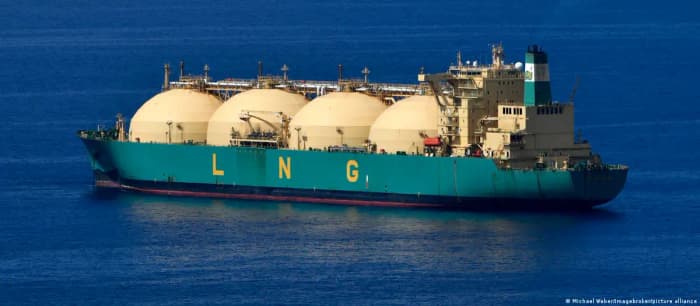 A tanker carrying liquefied natural gas (LNG). Photo: Michael Weber/Imagebroker/picture alliance
Whereas the Balkans once served primarily as a transit corridor for Russian gas, countries across the region are increasingly investing in liquefied natural gas (LNG) infrastructure and alternative gas routes. The United States has supported these initiatives as part of broader efforts to reduce Europe’s dependence on Russian energy supplies. At the same time, the Balkans’ growing strategic importance is heightening competition among the EU, the United States, and Russia for influence in the region.
The Balkans have emerged as a key transit link between Mediterranean LNG terminals and Central European markets. LNG imported from the United States and other global suppliers enters the region through the Alexandroupolis terminal and the LNG terminal on the island of Krk before being transported onwards via the Balkan gas network.
Another component of the European Union’s gas supply diversification efforts is the Southern Gas Corridor, which delivers Azerbaijani gas from the Shah Deniz field to Europe. At the same time, the EU is expanding a network of cross-border interconnectors, including the Greece–Bulgaria, Bulgaria–Serbia, and Croatia–Hungary links. These interconnectors enable gas to be redistributed across the Balkans and Central Europe and allow supplies to be rapidly rerouted in response to changing demand and the availability of import sources.
The Vertical Gas Corridor is also expected to play an important role. The project is intended to integrate the gas systems of Greece, Bulgaria, Romania, Hungary, and Ukraine. As of 2026, the corridor is partially operational, although full completion of the project is expected by the end of the year. In the longer term, it could become one of the region’s key alternative gas supply routes.
Countries in the Balkan region are gaining greater influence over the development of European energy projects and the allocation of investment. Their positions are increasingly shaping the implementation of new supply routes and broader integration initiatives.
However, the Balkans do not currently have a unified approach to energy policy, which limits the region’s collective development and influence in the market. Serbia and, to some extent, Bosnia remain dependent on Russian gas supplied via TurkStream, while Greece and Croatia have focused on LNG terminals and imports from the United States. Bulgaria, Romania, and North Macedonia source energy supplies from a variety of providers. As a result, the Balkans are evolving not into a single energy space, but into an arena of competition between different geopolitical models.
The United States is leveraging its position as a leading energy exporter to expand its geopolitical influence in Europe. Washington is strengthening its presence through long-term LNG supply contracts, investments in energy infrastructure, and participation in the development of new supply routes.
This year’s Three Seas Initiative Summit in Dubrovnik served as a platform for coordinating energy projects across Central and South-Eastern Europe, with the United States acting as one of the key external partners and investors.
During the summit, the U.S. company Venture Global signed an agreement worth approximately $6 billion with Greece’s Aktor LNG for the supply of American LNG to Albania after 2030. At the same time, the Alexandroupolis terminal is facilitating the distribution of U.S. gas through the Greece–Bulgaria–Romania–Ukraine corridor, which is gradually replacing the traditional east-to-west supply model. Alongside the development of new routes, countries across the region are becoming integrated into a broader system of U.S. contracts, infrastructure, and energy standards.
At the centre of this strategy is the “Trump Peace Pipeline Framework”, a programme aimed at developing new energy routes across Central and South-Eastern Europe. The United States also supports the Southern interconnector between Bosnia and Herzegovina and Croatia, which is intended to strengthen the region’s energy connectivity.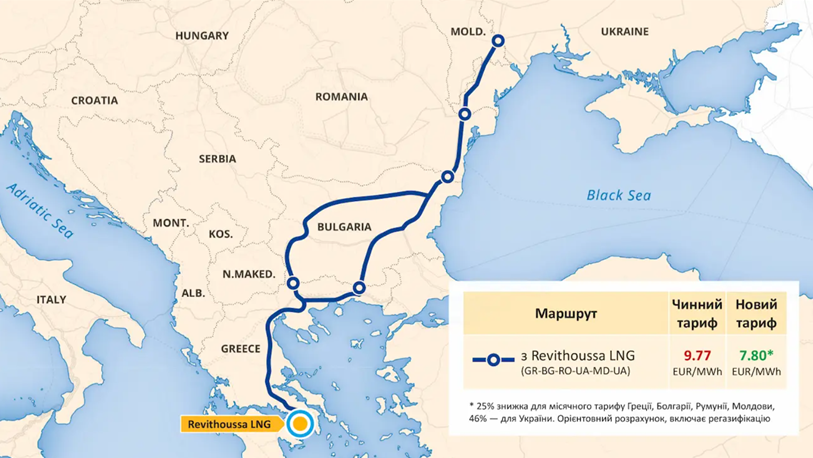 Routes 2 and 3 under the Vertical Corridor initiative, which enable gas imports to Ukraine. Source
The plan to build a new gas interconnector between Bosnia and Herzegovina and Croatia attracted particular attention, as it is linked to access to the LNG terminal on the island of Krk and involves U.S. investors.
In Brussels, concern is raised not by the idea of a new route itself, but by the way it is being implemented. EU Ambassador to Bosnia and Herzegovina Luigi Soreca warned that the proposed changes could conflict with the principles of transparency and competition required by the EU. Brussels is particularly concerned about the adoption of a special law that designates a private U.S. company as investor and developer without an open competitive selection process.
At the same time, concern is growing in the EU over the strengthening of the U.S. presence through LNG terminals and related projects. In particular, European Commission Executive Vice-President Teresa Ribera stated in 2026 that the EU is “significantly increasing its dependence on U.S. LNG” and should continue diversifying its supply sources. Against this backdrop, the expansion of U.S. energy projects in the Balkans could further strengthen the role of the United States in gas supplies to the region and Europe as a whole.
Following the reduction of most Russian gas export routes to Europe, the Balkans have effectively remained the only pipeline corridor for its supply. TurkStream has become the only active route for transporting Russian gas to European consumers. Through this pipeline, gas is delivered to parts of South-Eastern Europe, including Serbia.
Although Belgrade still receives a significant share of its gas from Russia, it is gradually seeking alternative energy sources. For example, the country is developing interconnectors with Bulgaria and planning new links with North Macedonia and Romania.
For Russia, this means a gradual loss of its position in the European gas market. Even Balkan countries that still receive Russian gas are actively diversifying their supplies and developing alternative infrastructure. This narrows Russia’s ability to maintain its energy influence in the region.
European energy is gradually shifting towards a more flexible system compared to the previous model, which was heavily dependent on Russia as a key gas supplier.
In this framework, what matters is not a single main transit route, but how countries are interconnected, as this enables the rapid redistribution of energy resources between suppliers in the event of disruptions or market changes. It also ensures deeper integration of Ukraine into the EU energy system.
Through new routes with Romania and Bulgaria, in particular via the Orlivka–Isaccea and Romania–Bulgaria interconnectors, Ukraine is gradually becoming integrated into this system. This means that the region’s energy system is becoming increasingly integrated through pipelines and interconnectors.
In this configuration, the Balkans serve as a key hub for receiving gas from alternative sources, primarily through Greece’s LNG terminals and the Southern Gas Corridor routes. At the same time, Eastern European countries provide transit, storage, and redistribution of gas flows to Central European markets.
For Ukraine, this means that its role is gradually shifting towards becoming Europe’s energy buffer, as underground storage facilities and the country’s gas transmission system enable gas to be stored and rapidly redistributed across different routes.
In the longer term, new energy routes could strengthen the role of the Black Sea–Balkan region within Europe’s energy system. In such a model, the importance of countries with developed infrastructure for gas storage, transportation, and redistribution will increase, and Ukraine is one of them.
European energy is gradually shifting from a model based on individual major pipelines to an integrated network of interconnectors. This increases the system’s flexibility and expands options for supply routes, although at the same time the role of individual LNG suppliers, primarily the United States, is growing. The Balkans are consolidating their position as a transit hub between Greece’s and Croatia’s LNG terminals, the Southern Gas Corridor, and Central European markets.
The region is not a single unified energy space. Some countries are integrating into Western routes through LNG and new interconnectors, while others continue to rely on Russian gas via existing pipeline systems. This creates parallel energy corridors within the same region.
As a result, the Balkans are turning into a contested space for competing supply routes and models of energy integration.
You may be interested