 INTERNATIONAL
INFORMATION AND ANALYTICAL
COMMUNITY


+ Join
Support INTERNATIONAL



Rostyslav Onyshchenko, trainee at the analytical center Resurgam in the field of Central and Eastern European countries analysis.
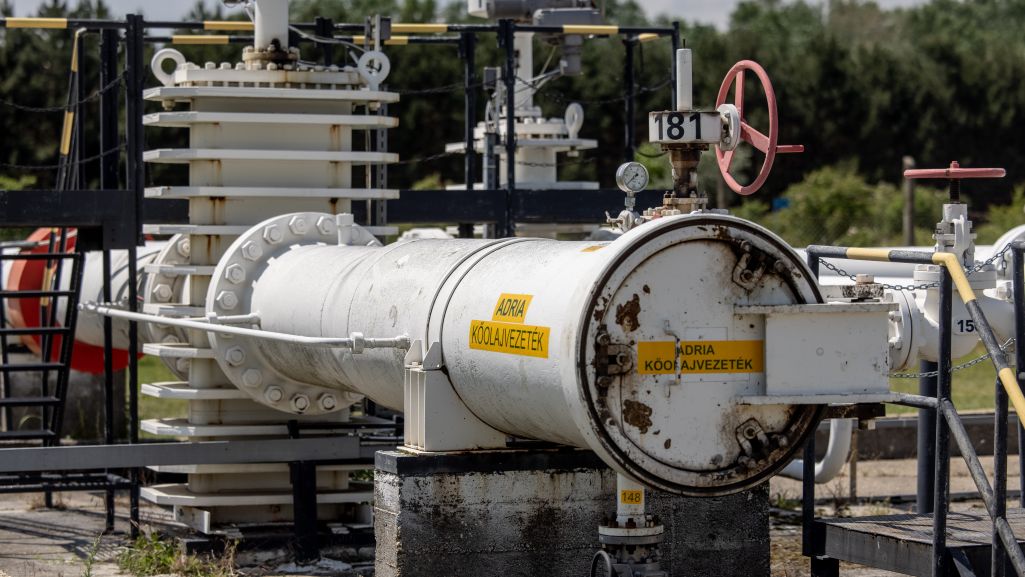 The Adria oil pipeline. Photo: Getty Images/Janos Kummer
Croatia's energy strategy today is defined by a combination of high external dependence and growing regional influence on Central European countries. Due to the lack of significant energy reserves and the depletion of deposits, the country is forced to import significant volumes of hydrocarbons. However, the favorable geographical location, modernization of infrastructure and integration into the European energy system contribute to the strengthening of Croatia's position in CEE.
In 2024, the level of energy independence of Croatia, i.e. the ratio between primary energy production and supply, was 42.5% ( according to the Eurostat methodology 40.1), which corresponds to the average among EU countries.
In terms of environmental friendliness, Croatia is considered one of the undisputed leaders in the region of Central and Eastern Europe, demonstrating significant progress. 73.6% of electricity is generated from renewable sources. A key element of green generation are large hydroelectric power plants, which account for 43.9% of total production, and 29.7% of electricity is generated from other renewable sources. However, even this is not enough, since domestic generation from all sources covers only 78% of demand.
In the structure of its energy balance, Croatia is a pronounced net importer. To compensate for this dependence on foreign markets, Zagreb is diversifying imports and at the same time increasing capacity, earning money on the transit of energy carriers to neighboring countries.
For example, as of 2024, Azerbaijan is the main supplier of crude oil ($982 million), but also significant volumes come from Kazakhstan, Nigeria, Norway and Angola. Imports are $1.82 billion, while exports are only $558 million, with Slovakia ($323 million) and Hungary ($231 million) being the main buyers. Since the beginning of the full-scale invasion, the country has stopped importing Russian crude oil, the share of which in 2021 was 27.2%.
In the oil refining segment, the Rijeka Refinery remains the only operating enterprise in Croatia. It is managed by the company INA, 49% of which is owned by the Hungarian MOL Group, 45% is held by the Croatian government, and the rest is owned by minority investors. The annual refining capacity is from 3.6 to 4.1 million per year, which makes it possible to fully meet domestic needs and export a significant part of oil products. In the first quarter of 2026, the Rijeka Refinery will be put into commercial operation after a large-scale modernization worth 700 million euros (the plant will increase diesel production by 30% – this is an additional 400,000 tons annually). The launch of the delayed coking unit allows the Rijeka Refinery to produce its own vacuum gas oil (VGO) – an intermediate oil product from oil residues, which serves as a raw material for the further production of finished diesel fuel. This closed cycle completely eliminates the need for its imports from Russia, which supplied it to the European market, including for Croatia, which had an exemption from sanctions until the end of 2025.
The trend of dependence is observed in the import of other petroleum products. As of 2024, the main supplier for Croatia is Italy, which accounts for almost half of all imports with a volume of $1.26 billion, followed by Slovenia ($640 million), Bulgaria ($238 million), Greece ($225 million) and Russia ($153 million). The main buyer of fuel in Croatia is neighboring Bosnia and Herzegovina with $307 million.
The electricity balance is also scarce (imports of $1.22 billion against exports of $578 million). Slovenia is also the leader in imports ($597 million – almost half of the total volume), which is explained by the receipt of electricity from the joint Krsko nuclear power plant, where the Croatian state-owned company HEP owns 50% of the shares. Other major suppliers are Hungary ($334 million), Bosnia and Herzegovina ($162 million) and Serbia ($126 million). Meanwhile, the main buyers of Croatian electricity are Slovenia ($173 million), Serbia ($170 million), as well as Bosnia and Herzegovina ($128 million) and Hungary ($107 million).
As a result, Croatia demonstrates a model of managed dependency — the internal shortage of primary resources is compensated by involvement in pan-European networks and the development of logistics routes that increase Croatia's role as an energy hub in the CEE region. A high share of "green" generation creates an environmental advantage, but due to the climatic instability of hydro and wind resources, the country additionally maintains a constant energy exchange with its neighbors within the European Network of Transmission System Operators for Electricity (ENTSO-E).
The region of Central and Eastern Europe, which for many decades has been totally dependent on Russian pipeline natural gas, is facing an urgent need to revise its national and regional security strategies. In conditions when energy carriers from Russia were openly used as an instrument of political blackmail and geopolitical pressure, Croatia was forced to look for alternative supply routes.
This search was dictated not only by external geopolitical threats, but also by acute internal vulnerability. In 2024, Croatia's own gas production was able to cover only 27.5%. As a result, total gas imports in 2024 reached 2,556.1 million cubic meters, while the total volume of domestic natural gas consumption in Croatia amounted to 2,366.1 million cubic meters. The United States emerged as the clear leader, providing 58.3% of the supply. A significant share was also made up of resources from non-European players – Algeria (16.4%), Trinidad and Tobago (13.3%) and Nigeria (almost 5%). On the other hand, pipeline purchases from traditional European neighbors turned out to be minimal.
Realizing the critical shortage of its own gas production, Croatia has made a significant turn from pipeline dependence to integration into the LNG market, which is the foundation of the country's modern energy resilience.
The Floating Storage and Regasification Unit (FSRU) called LNG Croatia is located on the island of Krk in the northern Adriatic Sea. The facility was put into commercial operation in January 2021. In response to the rapid growth in demand, Croatia has more than doubled its the capacity of the LNG terminal on the island of Krk – from the initial 2.6 billion to 6.1 billion cubic meters of gas per year. Since the beginning of commercial operation, more than 60% of all natural gas entering the transport system has passed through the LNG terminal.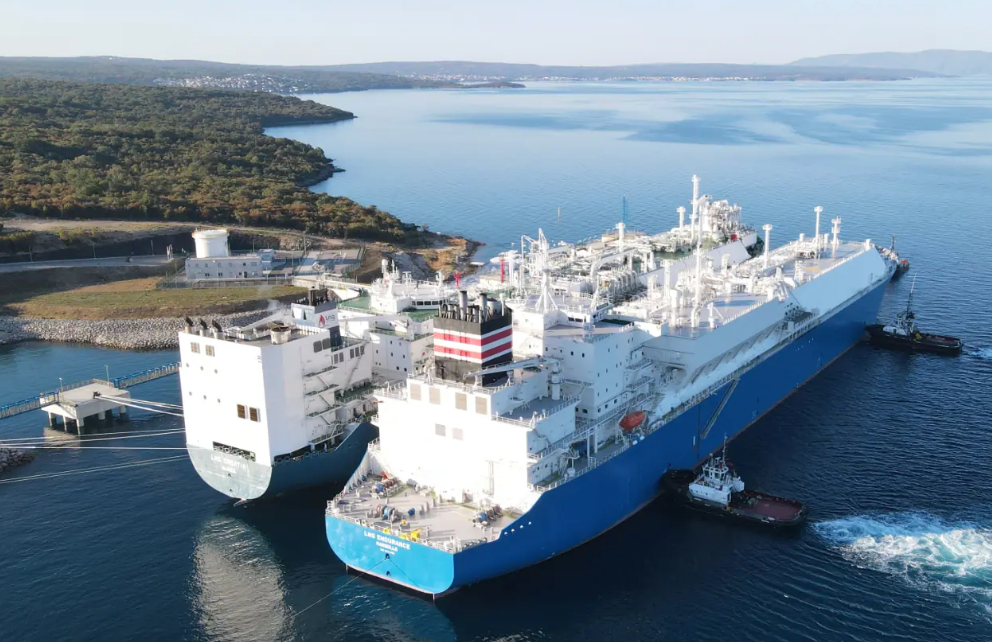 LNG Croatia. Source
The United States has become a key partner of Croatia in diversifying gas supply. From the launch of the terminal until 2024, the volume of imports of American LNG showed steady growth, reflecting the pan-European course towards energy independence from the Russian Federation. At the end of 2024 alone, the United States supplied 1.51 billion cubic meters of gas to Croatia. However, the terminal also accepted shipments from various countries, including Nigeria, Qatar, Egypt, Oman, and others.
The commercial attractiveness and strategic importance of the Croatian hub is confirmed by the fact that even before the commissioning of the new modules, all current available regasification slots at the terminal were fully booked by the companies until the gas year 2037/2038. Although the exact allocation of quotas is a trade secret, the key foreign customers of the terminal are the Slovenian company Geoplin, the Swiss MET Group and the Hungarian state-owned MVM CEEnergy. Expanding the sources of supply, The Hungarian side has reserved capacity under a contract with the British Shell, which guarantees the transportation of 200 million cubic meters of gas per year through Croatian infrastructure over the next decade.
Another project to expand export routes is the Southern Interconnector. Its construction allows Croatia to directly capitalize on the increased capacity of the LNG terminal, while securing its status as a strategic hub for expanding supplies from Bosnia and Herzegovina as opposed to Russian-Serbian infrastructure. Thanks to the construction of this highway, which will connect the terminal at Krk with Bosnia and Herzegovina, creating the first real alternative to Russian energy, Croatia will have direct access to the new market. The project provides for the construction of a bidirectional gas pipeline with a total length of 236 km (162 km will run in Bosnia and Herzegovina, and 74 km in Croatia).
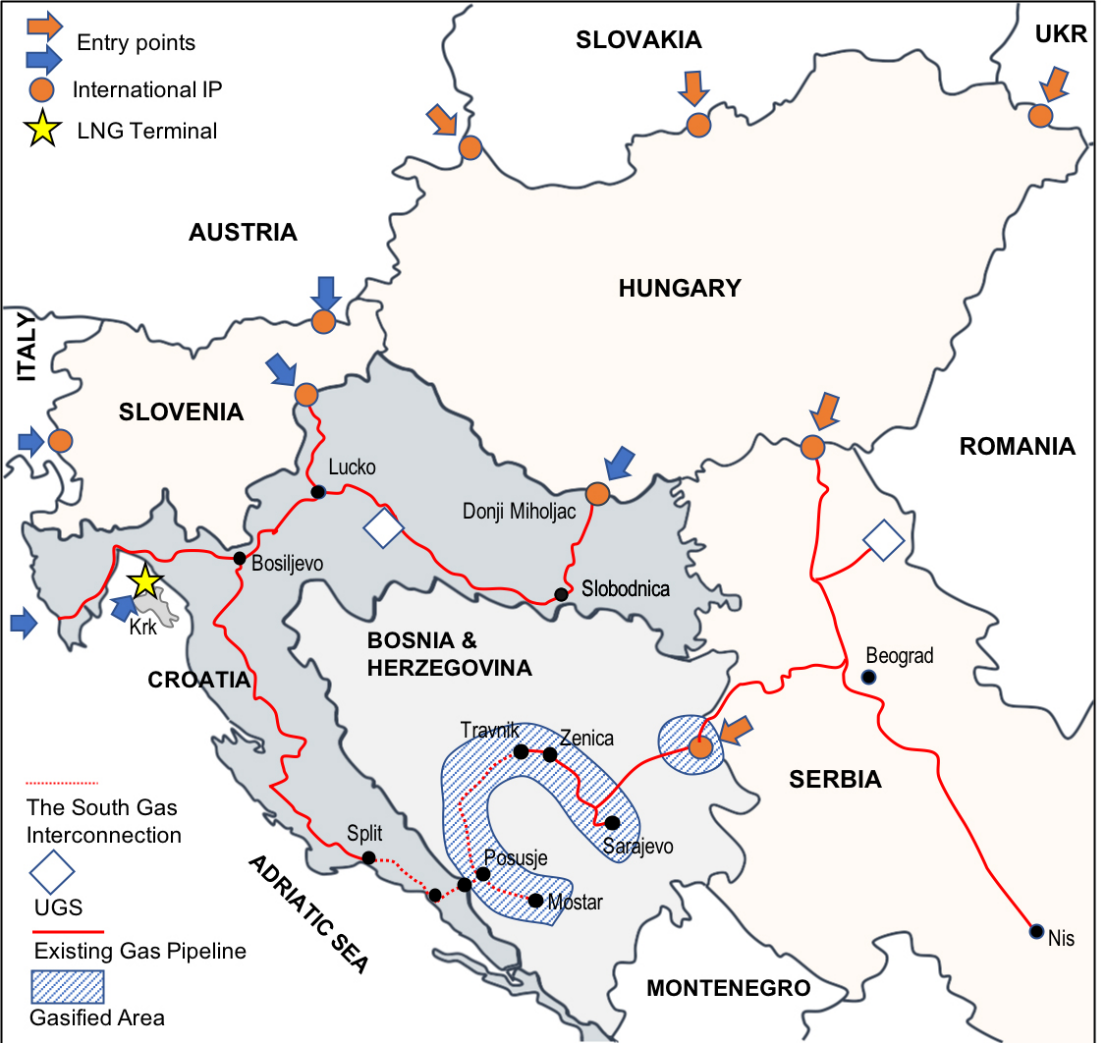 Southern interconnector. Sourse
If the Krk terminal opened up access to the global LNG market for Croatia, the Ionian-Adriatic Gas Pipeline (IAP) aims to connect the Croatian hub with Caspian resources. This strategic regional project, which Zagreb is preparing together with its neighbors, provides for the construction of a 511-516 km long highway and will unite the gas markets of Albania, Montenegro, Bosnia and Herzegovina and Croatia. It will stretch from the Albanian city of Fieri (where it will connect to the Trans-Adriatic Gas Pipeline TAP) to Croatia's Split. There, the pipeline will be integrated into the national network, forming a system (capable of pumping gas in both directions) compatible with flows from the LNG terminal on Krk.
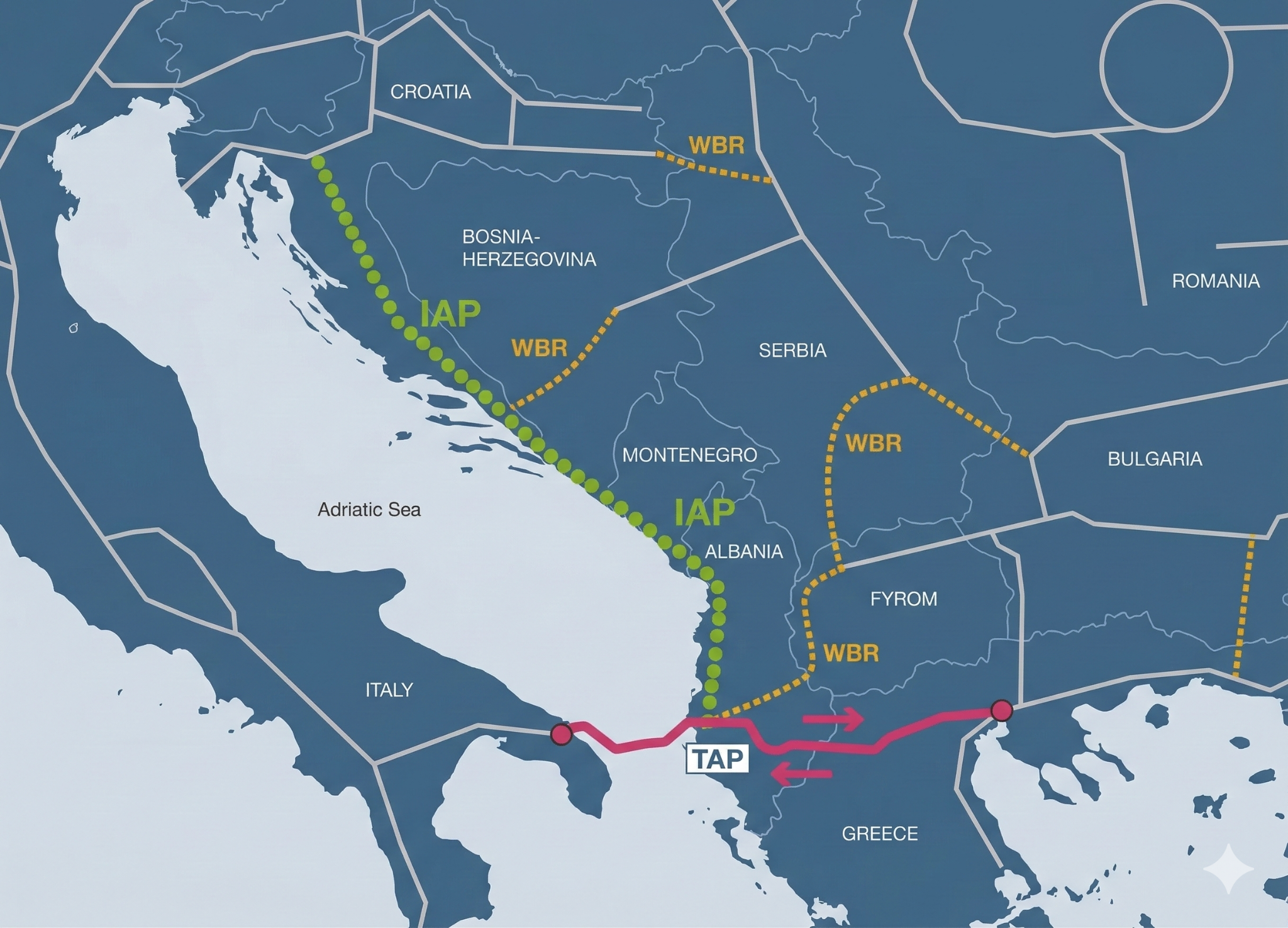 The Ionian-Adriatic Gas Pipeline and the Trans-Adriatic Gas Pipeline. Source
The total capacity of 5 billion cubic meters per year will be distributed through national quotas: Albania and Bosnia and Herzegovina will receive 1 billion cubic meters each, Montenegro – 0.5 billion, and 2.5 billion cubic meters will go to Croatia. Although the project was initiated back in 2007 and was slowed down for a long time due to lack of funding, the need to abandon Russian gas gave it a new powerful impetus.
Gas infrastructure is the most dynamic segment of energy growth. The expansion of capacities and the construction of new routes undoubtedly contribute to a change in the structure of gas imports in a region in which countries have traditionally been dependent on Russian energy resources. Reducing such dependence also helps to reduce the possibility of pressure from the Russian Federation, as well as increases the flexibility of these countries in diversifying supplies and making political decisions
Similar to the gas sector, Croatia's importance in the oil market of the macro-region is determined not by the volume of domestic production, but by the transit infrastructure.
Domestic crude oil production in Croatia (492.6 thousand tons) covers 25% of the needs of the national oil refining. However, due to the fact that part of its own raw materials (195.4 thousand tons) is exported, the only operating oil refinery in the country (Rijeka Refinery) operates mainly on imported oil. It was purchased in the amount of 1.8 million tons per year, which amounted to 91.2% of all oil refined in the country.
The JANAF pipeline was built in 1979 as an international oil transportation system connecting the tanker and terminal port of Omišalj with Croatian and foreign refineries in Eastern and Central Europe. The design capacity of the pipeline is 34 million tons of oil per year, while the installed capacity is 20 million tons (Danube) and Slovakia (at the Slovnaft refinery), and also has branches to Slovenia. The eastern branch supplies oil to Serbia (Pančevo refinery) and has a branch to Bosnia and Herzegovina (Bosanski Brod refinery).
Although today this branched highway is not used at full capacity, its strategic importance lies precisely in the geography of end users. The northern and eastern branches of the pipeline feed countries that have historically been in a zone of deep Russian political and energy influence. Therefore, in the perspective of the European market's complete rejection of Russian energy carriers, it is the current incomplete loading of JANAF that creates the necessary reserve of capacities that will reorient the market.
In the context of Hungary and Slovakia's substitution of Russian oil after the shutdown of the Druzhba oil pipeline at the end of January, special attention is paid to Croatia. The combined maximum demand for crude oil for the Danube refinery (8.1 million tons) and the Bratislava refinery (6.1–6.2 million tons), operated by the Hungarian MOL group, is about 14.2–14.4 million tons per year. The suspension of transit through this network has sharply aggravated Ukraine's already tense relations with Hungary and Slovakia. Ignoring the root cause of the destruction, the governments of Viktor Orbán and Robert Fico are using the situation for political pressure, accusing Kyiv of an artificial blockade.
Zagreb officially offered full coverage of the needs of their refineries through its Adria system, but fundamentally refused to transit Russian raw materials. MOL seeks to make excess profits thanks to the discount on Urals oil, because the logistics of non-Russian raw materials through the Adria pipeline will cost Bratislava more than five times more than the transit of Druzhba.
Croatia is a strategic hub for energy redistribution in Central and Eastern Europe. In recent years, the country has significantly developed LNG infrastructure, the JANAF oil transportation system, and interstate interconnectors, which increases its economic and geopolitical weight in the region. At the same time, the full use of this potential depends on the willingness of neighbors to abandon cheaper Russian energy. With the implementation of existing projects, Croatia can further strengthen its role as a key element of the CEE energy security architecture. Otherwise, its status will remain significant, but underrealized primarily due to political barriers in the region.
You may be interested