 INTERNATIONAL
INFORMATION AND ANALYTICAL
COMMUNITY


+ Join
Support INTERNATIONAL



Kyrychok Dmytro, intern at the Resurgam Center
 28 February 2026, the United States and Israel launched a large-scale operation against Iran - without informing their allies in advance. What followed was a crisis that hit Europe on three fronts at once. Iranian strikes on Cyprus raised urgent questions about the effectiveness of collective defence mechanisms; the closure of the Strait of Hormuz sent an energy shock through the continent; and the absence of any legal justification for the operation forced Europe to choose between transatlantic solidarity and the principles of international law.
European states responded in divergent ways, shaped by differing political interests and the absence of any advance warning from Washington. Yet a shared imperative, managing the fallout of American actions, has pushed European countries toward cooperation and the gradual construction of multilateral initiatives.
Long before the American-Israeli operation began, the European Union and the E3 states, France, the United Kingdom, and Germany, had been the principal architects of a diplomatic approach to Iran's nuclear programme.
In 2015, the E3, alongside China, Russia, and the United States, co-authored the Joint Comprehensive Plan of Action (JCPOA). The agreement's core bargain was straightforward: Iran would accept meaningful constraints on its nuclear programme in exchange for the lifting of international sanctions. Tehran committed to reducing the number of uranium-enriching centrifuges, lowering enrichment levels, and opening its facilities to IAEA inspectors. The deal was designed to foreclose a path to nuclear weapons while preserving Iran's right to civilian nuclear energy.
When Trump unilaterally abandoned the JCPOA deal in 2018, the EU stayed in, working to keep the agreement from unravelling. That effort ultimately proved insufficient to deter Iran from pursuing nuclear weapons capability. In September 2025, the EU reimposed sanctions that had originally been lifted under the deal. Escalation in the Middle East threatened energy stability, and any direct confrontation risked drawing NATO allies into a conflict that had never been part of prior consultations. Europe sought to compel Iranian engagement exclusively through economic pressure rather than force - an approach that yielded no results, and ultimately provided the conditions under which the United States and Israel chose to act. The European model ran headlong into a reality for which Europe, like much of the world, was wholly unprepared.
On 1 March, the EU's High Representative for Foreign Affairs and Security Policy, Kaja Kallas, issued a statement on the launch of the American-Israeli operation. She called for "maximum restraint", the "protection of civilian populations", and strict "adherence to international law". European Commission President Ursula von der Leyen, speaking at a conference of ambassadors, adopted a markedly different tone, declaring that there would be "no tears shed over the fall of the Iranian theocratic regime". In doing so, she framed the EU's response in the language of political realism, focusing on what was unfolding inside Iran rather than on the broader framework of international legal norms.
Iran, for its part, seized on these statements to accuse the EU of complicity in a war waged against it. But the deeper difficulty for the Union is one it has yet to address publicly: no formal legal assessment has been offered as to whether the American and Israeli strikes were lawful under international law. For an institution that casts the rule of law as foundational to its identity, the choice of deliberate ambiguity carries its own cost.
London found itself in a particularly difficult position regarding its alliance commitments. In mid-February 2026, Prime Minister Keir Starmer had refused the United States access to the Diego Garcia base - a decision read in Washington as a reluctance to share responsibility, and one that generated considerable friction. Once Iranian attacks began spreading to British allies across the region, however, the political calculus shifted. London granted American forces access to military installations and began deploying fighter jets and naval vessels toward the Middle East in defence of its partners.
The Iranian ballistic missile strike on Diego Garcia on 20 March sharpened the stakes considerably. Iran launched two missiles at the base; one failed in flight, the other was intercepted. No damage was done, but the message was clear: Iran can reach targets 4.000 kilometres away and is willing to strike British territory. London condemned Iran while pointedly noting that Britain had "taken a different position from the United States and Israel" on the conflict.
Britain's official stance is that it will not participate directly in strikes against Iran, but will provide logistical support and strengthen the air defences of its allies. British aircraft have been deployed for defensive and intercept missions in Qatar, Jordan, Iraq, and Cyprus. London additionally dispatched four fighter jets to Qatar and air defence systems to Bahrain, Kuwait, and Saudi Arabia. Prime Minister Starmer continues to emphasise de-escalation while keeping transatlantic channels open - the familiar posture of British foreign policy under pressure.
Chancellor Friedrich Merz has staked out the most conspicuously pro-American position among the E3 leaders. He labelled the Iranian regime "terrorist", endorsed the operation's disarmament objectives, and authorised the United States to use Ramstein Air Base - NATO's central European logistics hub.
On 10 March, Merz publicly acknowledged that no clear exit strategy from the war exists. Berlin had backed the operation despite having only limited understanding of its expected duration or ultimate aims. The admission can be read as an honest recognition of the strategic void in American planning, and as a sign of how much Germany fears being left exposed in the event of a prolonged conflict.
Berlin's pro-American course has its own internal logic. Political alignment with Washington serves as a mechanism for sustaining American engagement in Europe, particularly in the context of the war in Ukraine. In his meetings with Trump, Merz sought assurances that the United States would maintain its military presence in Germany.
President Emmanuel Macron warned that military action taken outside the bounds of international law risks destabilising the broader global order, and called for emergency deliberations in the UN Security Council. At the same time, Paris avoided direct confrontation with Washington and issued firm condemnations of Iranian retaliatory strikes.
Macron ordered an aircraft carrier and additional naval assets to the region to protect French state interests, including its military installations. French Rafale jets were deployed to defend the UAE against Iranian drone attacks, and France reinforced its European naval mission in the Red Sea with additional frigates. Altogether, France committed roughly half of its major surface vessels to the Eastern Mediterranean, including its sole aircraft carrier. Macron also noted that France holds formal defence agreements with Qatar, Kuwait, the UAE, and Jordan, which compels Paris to act against Iranian attacks on those partners. France's response is, in other words, shaped by both principle and treaty commitment, pursued while keeping dialogue with Washington intact.
Spain's position stands in sharpest contrast to those of the other E3 states, and represents the most legally principled stance taken by any European government. Prime Minister Pedro Sánchez barred the US from using jointly operated military bases on Spanish territory and described the intervention in Iran as a direct violation of international law. Despite Trump's threats to impose trade sanctions, Sánchez held firm and publicly rejected the pressure: "Spanish bases are not being used for this operation and will not be used for actions not covered by our agreement with the United States or inconsistent with the UN Charter".
Sánchez had been in strained relations with Washington well before the conflict erupted. Spain became the only NATO member to refuse a commitment to defence spending at five percent of GDP. In October 2025, Trump suggested that Spain should be "kicked out of NATO" for its reluctance to increase military expenditure.
The divergence in European positions was, in part, a product of a shifting global context. Throughout the Russo-Ukrainian war, Washington has consistently used Europe's dependence on American security guarantees as a recurring instrument of pressure - whether in pressing for higher defence spending, trade concessions, or political alignment. The Iranian crisis has, in part, reversed that dynamic.
Europe's extensive network of military bases and NATO logistics hubs has proven to be a critical enabler of American operations. Key nodes are located in Germany, Poland, Italy, Spain, and Romania. Germany has traditionally served as the primary logistics hub for troop and equipment transfers. Poland and Romania are essential for reinforcing the eastern flank, while Italy and Spain provide access to the Mediterranean theatre. This infrastructure has decisive operational value: it enables rapid crisis response, sustains continuous supply, and facilitates joint operational coordination.
And precisely because the United States needs its allies, Europe now has leverage. European states can negotiate the terms of their involvement in the American-Israeli campaign. This illustrates a fundamental tension in the American approach to burden-sharing: granting allies greater autonomy comes with the risk of losing the guarantee that Washington's initiatives will be supported to the degree it would prefer. The resulting friction between alliance partners has intensified. Faced with European refusals to contribute to operations against Iran, Trump has raised the prospect of US withdrawal from NATO. At a more operational level, discussions are said to be underway in Washington about establishing a framework of "differentiated treatment within NATO" tied to each member's degree of involvement in the Iran campaign.
For all its fragmentation, Europe's response produced one moment of genuine cohesion: the defence of Cyprus.
On 1 March, following Iran's strike on Cyprus, the response was immediate. Over 15 European warships were dispatched to the Mediterranean. France deployed its carrier strike group; the United Kingdom contributed additional vessels and aircraft; Spain sent a warship. Greece committed two frigates, including the newly delivered Kimon - commissioned only in December 2025 and not yet fully operational. The Netherlands and Italy also contributed to the naval deployment.
This is what European solidarity looks like when a member state faces direct attack. It stands as the single genuinely consolidated moment in an otherwise fragmented European picture.
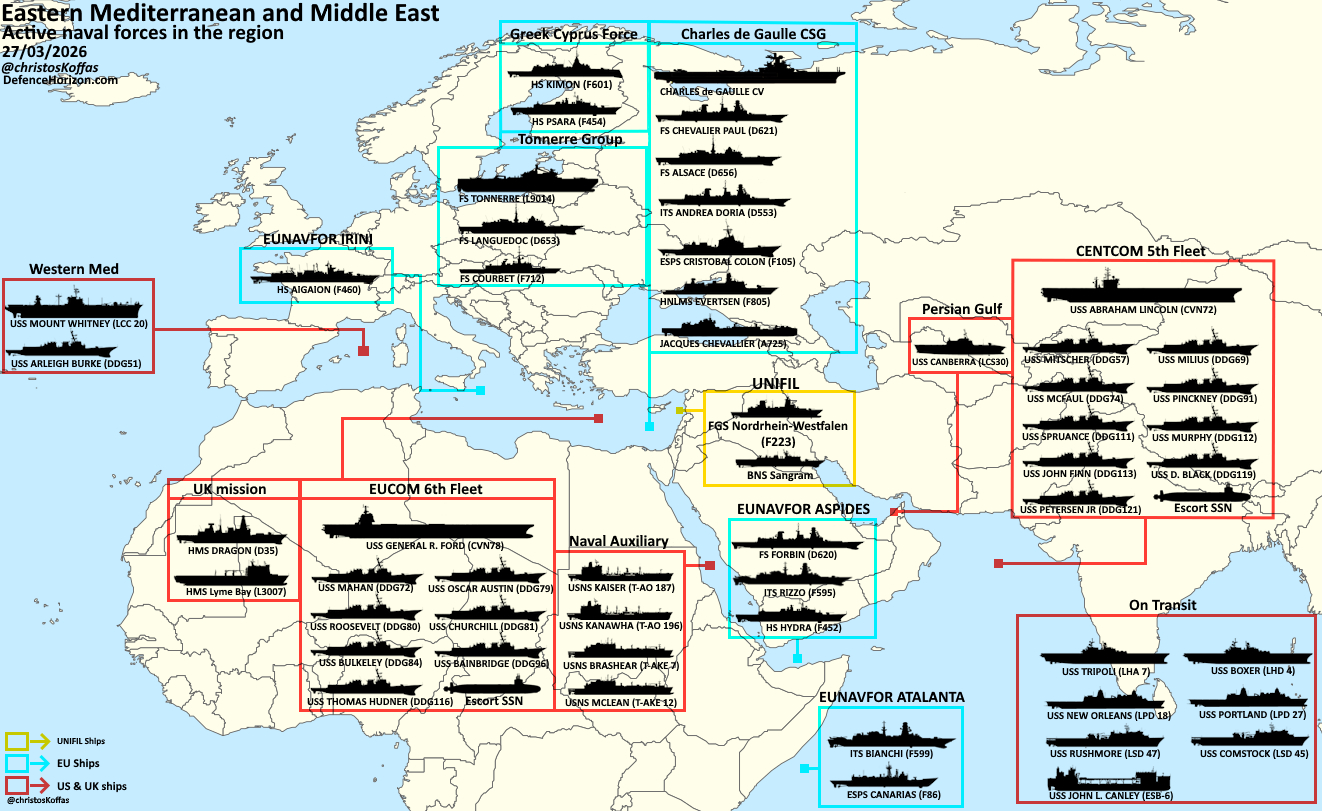 Deployment of national warships in the region. Source
The energy dimension of the Iranian crisis has proven considerably more painful for Europe than the security one. Rising energy costs have exposed a structural vulnerability - the absence of sufficient domestic oil and gas production that European governments have spent years attempting to address through supply diversification, particularly since Russia's full-scale invasion of Ukraine.
Europe's direct dependence on Gulf oil is relatively modest; the continent diversified its supply base long ago. The more insidious problem is demand displacement. The closure of the Strait of Hormuz means that Asia's principal buyers — Japan, South Korea, India, China who together account for the bulk of Middle Eastern oil and gas imports, are now competing for alternative sources on global markets. Since aggregate supply has not increased, this is driving up the price of energy worldwide. Approximately 20% of global oil exports, 30% of global LNG, and 20% of aviation fuel pass through the Strait of Hormuz.
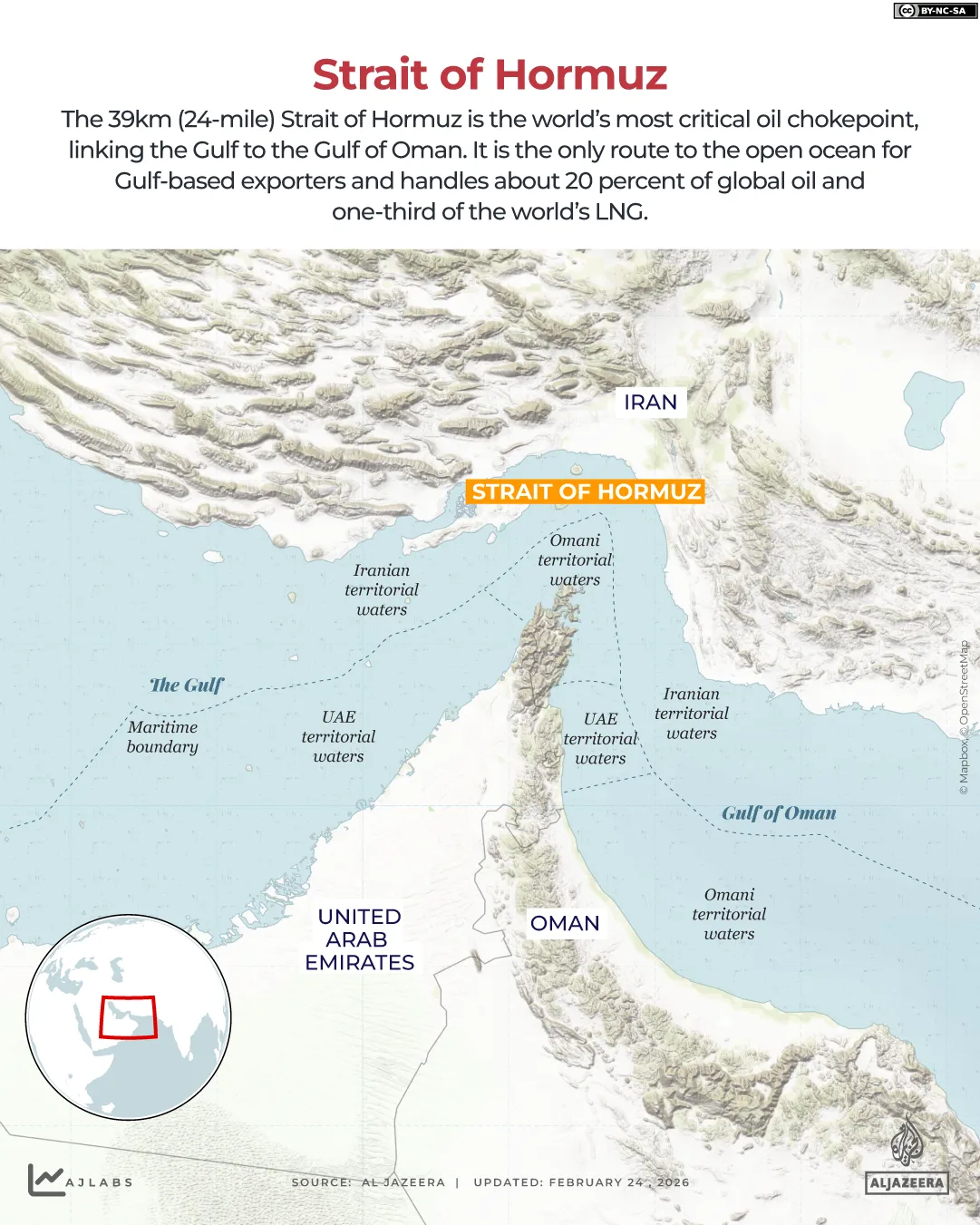 Strait of Hormuz. Source
A further complicating factor is the state of European gas storage. After a harsh winter, reserves stood at roughly 30% capacity at the start of 2026 - critically low as the bloc entered the period when it needed to rebuild inventories. Europe must inject close to 60 billion cubic metres before the next heating season. Against a backdrop of a disrupted LNG market and dramatically elevated prices, this task is both logistically demanding and fiscally costly.
A closed strait, a damaged LNG market, and critically depleted storage reserves together create acute price instability in the near term, and a genuine risk of supply shortfalls over the months ahead, should the conflict fail to reach a swift resolution.
One of the most significant developments to emerge from the crisis has been the formation of a so-called "Hormuz Coalition" aimed at reopening the strait. After NATO allies declined to support a US-led effort to unblock the passage, Trump declared on 16 March that the United States "does not need anyone's help". The underlying objective, however, did not disappear - it simply moved forward without Washington.
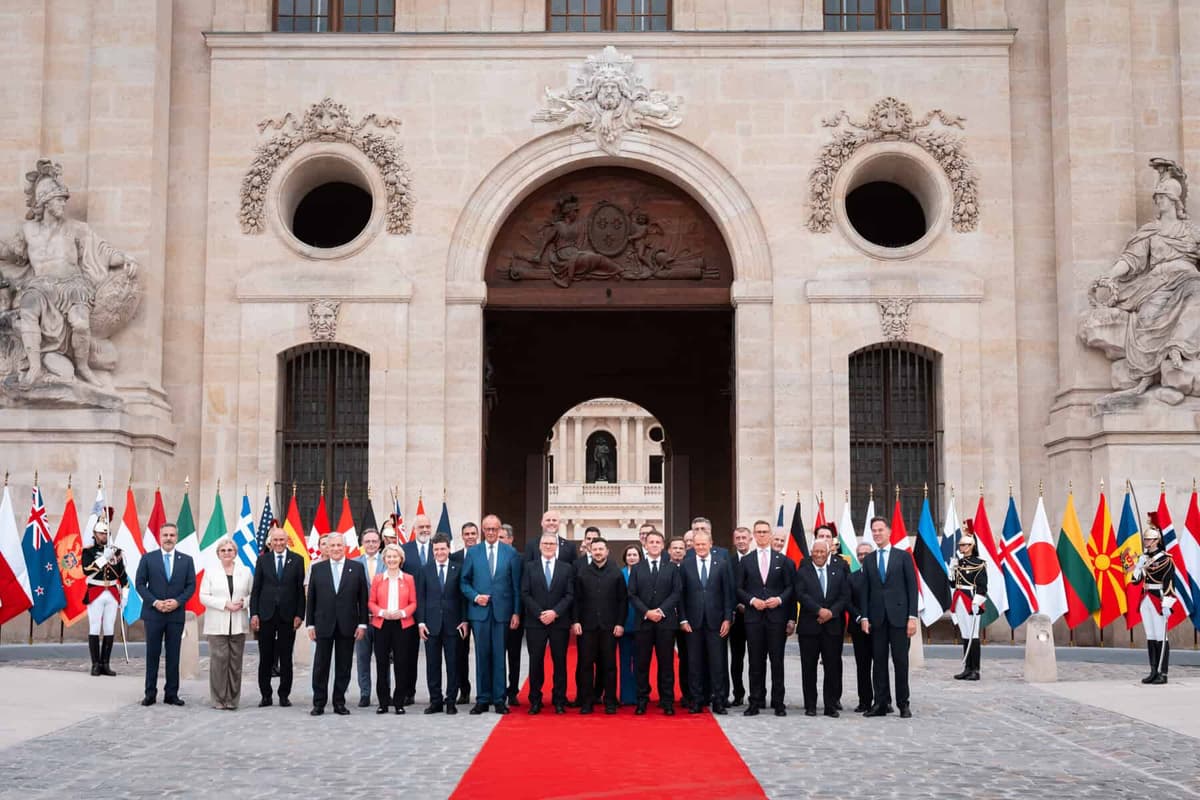
On 19 March, the British government published a joint declaration, co-signed by 37 countries including two Gulf states, affirming readiness to ensure safe passage through the Strait of Hormuz once hostilities cease. The United Kingdom and France assumed co-leadership of the initiative. By 2 April, the coalition had grown to 40 member states. Its declared aim, in the words of UK Foreign Secretary Yvette Cooper, is the "collective mobilisation of the full spectrum of diplomatic and economic instruments" to achieve a "safe and sustainable reopening" of the strait. The United States is absent from the list.
The coalition has not yet reopened the strait. Whether it does will depend on how the military situation evolves, whether members are willing to authorise the use of force if needed, and whether the UK and France can hold a country's coalition together. Yet the very fact of its formation speaks volumes about the destructive effect of the American approach, and about the willingness of third countries to step in and manage the consequences of a military campaign they had no part in launching.
Europe's response to the Iranian crisis reflects the full range of approaches that European states and the EU have brought to bear on the conflict. Yet when the challenge involves shared responsibility, as in the defence of Cyprus or the protection of common strategic interests, as in reopening the Strait of Hormuz - situational consensus begins to take shape.
The energy crisis remains Europe's most durable and long-term challenge. The structural vulnerabilities in the LNG and oil markets have not been resolved, and the longer the conflict persists, the more it crowds out the financial capacity needed for other priorities, including continued support for Ukraine.
The Hormuz Coalition is a telling response to the Iran crisis - not for what it has achieved, but for what it represents. 40 countries, without the United States, convening under British and French co-leadership to address a question of strategic access: that is a significant geopolitical step in its own right. It is the first significant security framework that Europe has sought to construct without American participation. Whether it translates from declaratory intent into operational reality, and whether it signals a meaningful deepening of European strategic autonomy, will depend entirely on the willingness of its members to move from statements to action.
You may be interested