 INTERNATIONAL
INFORMATION AND ANALYTICAL
COMMUNITY


+ Join
Support INTERNATIONAL



Liza Linden, junior Analyst at the Resurgam Center, specializing in European affairs. Specialization: Germany; Russian influence in Europe.
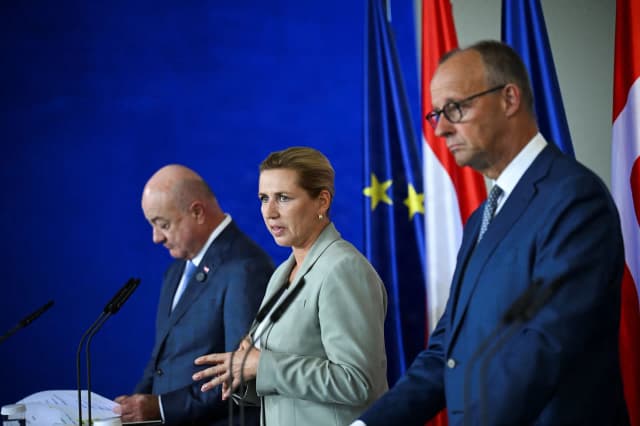
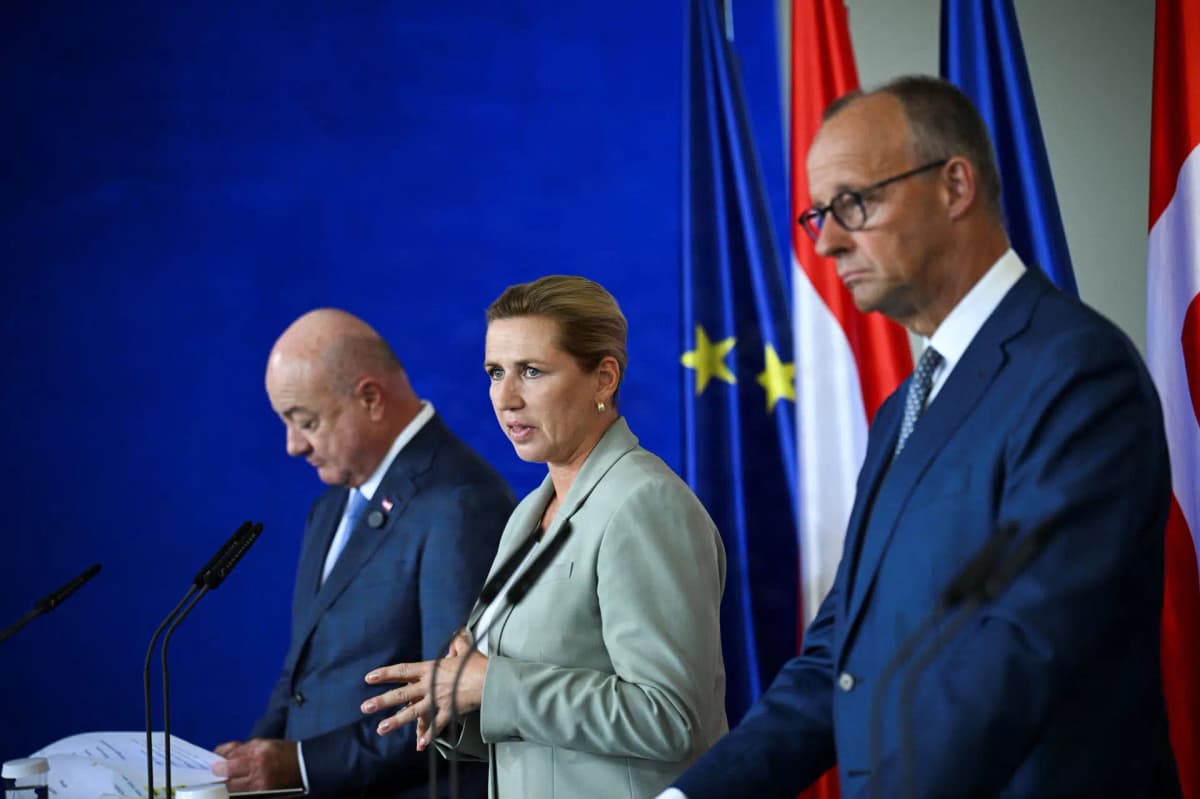
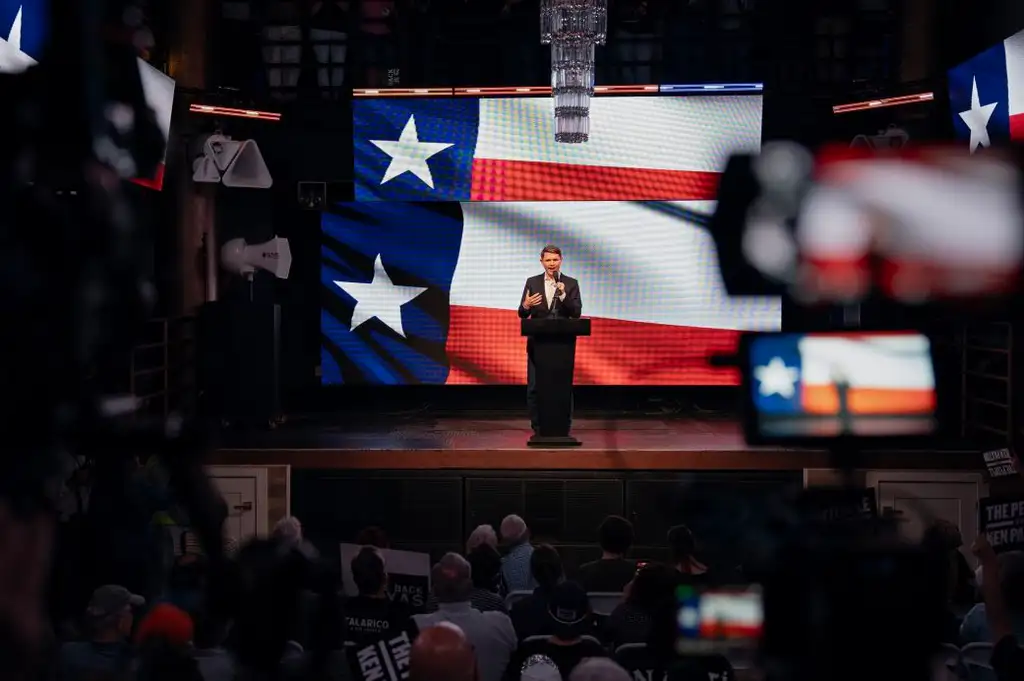
 Photo: Getty Images
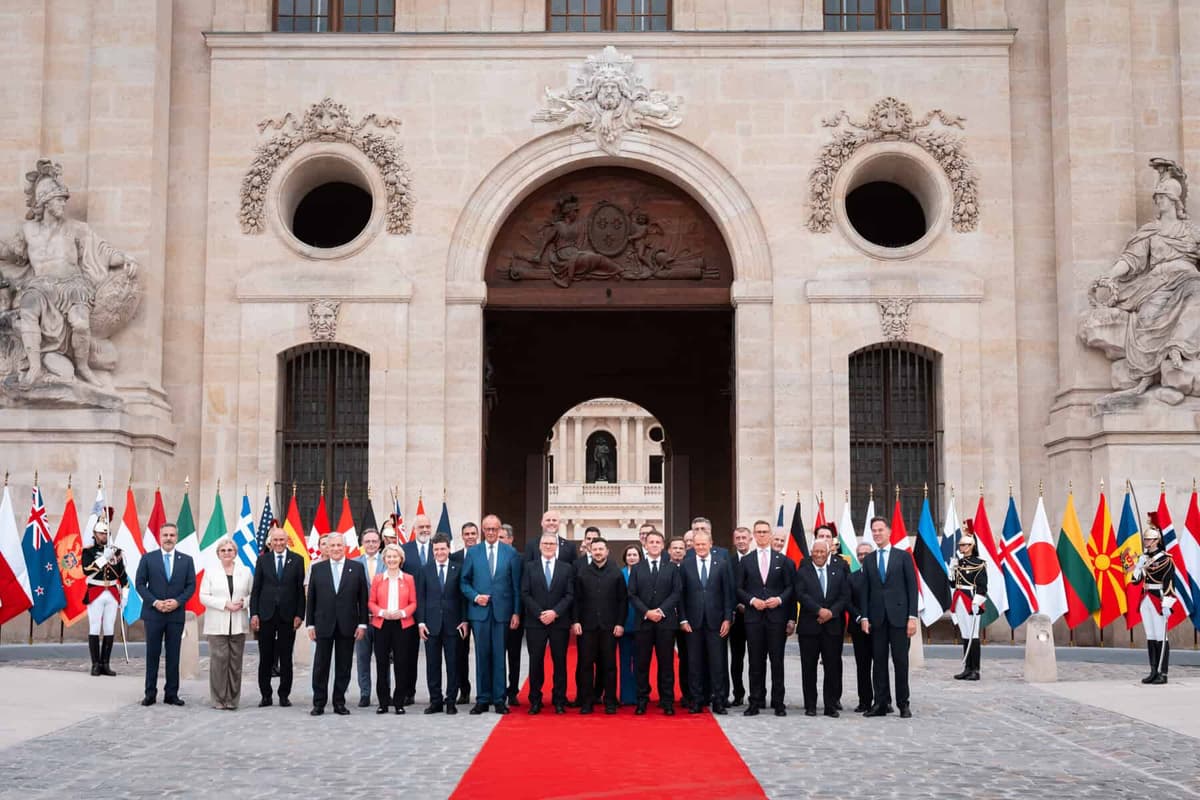
On February 13-15, the Munich conference was held, dedicated to the new world order and security. Among the invited leaders of the Western world were Emmanuel Macron, Ursula von der Leyn, Marco Rubio, Volodymyr Zelensky, Kaja Kallas and Mark Rutte, and it was opened by German Chancellor Friedrich Merz. The Munich conference is already attracting a lot of attention because of its format (it is the world's largest security conference, consisting of the most influential speakers and which is already 60 years old), and this year was no exception. One of the most controversial security topics was raised - the nuclear umbrella and negotiations on its formation.
A nuclear umbrella is a security concept and a form of safeguards under which a nuclear-weapon state undertakes to defend an allied or friendly country that does not have its own nuclear weapons from a nuclear attack or large-scale aggression.
We are talking about the speech of E. Macron and F. Merz, in which they talked about the subjectivity of Europe and disagreements with the United States. Merz, as the first speaker, set the tone of the conference: he emphasized the importance of common defence, cooperation, and the need to "restart NATO".
F. Merz:
The past world order, no matter how imperfect it was at the best of times, no longer exists. In the era of great-power politics, freedom, a key element of European countries, is on the verge of extinction."
There were direct words about disagreements with America, which will be more in the future, including because of the claim to Greenland. However, the chancellor, despite the apparent differences, steadfastly spoke out in favour of reviving trust and moving on a single flank. At the end, Merz mentioned Russia, which is “not ready for negotiations, at least not for real.
Therefore, the following message sounded logically: "I have started negotiations with French President E. Macron on the issues of European nuclear deterrence. We abide by our legal obligations and speak exclusively about participating in nuclear deterrence."
Macron was the last speaker on the first day of the Munich Forum and harmoniously continued Merz's narrative about Europe's defence capabilities without mentioning nuclear weapons. Against the background of his speech, the answer to the speaker's question about ". Has Europe wasted 6 years on nuclear defense negotiations without achieving anything?" Macron replied that Charles de Gaulle also spoke about the sovereignty of Europe, which should take care of itself, and that the issue of nuclear weapons is a difficult topic, so it is moving slowly.
E. Macron:
We need to reformulate our nuclear deterrence potential. We are discussing with Merz and European leaders how we can improve a national doctrine of deterrence based on our constitution, with compatible maneuvers to further advance security interests...
This is the first time France has done so in conjunction with Germany. It is about bringing our strategic interests closer together. And, of course, we are negotiating with the UK – another nuclear power.
The idea of nuclear deterrence by European forces is not new. For 6 years, Macron has already proposed this to A. Merkel and O. Scholz, but they rejected the idea. For such a step, it would be necessary to recognize the threat to the European Union, see the United States as an unstable partner and have the political will to make a decision. The topic was already relevant during Merz's election campaign, where he emphasized the need for a nuclear umbrella. Therefore, in 2025-2026, the conditions for its formation began to form.
The responsibility for the security of Europe has been placed on the United States with its nuclear arsenal, which it can potentially use in the event of an attack on one of the NATO countries. The largest number of US military bases is concentrated in Germany: the Americans store about 20 B-61 tactical nuclear bombs at their Büchel Air Base in Rhineland-Palatinate They are owned by the US and protected by the US military. They can only be used if the North Atlantic Council of NATO gives the appropriate political order to activate control in wartime, and this can only happen with the direct consent of the US. The belief in compliance with these rules and the implementation of Article 5 of NATO by the main ally was relevant for 75 years, until the Trump government demonstrated a change in priorities, instability and unreliability as a partner of Europe.
The actualization of the topic of European nuclear deterrence cannot be explained only by the atypical activities of the US President, it stems from three reasons:
1) the United States pursues "Weak Europe policy";
2) Russia threatens with nuclear weapons for supporting Ukraine in the war and feels impunity; 3) the old international order is destroyed, and the new one requires the protection of free countries from unexpected challenges and wars.
Moreover, the treaty between the two largest states with nuclear warheads has not yet been extended on the regulation of nuclear weapons (for the first time in 50 years), this creates an additional atmosphere of tension and chaos.
If the threat from Russia is clear, then the threat from an ally and partner is a crucial event that requires a deeper explanation. The fact is that the strategy of the Trump government is to weaken Europe through support of populist, right-wing radical parties that coincide in two aspects:
They are against a united Europe and want to dismantle the EU as a supranational entity;
They maintain ties with Russia and position themselves as its supporters.
This is explicitly stated in America's National Security Strategy 2025: America wants to have "strategic stability" with Russia, and the main threat to Europe is "Europe itself". They want to maintain resistance to the current trajectory of European countries through the so-called "patriotic" parties within the EU. From the first glance, Vance was focused on the confrontation with Europe and its erroneous understanding of freedom, while Rubio was more historical and complementary. But they retain a common component - the announcement of a new conservative ideology and the identification of their own governments as the enemy of Europe, and not conditional Russia/China. On the other hand, democratic Americans recognize only those parties that share the so-called MAGA ideology, so they openly contribute to their promotion in elections. Therefore, it can be argued that all speakers and slogans fulfill the same goal: the division of Europe, which will not be able to act as a united force and which will be easier to manipulate by the United States and Russia. And it is worth noting that there are indeed problems in Europe, but in order to maintain the alliance and strength, they must be solved within the alliance by all countries. This is not offered by the United States.
There is no separate sociology showing the perception of the nuclear umbrella among Germans after the Munich conference. Instead, there is a poll from June 2025 after Merz's election campaign. According to a survey by the Forsa Institute for Public Opinion Research, approval of European nuclear defense goes beyond all party preferences:
 There is another poll made on the eve of the Munich 2026 conference on NATO and defense. It showed the following results among the two countries:
 Historical experience constrains ambitions to shape military policy – in Germany, many believe that they should help shape a common European defense, but not be a leader as a driving force.
In the 2023-2024 survey, around a third of Germans surveyed believe that they can still rely on the US nuclear umbrella. Moreover, 82 percent would give up Germany's own nuclear weapons. The majority rely on allies: three-quarters want to work more closely with Great Britain and France to ensure nuclear deterrence. But no less important, 44 percent support a European nuclear order that does not involve the United States.
Plus, it is way more interesting to compare the results with the survey of the same fund in 2025-2026.
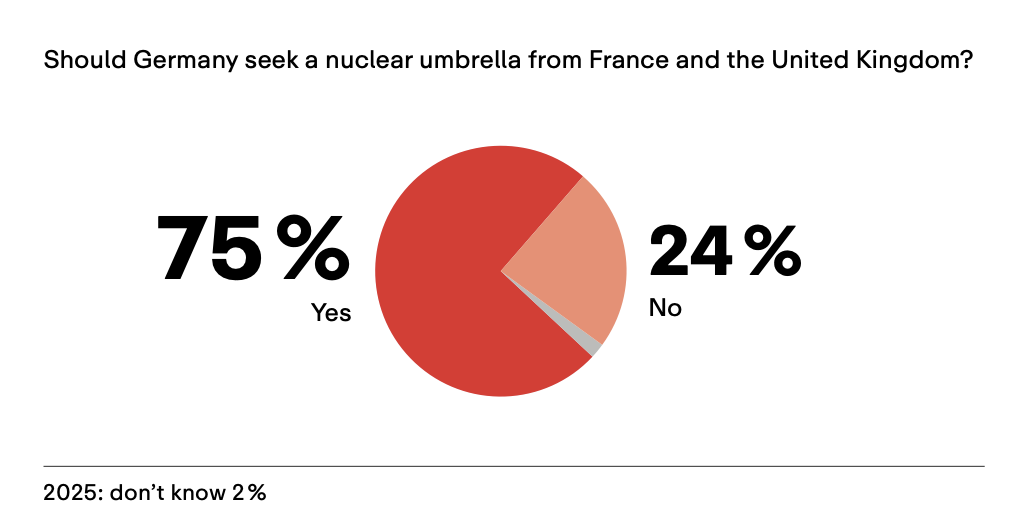
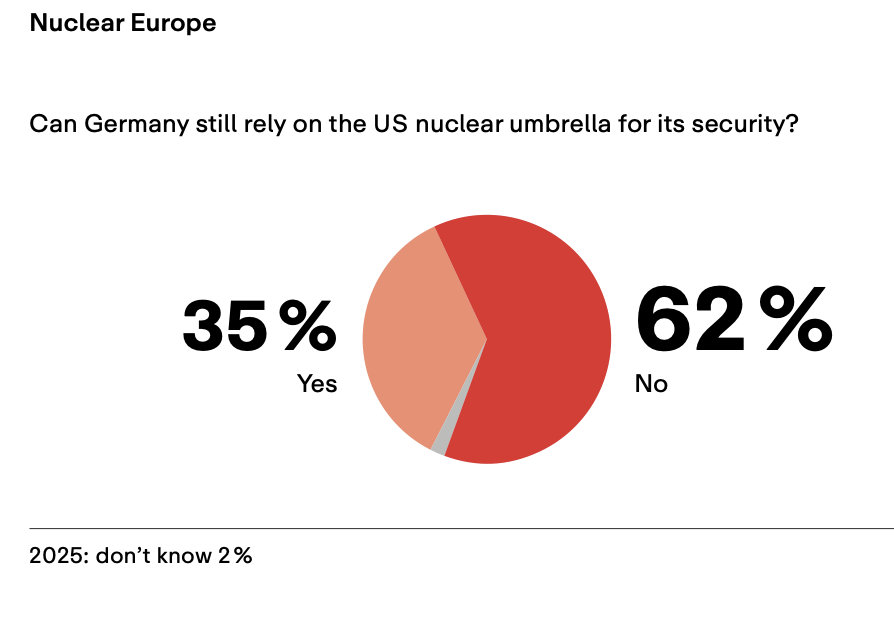
 The parties of the Bundestag did not speak out about the idea of Merz and Macron about a nuclear umbrella. The major parties are addressing this issue along with their pre-war positions on NATO, war, and nuclear weapons. At the moment, there is no direct declaration from the parliament or all parties together that supports or denies this issue in a coordinated way.
Among the establishment, opinions were divided:
In the video, SPD politician Ralf Stegner (German Social Democrat) expresses himself categorically: "Discussion of nuclear development is not crucial in order to solve global problems — even when it comes to security." He emphasizes that American nuclear forces are already present in Europe within NATO — and this is still an Abschreckung (deterrence) system.
Defense Minister Boris Pistorius (PSD) expressed a skeptical opinion about European nuclear deterrence. "Why should we, as Europeans, be interested in this nuclear deterrence, which is guaranteed by the Americans and seems that we question it because of other American activities."
Vice Chancellor Lars Klingbeil defended negotiations with France on a stronger European nuclear deterrent within NATO. "We said a few weeks ago [in January] that if France offers us negotiations, then we should also have these conversations among friends," Klingbeil told the German press agency. However, the SPD chief also stressed that Germany will adhere to NATO's nuclear deterrent system and will not buy its own nuclear weapons.
A small non-verbal gesture was the reaction of political leaders at the Munich Conference to M. Rubio's speech, where he tried to smooth out the corners and explain the differences in approaches regarding the concern for Europe. On the broadcast, everyone jumps and applauds with relief, nostalgia or even naivety, including Boris Pistorius and Johann Wadeful (CDU), the Minister of Foreign Affairs.
According to CDU foreign policy expert Armin Laschet, the issue of a European nuclear protective shield is not of the highest relevance. "It's right not to taboo the subject," he said on the ARD TV program. "Macron will not give German chancellor a joint decision on these nuclear weapons". Laschet also said that the more intensively the chancellor now discusses this topic, the more it will show to the United States that Germany will give up the American umbrella consciously.
In 2025, Jens Spahn, chairman of the CDU/CSU parliamentary group, is in favor of an "independent European nuclear umbrella". He warns that anyone who fails to deter foreign powers with nuclear weapons will become a "pawn in world politics". And Manfred Weber, leader of the European People's Party, said bluntly: "We need European nuclear weapons."
In social networks and in the comments under media posts, views also remain divided. "Europe must take more responsibility as trust in the United States falls. European citizens are increasingly doubting the reliability of the United States and are demanding greater independence in defense policy. Nevertheless, personal commitment remains low: many Germans consider military duty to be outdated and paternalistic. They prefer voluntary military service or civilian service. How this should increase the effectiveness of our armed forces remains a mystery." | "Dear Europe, let me know when you wake up. Thank you!"
 "Yes, we have seen on the example of Ukraine how everything works without nuclear weapons. Without sarcasm". | "I am horrified that, given the behavior of the Russians in particular and the withdrawal of US troops, there are still people who believe that defenselessness keeps the peace. It never helped!"
 "Yes, Fritz, come on, do it, then we will quickly see what the Russians are capable of. But then may God help you", | "Mertz is sick.", | "This guy really wants to start a war", | "He is worse than Putin"Based on these indicators, it can be said that some Germans see a threat in the right turn of the United States and are aware of their weakness in the face of uncontrolled great powers that refuse the international order. The others believe that it is the nuclear deterrence on the part of Germany that is dangerous and can, on the contrary, provoke a war.
There is still hope among the establishment for cooperation and understanding with the United States, as well as counting on its nuclear protection as a last resort. There is a noticeable lack of preparedness and fear of strengthening the military role of the EU and Germany separately, which is a logical consequence after a long period of lack of subjectivity and the United States' following in foreign policy.
Some of the chaos and disagreements among government officials and citizens can be explained by Germany's active search for a new world order and the development of a new defense formula. On the other hand, military experts from the European Nuclear Research Group in their study from February 2026 (after the Munich Conference) are more critical of the idea of joint nuclear deterrence and provide versatile arguments. They can be sorted according to the following dimensions:
| Type of risks | Arguments |
|---|---|
| Financial | Europe is still heavily dependent on the United States militarily, the separate execution and planning of nuclear missions will be difficult and expensive; The development of even conventional non-nuclear deterrence requires colossal injections |
| Security | Neither Russia nor the United States will remain inactive in the event of the creation of a European nuclear arsenal; The construction of a nuclear umbrella will take enough time for the Russian Federation to strike and not receive a response; Other countries will also think about their own nuclear weapons |
| Political | The responsibility problem in Europe: no one knows how to distribute correctly responsibilities and formalize them; simultaneous unrealistic perception of the threat among both government officials and citizens; Such projects are long-term, and the arrival of pro-Russian far-right forces interrupt the initiative; The World Bank and France are not ready to share power over nuclear weapons with third countries; Nuclear weapons do not automatically provide "control" and are not universal insurance against defeat, because the USSR lost in Afghanistan, the United States withdrew troops from Vietnam, and Ukraine has been fighting against nuclear Russia for 4 years; To develop nuclear projects, the opponent must believe in the threat to himself after the strikes, while there is no such belief; even with Trump's unpredictable policies, transatlantic security will not fall apart — Americans will still not give up guarantees that ensure their own strategic interest in Europe; active actions over a separate nuclear umbrella could lead to an even greater split in NATO and a stronger reluctance of the United States to defend Europe. |
| Technical | French nuclear weapons are not integrated into NATO command structures; British nuclear weapons are deployed exclusively on long-range missiles and are heavily dependent on American support; military infrastructure has not been developed, early warning systems, air defence and air-to-air refuelling are still entrusted to the United States; |
| Legal | The complexity of drawing up a supranational treaty on nuclear weapons, which belongs to only two countries; European nuclear deterrence should be regulated differently for the UK and France: it can be transferred to a group of European countries, or delegated at the transnational level to a European official, such as the President of the EU Commission or the President of the Council of the EU, but this point is limited by distrust states must agree on a single system of decision-making on launch, and this cannot happen through the convening of a committee every time — this is logistically and politically unacceptable; The Treaty on the Final Settlement with regard to Germany, also known as the "2+4" Treaty (Germany and the GDR and the USSR, the USA, France, Great Britain) allowed the reunification of Germany only on the terms of a ban on the production, possession and proliferation of nuclear weapons. |
Researchers are considering the following options for nuclear deterrence:
The option is to stick to the agreement with the Americans. This option is most likely taking into account the least risks and costs. The United States has repeatedly reiterated within NATO that it expects European allies to largely take over their traditional defences themselves. However, President Donald Trump's government has never questioned the nuclear umbrella, the authors claim.
Another option, according to experts, is to increase the participation of states such as Germany in the exercises of the French nuclear forces before accepting certain non-nuclear missions, such as refuelling carrier aircraft from the air, moderate growth of two arsenals, work on European command infrastructures. Under the second option, the mere fact of participation in joint non-nuclear missions should become a political signal that strengthens Europe's defence capabilities, and other programs will strengthen it in a practical way.
The deployment of nuclear weapons on NATO's eastern flank to restrain Russia, but the authors themselves emphasize that this rests on the problems of building a reliable independent nuclear deterrent. Carrier systems and warheads that allow a reliable retaliatory strike even after the first enemy strike will be associated with huge costs. And the deployment of nuclear weapons in individual countries will put an end to the Treaty on the Non-Proliferation of Nuclear Weapons, that is, a central international agreement that is designed to limit the proliferation of nuclear weapons and promote disarmament.
There are also opposing arguments in favour of the fact that European nuclear deterrence can be implemented at least partially. This opinion is expressed by security expert Moritz Brake, who says that Europe should not only rely on the United States, but also have some independence in this area. "In today's world, increasing competition between great powers and doubts about the reliability of the American nuclear "safety umbrella" make the issue of Europe's nuclear strategy more urgent."
Bruno Tertra is deputy director of the Paris Foundation for Strategic Studies (FRS) and has advised Emmanuel Macron. He believes that fears of Russia's use of nuclear weapons are exaggerated, since in 4 years of full-scale war with Ukraine, Russia has not used nuclear coercion: its statements are more like nuclear deterrence. Due to its geographical location, France has a vital interest in the territorial integrity of Europe. And she is also closer, so the defence under French leadership looks more believable. But even Tertra denies the deployment of French nuclear warheads in other territory: "We can rise to participate in nuclear exercises and protect British or French nuclear forces. But no further. I think we shouldn't cross a certain line."
At the Munich Conference, Macron and Merz recorded the end of the old international order and the need to build a new one. In it, Europe should become more subjective. To implement this, there must be additional exclusively European nuclear protection, which will consist in deterring potential aggressors. The discussion of nuclear deterrence has intensified over the past two years due to the sharp, unpredictable and critical policy of the United States, as well as the strengthening of hybrid operations of the Russian Federation on the territory of the EU. Actions by the United States (imposing tariffs, claims over Greenland, threats to Latin America, sharp criticism of Europe) made them doubt their reliability in the event of a nuclear scenario. Europe does not want to move away from the United States and supports the partnership course, but it wants to have clear security guarantees.
Among Germans, the vast majority positively assess additional nuclear protection and critically assess the actions of the United States. At the same time, both the government and citizens are united in renouncing their own nuclear weapons and rely on treaties that prohibit the keeping, possession and development of nuclear weapons. However, the presence of American nuclear warheads and military bases in Germany does not violate the ban, so the same can be done with French or British nuclear missiles.
Representatives of the German government distance themselves from nuclear policy as much as possible and demonstrate a higher level of trust in the United States, which is not justified, but conformist and clearly does not take into account the US National Defence Strategy, where they directly call European governments "enemies of Europe" and will contribute to the victory of "patriotic" parties in the elections — that is, they openly declare interference in the internal politics of European countries. However, some prominent German politicians support Merz's course and say that there is no alternative to the nuclear umbrella due to the ineffectiveness of other types of deterrence against aggression.
The implementation of the idea of a European nuclear umbrella rests on a ceiling of problems: huge financial costs, a reaction from the Russian Federation and the United States, a lack of subjectivity, problems with the distribution of responsibility at the supranational level, the unreliability of countries due to the potential coming to power of right-wing forces, and weak military infrastructure. Military experts do not offer a full-fledged alternative, but instead consider protection from the United States with the need to increase defence spending or work on command structures similar to NATO and Germany's participation in non-nuclear missions. The problem with such advice is that it could exist only in the old world order, but it no longer exists, and in the new one, no one pays attention to half-measures and the status quo.
In order to really implement the project of joint nuclear defence, it is necessary to at least equally assess the outside world and be motivated to change. Doubts even before the start of official discussions are a signal of fear of both a new reality and responsibility. This is a logical consequence of EU policy, which has ignored foreign policy for decades. which provide stability and prosperity, which has become a unique advantage of Europe. But in 2026, in order to preserve this system, we need to learn how to protect it.
The nuclear umbrella should become such a measure that will be implemented under any government. But it is also worth noting that the development of Europe's defence autonomy ends with nuclear deterrence, and does not begin with it. The slowness of the movement in its adoption and implementation is not evidence of the lack of movement in general, but rather an indicator of the complexity of implementing such a project at the supranational level.
It is worth remembering the chronology: first, the nuclear powers began an aggressive policy, and then the idea of their own nuclear deterrence arose. Some experts call nuclear weapons a non-universal advantage because members of the nuclear club have lost wars. But their report does not indicate a common feature of these wars, which neutralizes the argument about "non-universality" – they were fought on foreign territory, never crossing the threshold for the use of nuclear weapons. A potential war between the EU and the Russian Federation could become such.
Accordingly, its own spare nuclear umbrella is not a whim, but a reaction to the restructuring of international infrastructure, in which entities must prioritize their own security. The manifestation of loyalty and patience to the United States was not correctly assessed by them. At that time, the Russian Federation was already waging war in Europe, threatening to annex the Baltic countries, conducting hybrid operations, and "testing" Europeans by launching drones near military facilities. At the analytical level, threats from nuclear states can be measured in different ways, but as government officials, Europeans must respond to any level of danger, because it exists – and therefore there must be a force counterweight for those who pose a permanent threat.
The chances of implementing the nuclear umbrella depend on several variables: increased uncertainty in relations with the United States and the presence of sufficient political will to respond to these risks. Currently, there are problems with these items due to the long-term rejection of an independent defence and foreign policy. The proposal of Macron and Merz is correct and alternative in the context of the formation of a new world order and chaos. Yet, it is undeveloped and insufficient to change the balance of power in favour of the EU. The nuclear deterrence project needs to be deeper, other European countries should be involved in the discussion and rules for its implementation are to be formed.
The EU has a better chance of improving its nuclear and defence policy if it involves Ukraine in the process. There are much higher chances of confronting external opponents if the experience of a country that has already been at war with nuclear Russia for 4 years is used. A common European line of defence can undermine the firmness of Russia's beliefs in its impunity, because it will be strengthened by European money, the experience of modern warfare, Ukrainian cyber infrastructure, investments in Ukrainian defence projects, and a strong rear in the form of a united Europe. Ukraine needs to promote its candidacy now in order to have time to "overgrow" new qualitatively deeper agreements with Europe before the final formation of a new world order. Ukrainian diplomacy is already engaged in this and has successes, so any European defence initiatives should take into account the Ukrainian view and involve us in the implementation of joint defence projects. Nuclear defence is out of the question yet, since there is no common defence picture among EU members, but Europe has time for debates and compromises only thanks to Ukrainian defence, and European leaders understand this.
Such a project should begin with the awareness of the threat by all European countries and end with ideological and security transformation. Merz has already laid the first bricks and shown that it is necessary to talk about it and take responsibility for the unpredictable future. The level of involvement of other states determines whether the idea of a nuclear umbrella will be continued.
You may be interested