 INTERNATIONAL
INFORMATION AND ANALYTICAL
COMMUNITY


+ Join
Support INTERNATIONAL



Kostiantyn Hlushko, staff analyst and reviewer at the "Resurgam" Center for Northern European Policy
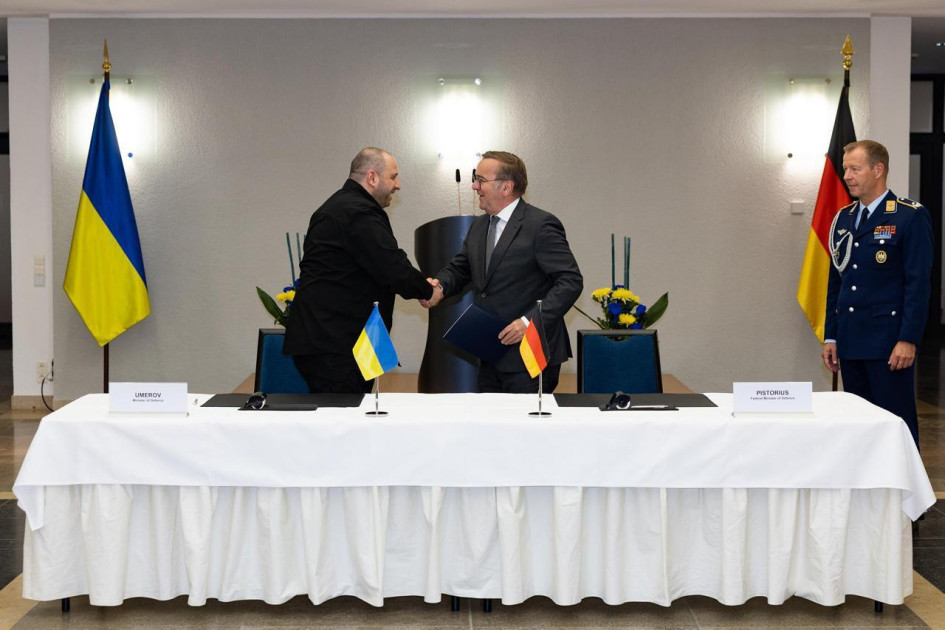 On 17 December, Ukraine’s Minister of Defence Denys Shmyhal announced the signing of a series of defence agreements with Germany worth over €1.2 billion.
The agreements include the supply of spare parts for Patriot systems, the procurement of Ukrainian UAVs worth more than €200 million, the joint production of 200 Bohdana self-propelled artillery systems on German Zetros chassis valued at €750 million, the delivery of electronic warfare systems, the joint production of “Linza” UAVs, and the allocation of €11.5 billion as a financial support to Ukraine in 2026.
These agreements are part of broader cooperation under Ukraine’s Build with Ukraine initiative and Germany’s plan to deepen defence cooperation with Ukraine.
The Build with Ukraine initiative enables the export of Ukrainian military technologies. Germany’s plan, in turn, envisages the establishment of joint defence enterprises, market integration, the possibility of federal investment guarantees, joint R&D in the defence-industrial sector, and the procurement of Ukrainian-produced defence equipment to protect NATO airspace.
In simplified terms, the German model of support may be described as follows: Germany invests in its own defence industry and in joint enterprises, while the resulting products are supplied to Ukraine. The construction of German-owned facilities in Ukraine and joint development projects are envisaged. In return, Ukraine transfers technologies related to modern weapons production to Germany and gains access to the European defence market.
Germany strengthens its defence-industrial base, gains Ukraine as a sales market, and acquires access to modern military technologies, such as UAVs. Ukraine, in turn, receives weapons, German investments in joint enterprises, gains opportunities to employ its own specialists at these facilities and access to the European defence market. In addition, locating some facilities in Germany makes them less vulnerable to Russian missile and drone attacks, although the risk of sabotage may not be ruled out; for this reason, their exact locations are not disclosed.
An example of such a joint enterprise is Quantum Frontline Industries (QFI). This joint enterprise is being formed from the collaboration of Germany’s Quantum Systems and Ukraine’s Frontline Robotics. QFI will produce “ZOOM” and “Linza” drones in Germany. Annual output is expected to exceed 10,000 units. The number of drones to be transferred to Ukraine will be determined by Ukraine’s Ministry of Defence.
Two additional Ukrainian initiatives, UkraineConnect and JobConnect, play an important supporting role in implementing the German model of support. UkraineConnect aims to facilitate the institutional entry of German defence companies into Ukraine, support industrial cooperation, and launch joint production and service projects. JobConnect is intended to support staffing for localized production facilities by linking Ukrainian specialists with the needs of German and joint defence facilities.
Currently, joint production of drones and self-propelled artillery has been confirmed, as these are the weapon systems Ukraine needs most urgently. Cooperation may also extend to the joint production of missiles and air-defence systems in the future. The field of ammunition—particularly artillery shells and their components—may see further collaboration, along with the development of repair and service centres for already supplied equipment.
Localizing repair and maintenance at Ukrainian sites or in joint defence facilities may shorten equipment recovery time and reduce the logistical burden.
For Ukraine, this would mean further consolidating its role as a partner rather than a recipient. For Germany, it offers an opportunity to build long-term defence supply chains in Europe that take into account Ukraine’s experience of modern warfare.
In the future, the German model may serve as a template for Ukraine’s cooperation with other European states, particularly those with developed defence-industrial sectors but limited domestic production capacity.
The combination of advanced Ukrainian military technologies, whose effectiveness has been proven by war, and German investment may become a key factor in reducing Europe’s dependence on the United States, strengthening Europe in the face of the Russian threat, and helping Ukraine enter global defence markets.
Kostiantyn Hlushko, staff analyst and reviewer at the "Resurgam" Center for Northern European Policy
You may be interested