 INTERNATIONAL
INFORMATION AND ANALYTICAL
COMMUNITY


+ Join
Support INTERNATIONAL



Diana Lebed, Political scientist and junior analyst at Resurgam, specializing in security dynamics in Central and Eastern Europe (Ukraine–Moldova–Romania–Hungary–Slovakia).
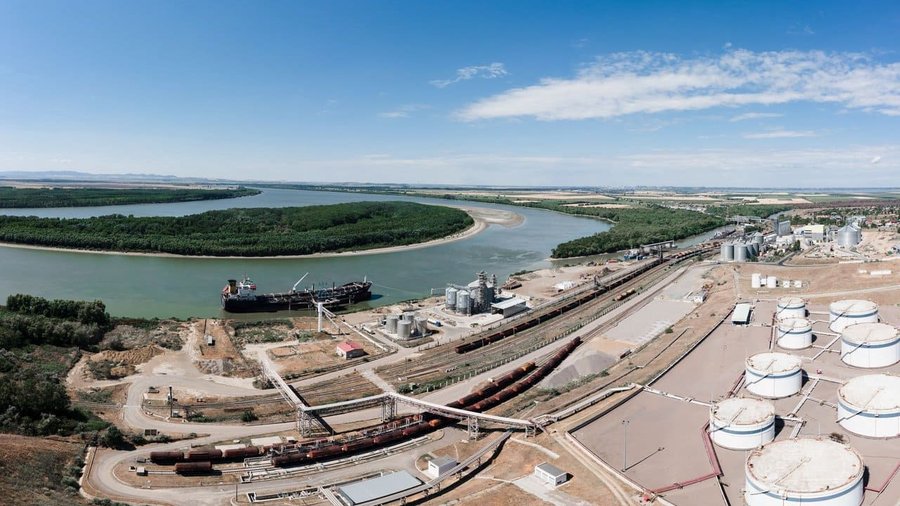 In January 2026, Romania acquired the International Free Port of Giurgiulești on the Danube in Moldova, which was owned by the European Bank for Reconstruction and Development. The project combines the economic interests of Romania, Moldova and Ukraine with the strategic goal of creating an alternative to the Black Sea routes blocked by Russia in 2022-2023 and weakening Russia's levers of influence through energy and transport.
The port of Giurgiulești has two separate facilities: the International Free Port, which was managed by Danube Logistics, and the state port, which belongs to the Government of the Republic of Moldova.
The Romanian government purchased only the part related to the private port operator without transferring state-owned land into its ownership. At the same time, the Moldovan Ministry of Economic Development emphasised that this is a commercial transaction with the private operator of the port of Giurgiulești, which is being carried out in accordance with current legislation.
This model allows Chisinau to avoid accusations of ‘selling off strategic assets,’ which is critically important for President Maya Sandu’s Action and Solidarity Party. Thus, formal sovereignty over the state-owned part of the port is retained, while financial, investment and management obligations for modernisation are handed over to the Romanian side.
In Romania's strategy, the port of Giurgiulești plays a key logistical role, providing transit between Ukraine, Moldova and the EU. Together with the port of Constanța, it offers an alternative to Black Sea routes. Its location three kilometres from the Ukrainian border allows cargo to be transshipped without additional transit costs.
Currently, despite its theoretical capacity to process up to 10 million tonnes of cargo per year, the actual performance of the port of Giurgiulești remains significantly lower. That is why Romania sees participation in the project as part of its strategy to expand Constanta's capabilities and strengthen its position in the Central and South-Eastern European market. The planned investments that Romania has planned to invest in the port of Giurgiulești, amounting to more than €24 million, will be directed towards the comprehensive modernisation of the port, including the development of terminals, the upgrading of railway logistics, the expansion of storage capacities, the digitisation of processes and the implementation of energy-efficient solutions. At the same time, the Moldovan government is implementing its own €34 million modernisation project, which involves increasing capacity by 800,000 tonnes and building a new universal berth for an additional 600,000 tonnes per year.
The agreement strengthens the informal strategic triangle of Moldova-Romania-Ukraine, combining economic benefits with long-term geopolitical effects. Moldova increases its transit potential and attracts investment, Romania includes the port in its own transport infrastructure, and Ukraine gains alternative routes. Russia loses one of its key levers of economic influence in the region.
The modernisation of the port is taking place in parallel with Moldova's energy transformation, supported by the European Commission with €250 million in funding. The launch of the Vulcanesti-Chisinau and Balti-Sucava power lines by 2027 will ensure a stable energy supply to the south of the country and reduce dependence on Russian resources.
At the same time, infrastructure changes are affecting the balance of power in relations with Transnistria. Previously, electricity was used as a lever of pressure by Tiraspol on Chisinau, but now Moldova has the opportunity to influence the economic stability of the separatist region. Transnistria's industry remains critically dependent on electricity supplies, and after the cessation of Russian gas supplies, its economic position has weakened significantly.
Economically, Giurgiulești could potentially also become a full-fledged logistics hub with a processing capacity of up to 3-5 million tonnes of cargo per year, which would ensure stable transit revenues for the budget and create jobs in the port, transport and customs sectors. This is an important structural boost for the development of the Cahul region and Moldova as a whole. In turn, this project strengthens Chisinau's position in its dialogue with Brussels, demonstrating real steps towards European integration and opening up access to additional financial assistance.
The key factor in the project is the security situation. Russian strikes on Ukrainian ports have forced Kyiv to reorient its export and import flows, making routes through Moldova strategically important. Giurgiulești provides imports of diesel fuel and petroleum products, particularly for agriculture and the transport system.
Given the destruction and loss of key refineries in Kremenchuk, Lysychansk and Odesa during 2022, Ukraine has been forced to radically rebuild its fuel supply system. In the first six months after the start of the large-scale war, fuel imports increased 12-fold, from 58,800 tonnes in March 2022 to 709,500 tonnes in August of the same year. By 2024, Ukraine was already importing 6.65 million tonnes of diesel fuel per year, accounting for 75% of the country's total motor fuel consumption. 95% of imported petrol and 72% of diesel fuel comes from EU countries, mainly Romania, Lithuania, Slovakia, Greece, Bulgaria and Poland. Under these conditions, the Danube route through Giurgiulești has transformed from a secondary to a strategically important supply channel, especially for the southern regions of Ukraine, as they are more vulnerable.
At the same time, the development of the Giurgiulești port expands Ukraine's grain export opportunities, reduces the burden on land borders and creates reliable channels for importing construction materials, equipment and other critical goods, ensuring fast and safe delivery compared to routes through western borders.
The optimistic scenario envisages the full implementation of Romanian investments without significant delays. The port is becoming a powerful logistics hub with expanded capacity, allowing Ukraine to diversify its supply routes despite Russian strikes on port infrastructure. Moldova receives significant transit revenues and strengthens its position as a transit country, which contributes to the process of European integration. Chisinau's influence on Tiraspol's economy and energy sector gradually reduces tensions in relations with Transnistria and paves the way for conflict resolution.
A realistic scenario envisages the gradual development of the port with possible delays due to bureaucratic and financial obstacles. In turn, this will give Ukraine an alternative route for part of its grain exports and fuel imports, increasing the resilience of the system, while the main flow of cargo will remain through Odesa, Izmail and land borders. Therefore, this project will only strengthen the Moldova-Romania-Ukraine triangle and limit Russian influence, maintaining the status quo in Transnistria.
This will give Ukraine an alternative route for 5-7% of grain exports and part of fuel imports, while maintaining the main flow through Odesa, Izmail and land borders. The project strengthens the Moldova-Romania-Ukraine triangle, limits Russian influence and leaves the situation in Transnistria ‘frozen’.
The pessimistic scenario envisages a slowdown in modernisation due to political instability, pressure from Russia or escalation in Transnistria. The project will not be fully implemented even in 5-7 years, Romanian investors will face risks, and Ukraine will not get an alternative route. Also, in the event of a sharp escalation, attacks on infrastructure and provocations on the Danube could render the route temporarily or completely inoperable, threatening a deep political crisis and strengthening Russian influence.
Along with its benefits, the project has a number of limitations and risks. The capacity of the Danube corridor is limited by the physical depth of the fairway, the speed of the current and seasonal fluctuations in water levels, which have a particular impact during droughts. Political instability in Moldova, the threat from pro-Russian forces, and uncertainty surrounding Transnistria could complicate long-term investment, and any change to a less pro-European government could call into question the fulfilment of concession terms.
Russia is already applying informational pressure, attempting to portray the economic project as a ‘threat to sovereignty’ and sow discord in Moldovan society. However, attracting foreign investors reduces Moldova's control over a strategic asset and could become a source of long-term tension in relations with Bucharest.
The agreement on the Giurgiulești port clearly demonstrates how infrastructure projects are becoming instruments of national security. In the context of war, every alternative supply route, diversification of imports and exports, and reduction of dependence on vulnerable logistics routes is of critical importance for Ukraine. Giurgiulesti is becoming a test of Moldova, Romania, and Ukraine's ability to build a sustainable regional infrastructure despite systematic pressure from Russia. The success of the project will be determined not by the formal parameters of the concession, but by Chisinau's political will to maintain a pro-European course and the willingness of Bucharest and Kyiv to support Moldova in critical moments.
You may be interested