 INTERNATIONAL
INFORMATION AND ANALYTICAL
COMMUNITY


+ Join
Support INTERNATIONAL


Ostap Denysenko, a U.S. politics analyst, exclusively for Resurgam
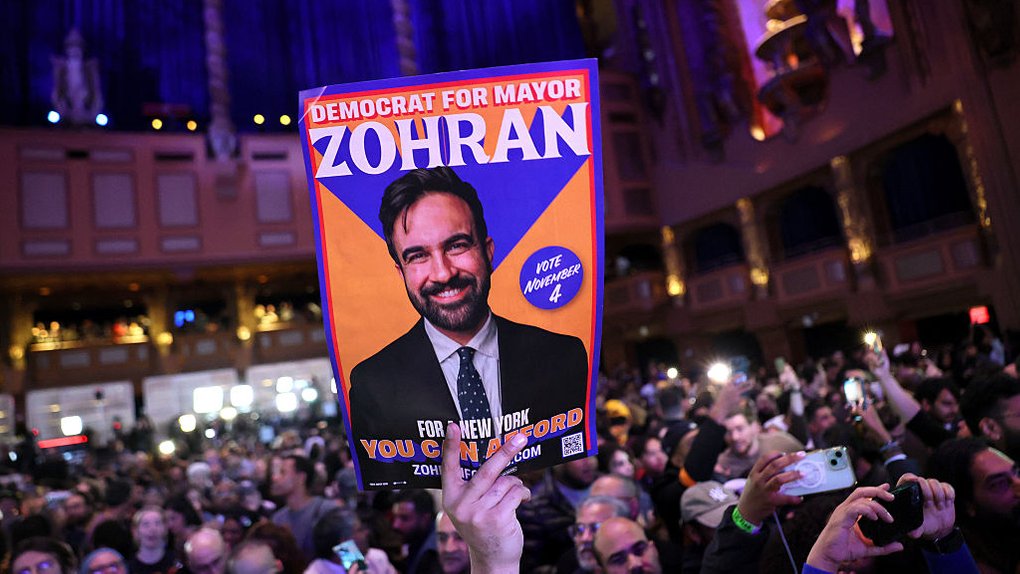 Photo: Getty Images/Michael M. Santiago
This is preparation for the midterms (intermediate elections), in which one-third of the Senate and the entire House of Representatives will be elected, and which will take place exactly one year from now. We will determine the important results of the elections and their significance for next year.
The most notable result was the victory of socialist Democrat Zoran Mamdani in the New York mayoral election. This election saw the highest voter turnout since 1997 and Mamdani received over 1 million votes, the highest result since the 1960s. At the same time, his fellow party member Andrew Cuomo received 800,000 votes, exceeding the results of previous winners.
In Virginia, Democrats won at all levels. Abigail Spanberger defeated Republican Vince Earl-Sears with a score of 57-42. Ghazala Hashmi became a lieutenant governor. Jay Jones defeated Jason Miyares, who was seeking re-election, and became the state's attorney general. The most stunning result was the Democrats' victory in the state House of Delegates election. The party won 64 seats in the House of Delegates, the best result for the Democrats since 1987, giving them a supermajority.
In New Jersey, Democratic candidate Miki Sherrill defeated Republican Jack Chiattarelli by 13%.
In California, voters supported Proposition 50, which gave the state government the right to redraw electoral districts without regard to the decisions of an independent commission. California Governor Gavin Newsom, a Democrat, was the face of the campaign in support of this referendum.
Right now, the Democrats don't have an obvious leader. After getting totally crushed in the 2024 election, that spot is still up for grabs. The progressive (left) wing of the Democrats wants to use this to take control of the party. The Democratic establishment's low-key response to Trump's actions and the progressive wing's energetic rallies against Trump, even in red states, gave the left wing within the Democratic Party hope that they could regain the initiative. All they needed was a candidate who could win the election.
That candidate was Zoran Mamdani. His campaign and victory in the New York mayoral election inspired enthusiasm among the left wing of the Democrats. Indeed, he ran an effective campaign that brought a large number of young people to the polls for the first time. His programme, which is extremely left-wing by US standards, addresses issues that concern the average voter: the cost of living, high rents, and public transport.
However, his programme was controversial even in New York. Of course, 1.3 million voters supported him, which is indeed the best result in the last half-century. But his rivals, Andrew Cuomo and Curtis Silva, received a combined total of 1 million votes. In percentage terms, Mamdani received only 50% of the vote, which is the worst result in the last 16 years. The left argues that there were three candidates in the election. True, but it is doubtful that Cuomo or Silva voters would have voted for Mamdani.
In addition, there was no strong centrist Democrat in New York to oppose Zoran, which was an advantage for him. His main rival, Cuomo, resigned as governor of New York due to a sexual harassment scandal. Even so, he received 800,000 votes.
In other words, if there had been a more or less popular centrist candidate, it would have been difficult for Mamdani to win the mayoral election in one of the most liberal cities in the United States. In the presidential election, the situation would have been much worse.
Democrats really need to adopt Mamdani's campaign style, paying attention to voters' vital issues and generating enthusiasm among them, but nothing more. Something similar to Mamdani's election programme would not work for a presidential candidate under any circumstances.
There is a belief that Republicans were doomed to defeat because the elections took place in blue states. This statement is somewhat misleading. Virginia and New Jersey are liberal states, but there are always a few ‘buts.’
In Virginia, the governor, lieutenant governor, and attorney general were Republicans before the election. Republicans controlled the House of Delegates from 2000 to 2020, and then from 2022 to 2024. Most of the time, the governors were indeed Democrats, but they had to negotiate with the Republican majority in the legislature. But it wasn't just the legislature that was controlled by Republicans.
Over the past 30 years, only two Democrats, including Jay Jones, have become state attorneys general. In other words, Republicans can win in Virginia, but not this year. A significant reason is that the state has the largest number of civil servants who have suffered from DOGE's activities and the shutdown, for which the majority of the public blames Republicans. In addition, many voters have emphasised that they are dissatisfied with Donald Trump's actions.
Their dissatisfaction can be assessed by the fact that Jay Jones was able to become the state's attorney general despite the scandal with old messages in which Jones wrote that he would ‘piss on the graves’ of his opponents from the Republican Party and fantasised about killing Republican Todd Gilbert, who was then Speaker of the House of Delegates. It is also worth looking back a year, when Kamala Harris defeated Donald Trump in the state by a lead of 5.7%. This year, Spanberger won by a lead of 14.8%. In other words, support for the Democrats grew by 9%.
In New Jersey, the situation was interesting in that Republicans believed in the possibility of victory for their candidate, Jack Chiattarelli. Polls predicted a victory for Miki Sherrill, but the difference between them averaged 1-3%, and in the last few days Chiattarelli was catching up with Sherrill. Therefore, Republicans hoped that there was a chance of victory. On election night, their hopes were crushed, as Sharill won by a lead of 13%. Incidentally, she also performed better than Kamala Harris did a year ago. At that time, Harris won by a lead of 5.9%.
But let's assume that Virginia and New Jersey don't count. Even in this case, the situation for Republicans will not be any better. Mississippi and Georgia also had their own elections, which should be of concern to Republicans.
In Mississippi, Republicans lost their supermajority in the state Senate, which they had been holding since 2019. Although they still have a majority, it will now be more difficult for them to propose constitutional amendments and perform procedural actions such as reviving inactive legislation.
In Georgia, elections were held for the State Board of Elections, in which two Democrats destroyed their Republican opponents. At first glance, these elections seem insignificant. However, it is worth noting that in the last 20 years, no Democrat has been able to win an election to this board, or any other non-federal election at the state level. This is an alarming sign, especially a year before the Georgia gubernatorial and Senate elections.
Republicans are losing support not only in the states but also among voter segments. Donald Trump's victory in 2024 was due to the involvement of a broad coalition of voters, including Latinos. Previously, Latino voters had mostly voted for Democrats, but in 2024, many of them switched to Trump. Republicans believed they were on their way to winning this group away from the Democrats. This turned out to be a miscalculation.
Latino support for Trump fell from 45% in April to 25% in October. In New Jersey, where Trump received 46% of the Latino vote in 2024, only 31% of Latinos supported the Republican candidate for governor. In Virginia, Spanberger won in Manassas Park, a city with a large Latino population, with a 42% lead. Kamala Harris won there last year with a margin of less than 20%. Republicans should take note of this, as Latinos are a significant segment of the electorate in some states.
Republicans cannot win if Trump's name is not on the ballot, because his voters simply do not show up to vote. This will be a big problem for them in 2026. Republicans could abandon unpopular ideas such as trade tariffs, but they will not do so because Trump will not allow it. The US president believes that the best solution would be to redraw on a map electoral districts in favour of Republicans in red states, but Democrats are using this in their favour. Proposition 50 in California, as a countermeasure to this, received enormous support even among Republican districts and cemented Governor Newsom's presidential ambitions.
Republicans are unable to fix the situation because they are too dependent on Trump. Democrats need to understand the reason for their success today in order to repeat it in a year. Trump's policies will help them do that.
You may be interested