


 INTERNATIONAL
INFORMATION AND ANALYTICAL
COMMUNITY


+ Join
Support INTERNATIONAL


 The French media landscape generally provides accurate coverage of the Russia–Ukraine war to its audiences. However, certain authors, in their reporting on Russia’s invasion, violate journalistic standards and distort facts, thereby contributing to the spread of Russian disinformation. Another concern is the publication by French media outlets of articles from Russian news agencies without sufficient contextualization. These are the findings of a study on French media coverage of the Russia–Ukraine war conducted by the international analytical community Resurgam.
In 2026, the international information and analytical community Resurgam conducted a study on the quality of French media coverage of the Russia–Ukraine war. This marks the community’s second study, following its analysis of Spanish media, which was presented in August 2025.
Based on its proprietary content analysis methodology, representatives of the Resurgam community examined articles from eight prominent French media outlets between September and November 2025, namely Le Figaro, Le Monde, Le Point, L’Express, Le Nouvel Obs, Libération, La Provence, and Le Journal du Dimanche. The study analyzed a total of 3,893 articles covering the Russia–Ukraine war, published by the aforementioned outlets in 2024.
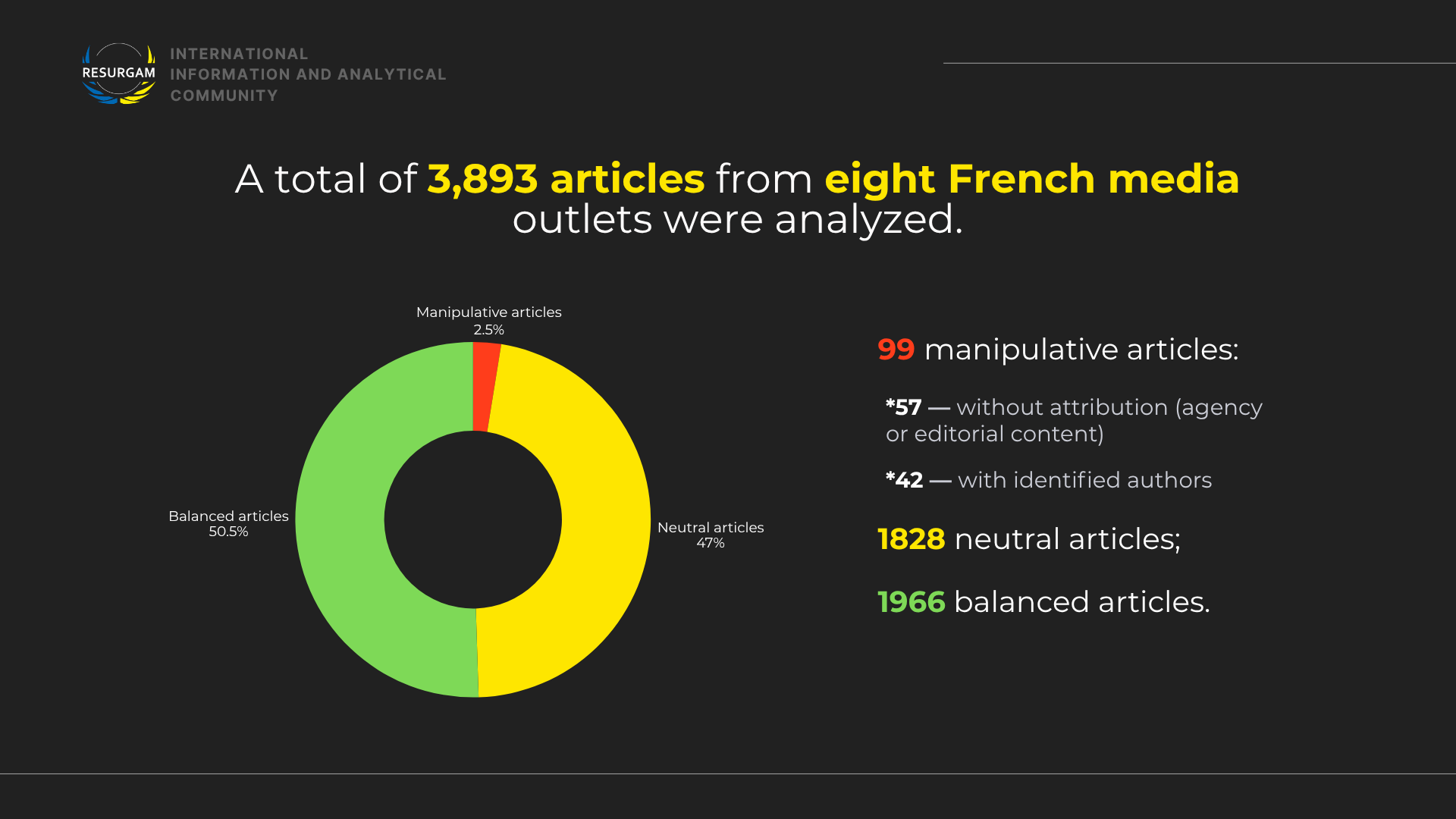 Classification of the Analyzed Articles According to the Research Methodology
Overall, only 2.5% of the analyzed articles (99 out of 3,893) were classified as belonging to the red category. These articles contained serious violations of journalistic standards, including manipulation, distortion, and the misrepresentation of cause-and-effect relationships. In such publications, the topic of Russia’s invasion was covered in a manipulative manner, while pro-Russian narratives were promoted. It is important to note that 57 out of the 99 red-category articles were published either without attribution or as agency or editorial content.
Half of the analyzed articles (50.5%, or 1,966 articles) were classified under Resurgam’s methodology as belonging to the green category, meaning they provided accurate and balanced coverage of Russia’s invasion. The remaining articles (47%, or 1,828 articles) were assessed as largely compliant with journalistic standards, with only minor inaccuracies that did not affect the overall quality or objectivity of the coverage. Overall, French media outlets cover the Russia–Ukraine war in a generally accurate and reliable manner.
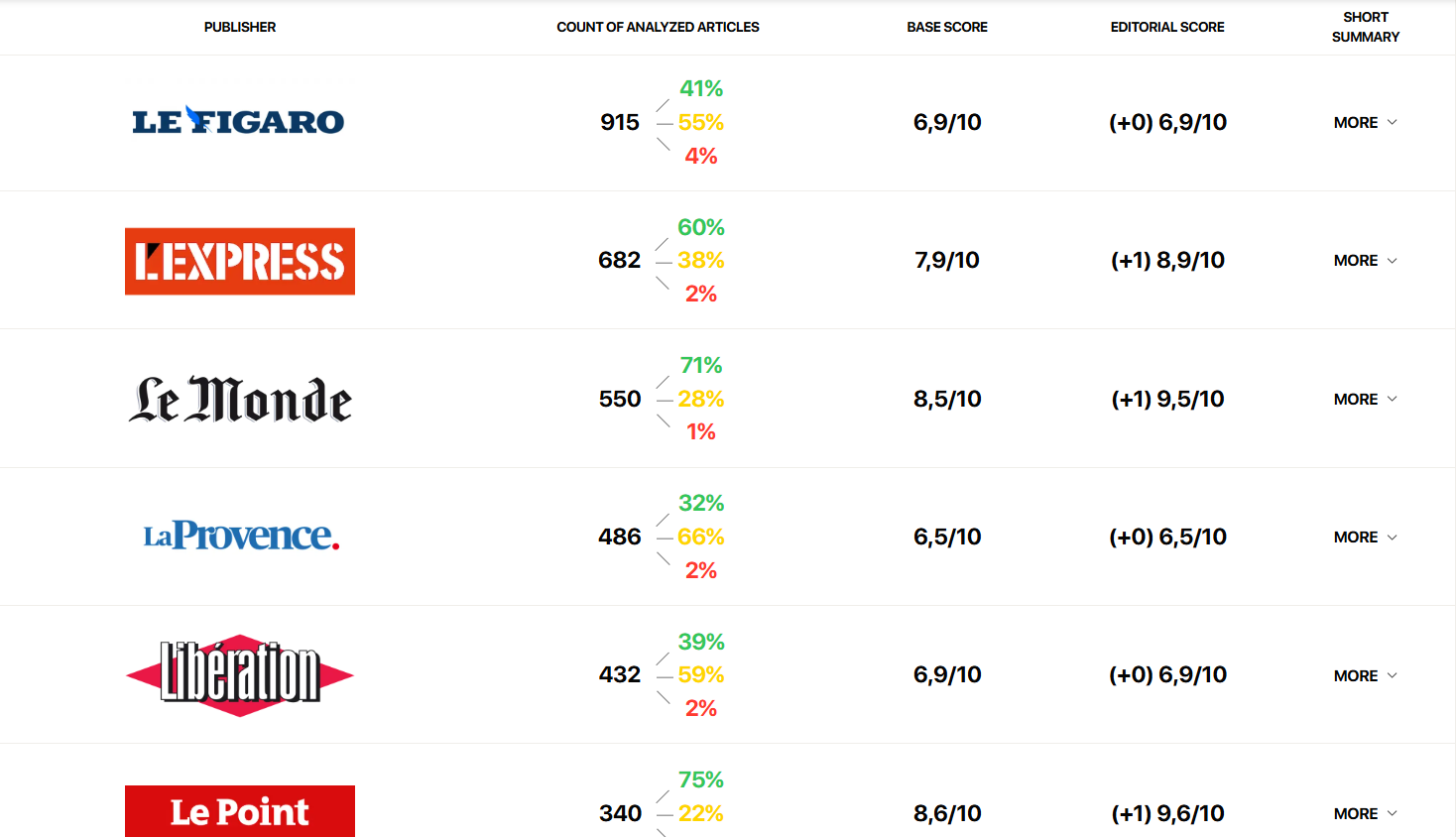
Half of the analyzed media outlets — namely Le Point, Le Monde, L’Express, and Le Nouvel Obs — received the highest assessment for the objectivity and reliability of their coverage of Russia’s war against Ukraine.
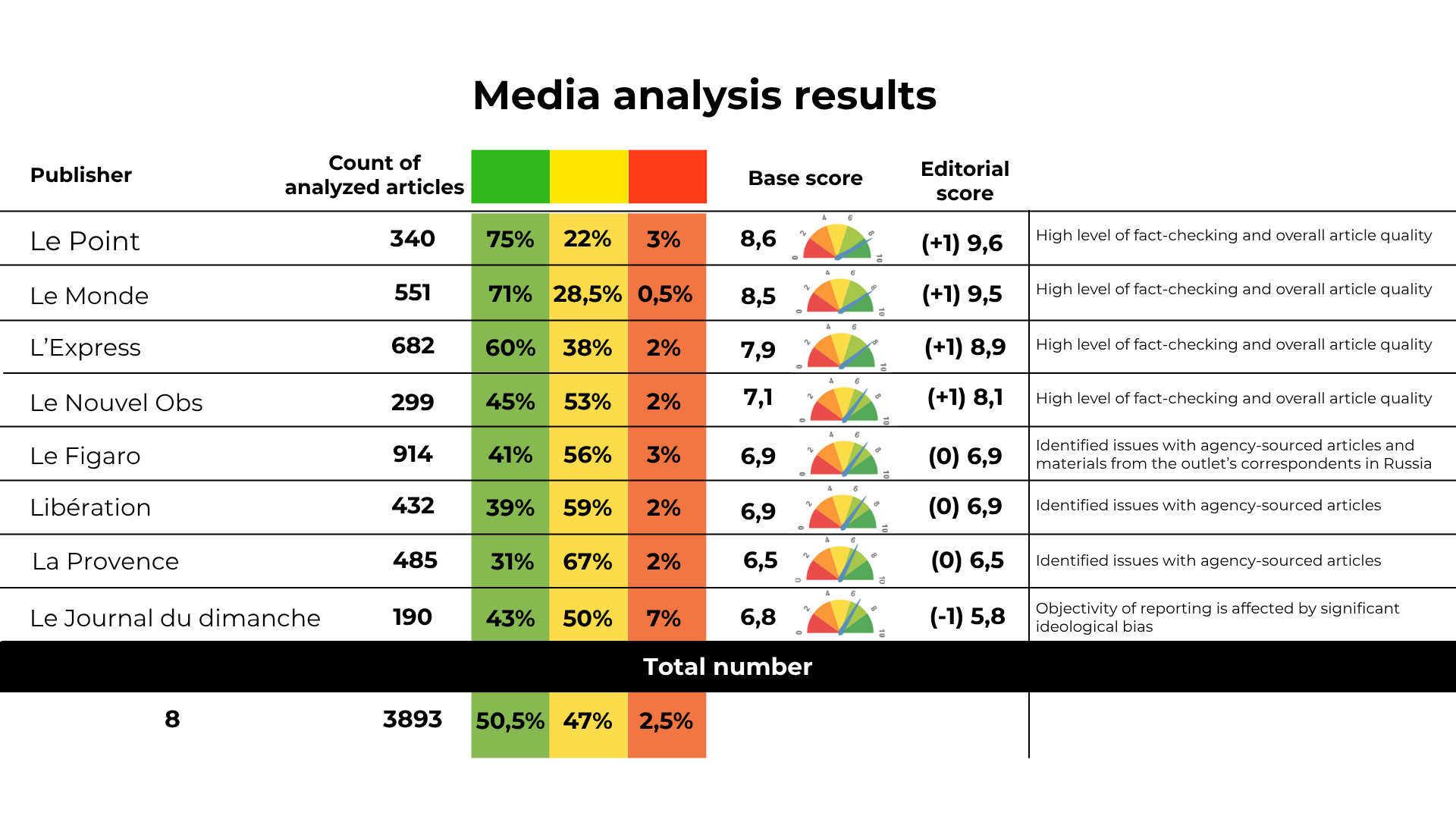 Ranking table of media outlets according to the study results
At the same time, the rankings of Le Figaro, Libération, and La Provence were downgraded due to the publication of content from international news agencies that was not accompanied by additional analysis or contextualization.
Such materials are based on reports from Russian news aggregators or official Russian state sources, and in some cases constitute their direct reproduction. In particular, this refers to publications by the Agence France-Presse that include statements by Russian political figures or press releases from state institutions. As a result, not only is Russian disinformation and propaganda disseminated, but the Russian perspective is also presented as if it reflects objective reality, rather than the position of a state that initiated aggression against an independent country. It is important to note that the study does not assess whether the dissemination of Russian disinformation by media outlets was intentional or unintentional.
A similar issue arises in the publication of reports by media correspondents based in Russia without appropriate contextualization, in particular in Le Figaro. Freedom of speech in Russia is currently restricted by existing repressive legislation, which also affects foreign journalists and makes it impossible to report on events in an objective manner. For example, there is a requirement to use the term “special military operation” instead of “Russia’s invasion of Ukraine,” among others, which also contributes to the dissemination of Russian disinformation and propaganda, while the Russian perspective is presented as if it reflected objective reality, rather than the position of a state that initiated aggression against an independent country. We recommend labelling such texts and comments as content produced under coercion.
It is important to note that the key issue does not lie in the use of materials from news agencies per se, but rather in the absence of editorial context. As a result, such texts may be perceived by audiences as editorial content that complies with media standards, while in fact they reproduce Russian narratives.
At the same time, Le Journal du Dimanche demonstrated the lowest level of objectivity and reliability in its coverage of Russia’s war against Ukraine. Its ideological bias (the outlet has a far-right political orientation) affects the objectivity of its reporting and places it at the bottom of the ranking.
Based on the results of our study, we compiled a list of authors who report on Russia’s invasion in breach of journalistic standards and deliberately distort facts, thereby contributing to the spread of Russian disinformation and propaganda in Europe.
| First name, last name | Number of analyzed articles and overall assessment (maximum score: 10) | Comment |
|---|---|---|
| Régis Le Sommier | 14 articles, of which 7 are yellow and 7 are red. Overall rating: 2.5. | The author presents a one-sided portrayal of the Russian–Ukrainian war in favor of Russia and attempts to justify Russia’s invasion of Ukraine. He reproduces pro-Russian narratives, such as describing the conflict as a civil war (in particular by using terms like “pro-Russian autonomists” and “pro-Russian separatists” instead of “pro-Russian collaborators”), as well as claims that Russia and Ukraine are “brotherly nations,” that Ukraine is a puppet of the United States, and that neo-Nazi views are widespread in Ukraine. The author also opposes European, including French, military support for Ukraine, incorrectly arguing that it may lead to World War III. |
| Alain David Pierre Barluet | 25 articles: 2 green, 17 yellow, and 6 red. Overall rating: 4.2. | The author regularly visits Russia-occupied territories of Ukraine and, in his articles, uses the voices of ordinary people to legitimize the Russian occupation administration and promote Russian narratives, such as the belonging of the occupied territories to Russia, the satisfaction of local residents with this situation, and their fear of Ukraine’s return. |
| Julian John Colling | 3 articles: 1 yellow and 2 red. Overall rating: 1.7. | The author promotes Russian narratives such as the presence of Russophobia in Ukraine, while simultaneously emphasizing the Russian-speaking population in Ukraine. Thus, he probably attempts to justify Russia’s invasion. The author also seeks to humanize Russia through the presentation of personal experience and, in his texts, distorts cause-and-effect relationships. |
| Vincent Hervouët | 4 articles: all red. Overall rating: 0. | In his articles and podcasts on the war between Russia and Ukraine, Hervouët stands out for his pessimistic assessments: he frequently emphasizes that European leadership has failed and that hopes for the full liberation of Ukrainian territories are an illusion. In a number of columns, he criticizes authoritarian tendencies of President Zelensky and stresses that negotiations with Russia are inevitable. |
| Laeticia Strauch-Bonart | 1 article: red. Overall rating: 0. | The author conducted an interview with British national Owen Matthews, who participates in Russian propaganda-related information events, during which the journalist promoted Russian narratives about Russophobia in Ukraine and nationalism (in a negative connotation). When the speaker equates Russian-speaking Ukrainians’ switch to Ukrainian language with Russophobia and nationalism, she does not respond. Although, as an author of books on conservative ideologies, she is expected to understand that these are unrelated phenomena, and that negative attitudes toward the Russian language are a consequence of the Russian invasion. The author also leaves without comment the speaker’s expressions of disrespect for Ukraine’s territorial integrity and his justification of Russia’s attack on Ukraine. |
| Pierre Lellouche | 1 article: red. Overall rating: 0. | The author attributes responsibility for the war to Europe rather than Russia, portrays Ukraine and the EU as lacking agency, overestimates Russia’s military capabilities while simultaneously downplaying Europe’s strength, and advocates against providing weapons to Ukraine. Given that Pierre Lellouche is a well-known French politician and member of parliament, as well as a former Secretary of State in the governments of François Fillon, presenting his position without appropriate editorial commentary may have a significant impact on French society. |
| Anne Nivat | 2 articles: red. Overall rating: 0. | The journalist has repeatedly visited the occupied territories of Ukraine. In her articles, she promotes the narrative that Ukrainians do not care which flag they live under, removes responsibility from Russia for the invasion, and contributes to the legitimization of the occupation authorities. |
| Julien Chabrout | 3 articles: 2 green and 1 red. Overall rating: 6.7. | The author shifts responsibility for the war from Russia to Ukraine, distorts cause-and-effect relationships, and presents events exclusively from a Russian perspective. |
| Stanislas Poyet | 11 articles: 5 green, 4 yellow, and 2 red. Overall rating: 6.4. | Despite being a correspondent in Ukraine, the author does not have a full understanding of Ukraine’s domestic political context. The journalist attempts to normalize the issue of draft evasion in Ukraine’s defense forces by presenting it in a one-sided way, while ignoring the fact that Ukraine is at war due to Russia’s invasion and must defend itself against Russian aggression. The author also has a limited understanding of Ukraine’s church and religious context and therefore accuses Ukraine of attacks on the Ukrainian Orthodox Church of the Moscow Patriarchate. |
The international information and analytical community Resurgam continues its study of the quality of coverage of the Russian–Ukrainian war in prominent media outlets across several European countries, which it began in 2025. The study is planned to include media outlets in Germany and the United Kingdom.
The Resurgam methodology includes three levels of article assessment. The first level is a cross-evaluation of texts conducted by Resurgam volunteers according to predefined criteria, including adherence to basic journalistic standards and compliance with international law (in particular, condemnation of Russia’s invasion of Ukraine and recognition of Ukraine’s independence and subjectivity). The evaluation uses the following categories: “green” (constructive coverage of events, correct structure, and compliance with journalistic standards), “yellow” (the article generally complies with standards, while minor inaccuracies or violations do not affect its overall quality and objectivity), and “red” (serious violations of journalistic standards, including manipulation, distortion, and distortion of cause-and-effect relationships).
The second level involved the preparation of dossiers on article authors by Resurgam experts, including an examination of the authors’ backgrounds, an assessment of the consistency of other potentially provocative publications outside the scope of the study, an analysis of contacts, and verification of possible links to Russia and levels of bias.
The third level consisted of external peer review (without the involvement of Resurgam representatives) of articles by members of academic journalism, editors-in-chief of Ukrainian media outlets, experts in fact-checking, political psychology, and other fields.