 INTERNATIONAL
INFORMATION AND ANALYTICAL
COMMUNITY


+ Join
Support INTERNATIONAL



Mykyta Laktionov, Deputy Chair of the Board of the Alliance for the Recovery of Ukraine, Member of the Youth Council under the Ministry of Recovery, Infrastructure and Transport of Ukraine. Master’s degree in International Relations, PhD candidate in Political Science.
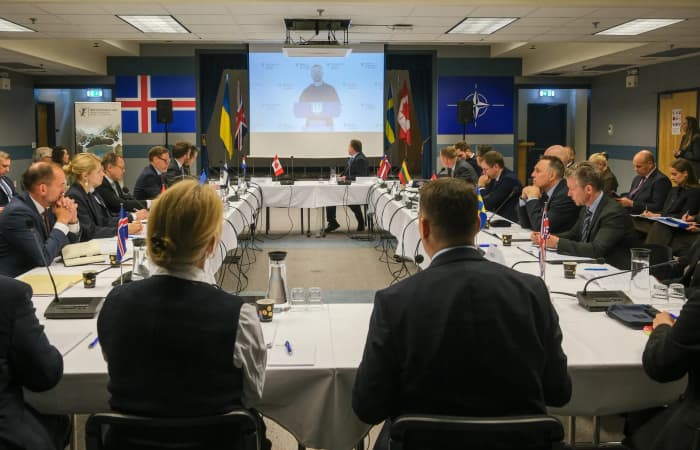 Ministers of Defence of the Joint Expeditionary Force (JEF) during a meeting with Ukraine’s Minister of Defence, Yevhenii Khmara. Source: Ministry of Defence of Ukraine
None of these initiatives was part of a coordinated plan. They emerged in response to specific incidents. But taken together, they are already forming the foundation of what may be called a functional security architecture for NATO’s eastern flank, with Ukraine seen as one of its sources of technology and expertise.
The traditional reliance on NATO and Article 5 of the Washington Treaty, which served as a guarantee of stability for decades, has clear limitations in the face of intense grey-zone conflicts and hybrid threats.
The Washington Treaty is formally designed to address a conventional armed attack — a situation in which an act of aggression can be clearly established and a collective response can be launched. But for the past three - four years have brought a very different type of threat: drone and missile debris regularly falling on the territory of Romania, Poland and Latvia; drones violating national airspace without being officially intercepted; electronic warfare targeting civilian aviation; and acts of sabotage and undersea cable disruptions in the Baltic with no perpetrator identified.
These make it necessary to develop more flexible response mechanisms. The need to reach political consensus among all 32 NATO members creates a dangerous gap in the Alliance’s response, leaving frontline countries to fill it on their own.
InIn September 2024, the defence ministers of Romania, Poland and Latvia signed a joint letter to NATO demanding the urgent strengthening of its eastern flank and the introduction of a rotational air defence model. The fact that three allies had to send such a letter outside NATO’s formal structures shows how slowly the consensus-based decision-making process works. Photo: Getty Images
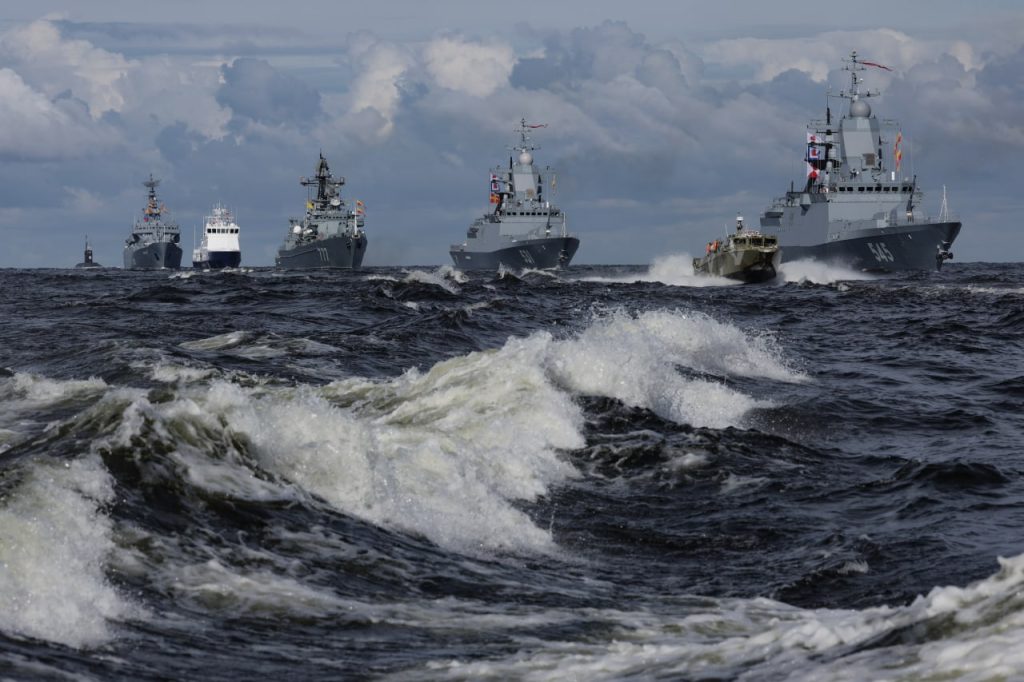
The clearest example is the Mine Countermeasures Black Sea Task Group (MCM Black Sea TG), established by Türkiye, Romania and Bulgaria in January 2024 in response to the threat posed by drifting mines.
Over the two years since its establishment, the group has been activated eleven times. Command rotates every six months among the three navies, and at the NATO summit in Ankara in July 2026, its mandate was expanded from mine clearance to the protection of critical undersea infrastructure, including energy cables and pipelines, such as those serving Romania’s Neptun Deep offshore gas project.
The threat became clear in August 2026, when Romanian forces detected Russian Gerbera drones drifting in Romania’s exclusive economic zone, just a few hundred metres from the Neptun Alpha gas platform. F-16 fighter jets and military divers had to be deployed to destroy them.
Since 2024, the group has also neutralised more than 150 drifting mines along routes used for most of Ukraine’s agricultural exports.
Ukraine is not formally a member of MCM Black Sea. Türkiye’s defence minister stressed that the mine countermeasures initiative would be open only to vessels from the three allied coastal states. In effect, this ruled out the participation of other NATO countries in mine clearance to avoid violating the 1936 Montreux Convention, which regulates passage through the Bosporus and Dardanelles during armed conflicts.
The effectiveness of Western deterrence in the Black Sea is severely constrained by international maritime law, particularly the 1936 Montreux Convention. Adopted under very different geopolitical circumstances, the convention remains a key instrument governing the balance of power in the region. In late February 2022, Türkiye invoked Article 19 of the convention, recognising the state of war between Ukraine and Russia and prohibiting warships belonging to the belligerent parties from passing through the Bosporus and Dardanelles.
This move had a dual effect. On the one hand, it made it impossible for Russia to reinforce its Black Sea Fleet with ships from the Mediterranean Sea or the Pacific Fleet, which strategically helped Ukraine defend the Odesa coastline. On the other hand, Ankara implemented the so-called “Montreux Plus” format — an informal arrangement that extended the ban on the passage of warships belonging to NATO member states that do not border the Black Sea. Türkiye justifies this by its desire to avoid escalation and prevent the Black Sea from becoming an arena for direct confrontation between Russia and the Alliance.
The US and other allies have repeatedly tried to persuade Ankara to adopt a more flexible interpretation of the convention to ensure freedom of navigation, particularly to protect commercial shipping routes. However, Ankara firmly rejects any attempts to revise the convention, viewing it as a cornerstone of its national sovereignty and regional influence.
This legal and political vacuum means that the world’s major naval powers will not step in to protect trade routes or Romania’s offshore infrastructure. Responsibility for Black Sea security rests entirely with the coastal states — Ukraine, Romania and Bulgaria. Under these circumstances, forming local military alliances becomes a matter of national survival.
A less obvious but more revealing example is Ukraine’s status in the Joint Expeditionary Force (JEF), a British-led coalition of ten Northern European countries established in 2015 outside NATO’s command structure.
JEF thus complements the existing Nordic Defence Cooperation (NORDEFCO), established in 2009. These are two key regional defence initiatives in northern and Euro-Atlantic Europe that closely complement each other and NATO.
The advantage of this format is that it does not require full consensus. For example, activating JEF forces requires the agreement of the framework nation and just one other participating country, allowing for a more flexible and rapid response than the cumbersome decision-making process of the North Atlantic Council. This is precisely the kind of autonomous and rapid response that the Black Sea needs.
In November 2025, Ukraine was granted the status of an “enhanced partner” of JEF, becoming the first non-member state to receive this status.
Ministers of Defence of the Joint Expeditionary Force (JEF) during a meeting with Ukraine’s Minister of Defence, Yevhenii Khmara. Source: Ministry of Defence of Ukraine
This is already a working model for what a “Black Sea JEF” could look like: a flexible format that does not require consensus among all 32 NATO members, with Ukraine as a technological and operational partner on the basis of mutual interest.
The idea of bringing together countries between the Baltic, Black and Adriatic seas is not new. In the interwar period, Józef Piłsudski promoted the concept of Intermarium — a defensive alliance against Russia and Germany that was also intended to include Ukraine. The modern iteration, the Three Seas Initiative, launched in 2015 by Polish President Andrzej Duda, is a very different project in its underlying logic: it is primarily an economic and infrastructure platform for twelve countries, with membership strictly tied to EU membership.
Ukraine is excluded for this very reason: from the outset, the initiative has been open only to EU member states. Although Ukraine’s deputy economy minister mentioned it in 2024 as a potential platform for reconstruction projects and insurance against war risks, there has been no tangible progress on Ukraine’s involvement. A direct comparison with the Three Seas Initiative therefore falls short: Ukraine cannot simply “join” it without first becoming an EU member.
Today, however, 3SI projects that were once justified purely on commercial or civilian grounds are increasingly viewed through the lens of military mobility and dual-use infrastructure. The ability to rapidly deploy heavy armoured formations, ensure the resilience of energy networks and protect digital infrastructure has become a critical element of deterrence on NATO’s eastern flank.
This transformation is laying the groundwork for the so-called “Eastern Shield of Europe” — a continuous anti-access and area-denial (A2/AD) zone stretching from the Baltic to the Black Sea and partly echoing the geopolitical concept of the Baltic–Black Sea axis. Poland and the Baltic states are already investing billions of euros in building physical and technological barriers.
In particular, Poland’s Eastern Shield programme (Tarcza Wschód), with a budget of around 10 billion zlotys ($2.5 billion), involves building a multi-layered system of anti-tank obstacles, minefields and sensor networks along the borders with Russia’s Kaliningrad region and Belarus. However, ground fortifications cannot stop aerial and hybrid threats, making technological integration with Ukraine’s defence industry an indispensable necessity for Central and Eastern European countries.
A separate, and perhaps the most tangible, dimension of this cooperation is the “Danish model” of direct funding for Ukraine’s defence industry. Over the past two years, Sweden, Norway, Iceland and Canada have joined the initiative, providing €588 million in arms deliveries in 2024.
More importantly, cooperation is moving towards joint production. In July 2025, Denmark’s Erma Group announced a partnership with Ukraine’s Odd Systems to develop a drone interceptor. In autumn 2025, Ukraine and France signed a letter of intent on the joint production of weapons both in Ukraine and in France. According to President Zelenskyy, joint defence activities are already under way with Türkiye, Romania, Poland and the United Kingdom.
More importantly, cooperation is moving towards joint production. In July 2025, Denmark’s Erma Group announced a partnership with Ukraine’s Odd Systems to develop a drone interceptor. In autumn 2025, Ukraine and France signed a letter of intent on the joint production of weapons both in Ukraine and in France. According to President Zelenskyy, joint defence activities are already taking place with Türkiye, Romania, Poland and the United Kingdom.
European governments are investing in Ukrainian production because it is cheaper and faster than rebuilding their own production lines. In return, Ukraine receives capital investment and access to Western markets and standards. It is a win-win arrangement: for allies, it offers a cheaper way to secure weapons production, while Ukraine serves as a kind of testing ground for technologies that Western militaries still have limited experience using.
This is the framework within which the idea of establishing Ukrainian defence production facilities in Romania or the Baltic states should be viewed: as a commercially and technologically viable exchange.
The development of the Eastern Shield cannot be analysed in isolation from the geopolitical and geoeconomic dynamics of the Black Sea region, where the Odesa port hub plays a strategic role. Since the start of the full-scale invasion, the deep-water ports of Greater Odesa (Odesa, Chornomorsk and Pivdennyi) have come under unprecedented pressure, forcing exporters to seek alternative routes. The blockade of traditional maritime routes has shifted the centre of gravity of global food logistics to the Danube Delta, towards the ports of Reni, Izmail and Kiliia.
This forced logistical shift has created a close interdependence between Ukraine and Romania, turning the Romanian port of Constanța into a critical transit hub for Ukrainian grain. However, in the second half of 2026, this logistical artery has faced a systemic crisis. Repeated strikes on port and energy infrastructure have pushed war-risk insurance premiums for civilian shipping in the Black Sea to 2% of a vessel’s value. For a typical bulk carrier worth $30 million, this means more than $600,000 in additional costs for a single port call, even before loading begins.The situation has been compounded by critical climate and infrastructure factors. A prolonged drought in the summer of 2026 led to record-low water levels on the Danube. Barges travelling to Constanța have been compelled to reduce their cargo loads, proportionally increasing the number of trips needed to transport the same volume of goods. This has caused congestion along river routes and sharply increased freight rates, which have doubled on some routes.
The Sulina Canal has become the bottleneck of the entire system. It is the main shipping route connecting the Danube to the Black Sea through Romanian territory. In late August 2026, up to 70–80 vessels were waiting to transit the canal. A shortage of pilots, restrictions on night-time navigation and the need to give priority to certain cargoes, such as fuel, reduced the canal’s capacity to just 2–3 vessels per day. Each day of delay (demurrage) costs charterers up to $8,000, making Ukrainian exports uncompetitive on the global market.
This infrastructure crisis is not solely a Ukrainian problem; it poses a direct threat to the European Union. The EU’s Solidarity Lanes initiative has enabled the export of more than 230 million tonnes of Ukrainian goods and facilitated trade worth over €300 billion.
A disruption to this system threatens to trigger global inflationary shocks in food markets. Recognising this risk, Ukraine, Romania and the European Commission have launched the PRIMUS project, aimed at introducing round-the-clock pilotage on the Sulina Canal and certifying Ukrainian pilots to operate in Romanian waters. Protecting and expanding the logistics networks of Greater Odesa and the Danube region is thus becoming a geostrategic imperative for the Eastern Shield, rather than merely a commercial task.
Romania has an opportunity to cement its status as a geopolitical anchor and the main logistics hub on NATO’s south-eastern flank. By establishing a joint anti-access and area-denial zone and integrating Ukrainian early-warning systems and maritime robotic platforms, Bucharest protects its own offshore projects and become a guarantor of stability in the cross-border Danube Delta.
Establishing Ukrainian defence companies on Romanian soil through technology-exchange agreements would create new jobs and significantly strengthen Romania’s own defence capabilities.
At the same time, Romania bears a disproportionate share of the impact of grey-zone conflict, which Article 5 of the Washington Treaty does not effectively cover. The regular fall of drone and missile debris on Romanian territory, along with the constant threat of asymmetric attacks on Danube-region logistics, requires Bucharest to make independent and rapid military decisions.
This creates a risk of local escalation, in which Romania may have to take decisive action without waiting for the lengthy process of reaching consensus among all 32 Alliance members.
As Poland develops its broader regional framework, it is becoming the dominant military power in Central Europe. Integration with Ukraine’s defence industry helps Warsaw address a critical problem facing European arsenals: the shortage and high cost of conventional weapons in the face of widespread hybrid threats.
By drawing on Ukraine’s ready-made defence algorithms and unique combat experience in countering UAVs, Poland is building an impenetrable land-based component of the Eastern Shield that can operate quickly and independently, cementing its role as a key US ally in the region.
However, this ambitious role makes Poland a primary target for Russian kinetic and hybrid pressure, as incidents involving falling drone and missile debris have already become a reality for the country. By taking on the role of the main military buffer, Warsaw already risks facing hostile use of electronic warfare systems in its border areas.
Poland is also compelled to invest enormous sums in defence, knowing that if the grey zone is breached, a political vacuum within NATO could turn its territory into a battlefield.
For the Baltic capitals, joining an updated eastern defence framework is a matter of existential survival and deeper strategic integration. At a time when Article 5 does not cover incidents such as the recent crashes of military drones in Latvia, Ukraine provides them with proven countermeasures and ready-made defence procedures.
Localising Ukrainian defence production and establishing flexible regional pacts would enable them to respond to threats operationally, compensating for their limited strategic depth.
The main risk for the Baltic states lies in their extreme geographical vulnerability and direct borders with Russia and Belarus. Any local escalation, including the hostile use of electronic warfare, could paralyse their logistics, civil aviation, energy sector and economy as a whole before the wider Alliance can overcome its internal consensus deadlock and decide to intervene.
Northern Europe can build on the successful frameworks of the Joint Expeditionary Force (JEF) and Nordic Defence Cooperation (NORDEFCO) to integrate Ukrainian technologies into the protection of its critical underwater infrastructure. As Europe’s defence industry struggles to provide affordable solutions to asymmetric threats, the expansion of Ukraine’s mil-tech sector offers the Nordic countries a mutually beneficial exchange: they fund innovation and, in return, gain detection and interception systems that fill gaps in their own costly conventional arsenals.
At the same time, the region’s substantial financial resources and political will create highly favourable conditions for the large-scale adoption and deployment of Ukrainian military technologies, opening up new strategic opportunities both to attract investment and to strengthen Ukraine’s sovereign defence industry.
However, deeper integration requires the Nordic countries to act pre-emptively and take responsibility beyond NATO’s bureaucracy. There is a risk that Russia will make more aggressive use of its ‘shadow fleet’ and carry out underwater sabotage in the Baltic and North Seas. Northern Europe would then find itself at the centre of an exhausting hybrid maritime conflict that it would have to defend against using its own capabilities, without relying on Article 5 mechanisms.
Bulgaria stands to gain significant advantages from a hypothetical trilateral agreement on the joint protection of trade routes in the western Black Sea. Since the Montreux Convention restricts the entry of Alliance forces from outside the Black Sea region, integrating Sofia into a joint A2/AD network with Ukraine and Romania through unmanned systems would allow Bulgaria to turn its relatively small fleet into a modern technological force. This would ensure the stability of their maritime corridors and the development of port infrastructure.
However, this carries significant domestic political risks for Bulgaria. The country has historically been vulnerable to Russian information influence and political polarisation. Openly joining a military pact without the direct involvement of the US or major European powers would make Bulgarian infrastructure a target for asymmetric Russian attacks, to which Sofia may not be institutionally prepared to respond firmly.
For Georgia, the development of the Eastern Shield architecture represents a potential window of opportunity to break free from its geopolitical trap, drawing on Ukraine’s success in ensuring the security of shipping in the Black Sea.
Participation in informal intelligence-sharing pacts and technological partnerships could help Tbilisi partially restore its maritime surveillance capabilities using low-cost Ukrainian robotic systems, bypassing politically sensitive issues and complex bureaucratic procedures associated with formal NATO membership.
However, this course carries existential risks for Georgia. Without any guarantees, not even those provided by Article 5, any closer alignment with a Ukrainian-Romanian-Bulgarian military framework could provoke Russia into an immediate pre-emptive strike, whether kinetic, economic or hybrid.
The Kremlin fully understands how cumbersome consensus-based decision-making among Western allies can be, leaving Georgia at risk of facing the aggressor alone before the new frameworks become fully operational.
To firmly establish itself as an indispensable security provider and a frontline state that protects European societies through preventive action, Ukraine needs to implement the following elements of a proactive model:
Miltec expansion
Ukraine needs to move from one-off procurement to the systematic establishment of Ukrainian defence production facilities in neighbouring countries on mutually beneficial terms. We should offer comprehensive packages: sharing expertise in developing strike drones, autonomous platforms and dual-use technologies in exchange for production capacity, lower tax rates (technological barter) and deeper integration into European value chains.
Initiating a Black Sea expeditionary framework
Building on successful European defence frameworks such as JEF and NORDEFCO, Ukraine must propose the creation of an autonomous military alliance for the Black Sea, capable of acting independently and swiftly. This framework must allow a coalition of the willing to make immediate decisions on intercepting hybrid threats at sea and in the air, without having to wait for political consensus among all 32 NATO members.
Establishing a cross-border A2/AD network
Kyiv must initiate the creation of a joint anti-access and area-denial (A2/AD) zone. In practice, this means integrating Ukrainian early-warning systems and maritime and ground-based robotic systems into a shared network with Romania and Bulgaria.
Formalising a pact to protect logistics and trade routes
A trilateral agreement must be concluded to jointly protect trade routes in the western Black Sea and the cross-border Danube Delta. A broader agreement involving the Baltic states and Poland should also be developed, allowing the wider shield to stretch from the Balkans to the Baltic.
Exporting grey-zone countermeasures
Drawing on its unique experience in maritime drone warfare, Ukraine must offer its neighbours ready-made defence procedures. These should include approved protocols for neutralising drones in civilian airspace, countering hostile electronic warfare and protecting critical logistics hubs from asymmetric sabotage.
Building the macroeconomic foundations of security
Defence initiatives must be firmly tied to reconstruction plans. The physical protection of logistics corridors in the Danube region and Greater Odesa is a fundamental prerequisite for stability and investment, ensuring protection against asymmetric attacks. Establishing a local regulatory framework would prevent Russia from reasserting its dominance during operational and tactical pauses.
Transformation of strategic communications
At the diplomatic level, the narrative must change. Ukraine must be positioned as a country offering a practical partnership stretching from Poland and the Baltic states to the Balkans, helping address the European defence industry’s critical shortage of conventional weapons and their high cost in the face of widespread asymmetric threats. By translating its combat and technological experience into geopolitical influence, Ukraine protects European countries against Russian aggression and interference.
Building a new security architecture on Europe’s eastern flank requires moving away from abstract political declarations and towards scaling up existing, specialised military instruments that are already working. Rather than attempting to revive historical concepts such as Intermarium, which are traditionally paralysed by a lack of consensus among their own participants, the focus must be on expanding the mandates of MCM Black Sea, particularly in protecting critical infrastructure; extending partnerships based on the JEF model; integrating into European structures such as FINABEL and OCCAR; and developing a network of bilateral defence-industrial agreements.
The legal and institutional formalisation of these frameworks and the local regulatory framework is necessary now, without waiting for the global conflict to end. This is the only way to close the window of vulnerability, prevent Russia from attempting to reassert its dominance during operational and tactical pauses, and ensure the stability of critical transport corridors.
Within this framework, Ukraine fundamentally transforms its role. By translating its combat and technological experience into geopolitical influence, the country establishes itself as a security provider and a frontline state that proactively protects European societies from the spillover of Russian aggression through hybrid means.
However, this symbiosis will be sustainable not because Kyiv has selflessly taken on the burden of the Eastern Shield, but solely because it rests on a pragmatic balance of interests. Ukraine provides a unique asset: specific defence procedures, datasets and production facilities that fill its allies’ technological gaps, creating a robust deterrence architecture without the bureaucratic delays of the wider Alliance.
You may be interested