 INTERNATIONAL
INFORMATION AND ANALYTICAL
COMMUNITY


+ Join
Support INTERNATIONAL



Vitalina Mirko, analyst specializing in the EU and Northern Europe.
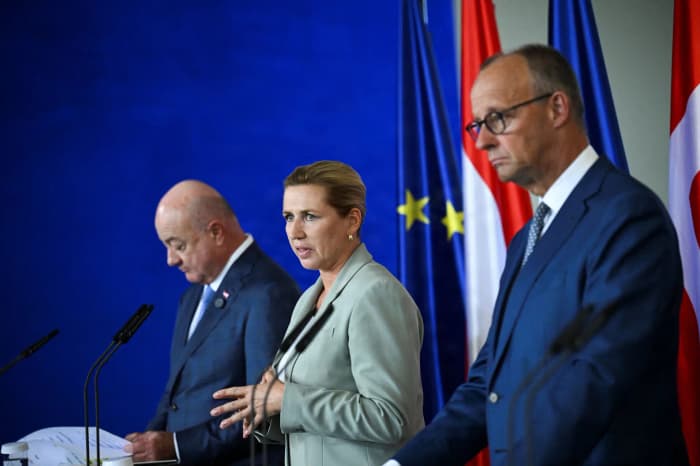 Austrian Chancellor Christian Stocker, Danish Prime Minister Mette Frederiksen and German Chancellor Friedrich Merz during a press conference in Berlin on 27 August 2026. Annegret Hilse/Reuters. Source
Earlier, on 28 September, ahead of the meeting, the leaders of six so-called “frugal” countries — Germany, Austria, the Netherlands, Denmark, Sweden and Finland — sent a letter to Irish prime minister Micheál Martin and European Council president António Costa, demanding cuts of several hundred billion euros to the budget. On 10 October, Ireland proposed reducing the European Commission’s draft budget to €1.8 trillion, but the six countries deemed this insufficient. Thus, it is improbable that Ireland’s proposal will be adopted without substantial amendments.
We examine the “frugal” countries’ position and whether the proposed budget changes will affect Ukraine.
The demand for cuts to the budget, specifically the multiannual financial framework (MFF), is nothing new. Back in June 2026, Cyprus, which held the presidency of the Council of the EU at the time, proposed cutting the Commission’s draft by 2%, or €32.8 billion. However, this proposal does not satisfy the group of “frugal” countries.
At a meeting of the six countries in Berlin on 27 August, German Chancellor Friedrich Merz said that the Commission’s proposal “simply does not reflect the times we live in”. The Frugals demand cuts to spending across all areas of the EU budget, while placing greater emphasis on defence and security, competitiveness, innovation and tackling illegal migration. This means that less funding may be available for agriculture and regional policy, which traditionally account for the largest share of the budget.
Germany, Austria, the Netherlands, Denmark, Sweden and Finland, which account for 40% of EU member states’ contributions to the EU budget, oppose joint borrowing to finance the budget. Joint borrowing means that the EU takes out loans on financial markets on behalf of all member states, which must later be repaid from the budget, primarily at the expense of the largest contributors.
Ireland’s proposal provides for cuts to funding for precisely the areas that the six countries want to strengthen. Dublin has proposed making the largest cuts to the “new priorities”, namely budget headings covering spending on competitiveness, defence and foreign policy, while making smaller cuts to spending on agriculture and cohesion policy.
Spain, Italy and Poland oppose major cuts to the EU budget because they want to preserve funding for cohesion policy — investments in regional development, transport and infrastructure. These countries are part of the “Friends of Cohesion” group, which defends spending aimed at reducing economic disparities between regions and supporting their development. Spain has also proposed extending the repayment period for pandemic-related debt, which would free up around €70 billion, and promotes a new joint borrowing mechanism.
Denmark, Sweden and Finland support reducing the overall EU budget, but have different priorities.
Denmark has long been an advocate of a frugal EU budget. However, following Russia’s full-scale invasion of Ukraine, Copenhagen’s position became more flexible. In 2023–2024, Denmark supported an additional €50 billion for Ukraine under the existing budget. In late 2024, Mette Frederiksen stated that she saw no alternative to joint borrowing to finance Europe’s needs. Despite this shift in her position on borrowing, Frederiksen explicitly identifies defence, security and support for Ukraine as her priorities, while proposing to cut spending on agriculture instead.
Sweden takes the toughest stance among the Nordic countries. Back in April, Prime Minister Ulf Kristersson stated that “there is no such thing as free money”. On 15 October, ahead of the summit, Kristersson called the Irish proposal unacceptable, saying that Sweden was “not an ATM for the EU”. The Swedish government wants a significantly smaller EU budget because the current proposal would increase Sweden’s contribution by more than 60%, according to the government’s estimates. At the same time, Kristersson has stressed that the next budget must prioritise Ukraine’s security, but without new European taxes or joint borrowing.
As for Finland, its minister for European affairs, Joakim Strand, described the Irish compromise as a step in the right direction ahead of the ministerial meeting on 13 October, but called for savings to be distributed more evenly across the entire framework. According to Strand, competitiveness is being cut too heavily. A key issue for Finland in these negotiations is funding for its eastern border. Since Finland closed its border with Russia in 2023, the cost of border security has risen due to growing security threats.
Finland proposes taking the length of the EU’s external borders into account when allocating funding. The Irish proposal partially addressed these concerns: a weighting factor of 1.25 was included in the funding allocation formula for border protection along the borders with Russia and Belarus. At the same time, Finland is open to supplementing the EU budget with certain new sources of revenue, including a carbon border levy and revenue from tobacco excise duties. Finland also supports Ukraine. At the meeting in Berlin, Prime Minister Petteri Orpo added that support for Ukraine would remain a key issue in the next budget.
Countries’ positions on the budget reflect their differing priorities. The main disagreement is therefore less about the overall size of the budget than about which areas should face cuts to fund those priorities.
You may be interested