


 INTERNATIONAL
INFORMATION AND ANALYTICAL
COMMUNITY


+ Join
Support INTERNATIONAL



Dmytro Ananiev, staff Analyst at the “Resurgam” Center for Western and Central European Policy
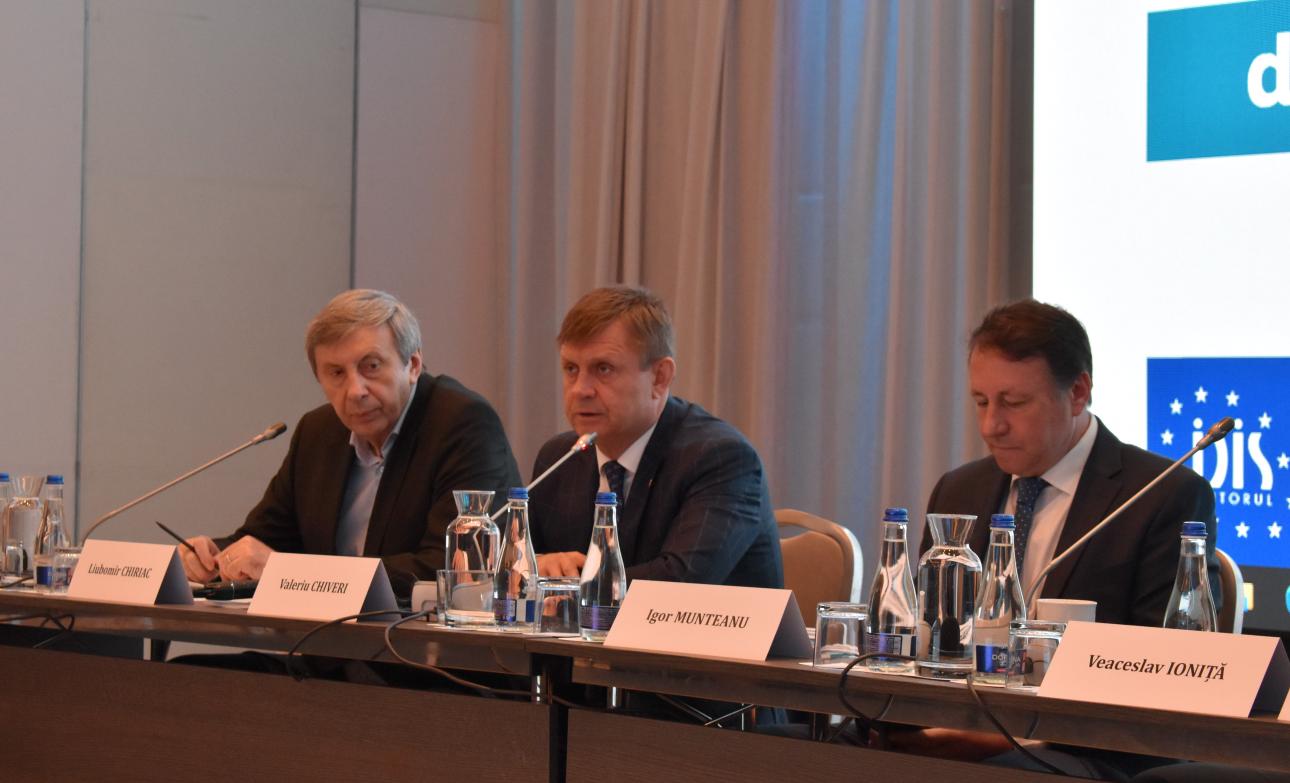 Moldova’s Deputy Prime Minister for Reintegration, Valeriu Chiveri, during the presentation of the study “The Transnistrian region in 2026: structural crisis, economic convergence and prospects for reintegration”. Source
Beyond using the OSCE as a mediator, Chisinau is gradually reintegrating Transnistria through practical measures. We examine how this process is unfolding and the role Moldova’s EU accession plays in it.
Previously, greater emphasis was placed on the idea that the parties could reach a political agreement through mediation by external actors. However, the last meeting in the “5+2” format, involving Moldova, Transnistria, the OSCE, Ukraine, Russia, the EU and the US, took place in 2019. The format was intended to establish the parameters for a final political settlement of the Transnistrian conflict. Since it effectively became defunct, the negotiation process has increasingly narrowed to direct “1+1” contacts and working groups. This prompted Chisinau to pursue a model of gradual reintegration without waiting for international mediation, placing greater emphasis on practical steps to bring the two banks of the Dniester closer.
Moreover, following the start of Russia’s full-scale invasion of Ukraine, negotiations on Transnistria’s reintegration accelerated significantly. In 2023, the Moldovan government identified the restoration of unified customs, tax, economic and education systems among its priorities.
Meetings in the “1+1” format continued until November 2024, when they were suspended for more than 15 months. Moldova and Transnistria resumed talks at chief negotiator level on 26 February 2026, apparently against the backdrop of the economic difficulties discussed below.
Since September, Chisinau has been encouraging businesses in the region to gradually adopt Moldova’s tax system, with the aim of bringing tax and customs rules on both banks of the Dniester fully into line by 2030. At the same time, Chisinau is working to extend Moldovan public services to the left bank, including support for Romanian-language schools and services such as pension payments and the issuing of driving licences and number plates. These measures make it easier for local residents to deal with the Moldovan authorities, while gradually making reintegration part of everyday life.
To support this approach, Moldova established an additional instrument in spring 2026: the Convergence Fund, which finances social and infrastructure projects in Transnistria. The fund receives contributions from external donors and revenue from taxes and excise duties paid by businesses in Transnistria.
Chisinau and the EU are also increasingly linking Transnistria’s reintegration to Moldova’s EU accession process. Chisinau has already presented its European partners with an informal document outlining the basic principles for gradually bringing the two banks of the Dniester closer and is working on its own reintegration plan.
Transnistria’s economic situation is deteriorating, with the region’s budget deficit in 2026 estimated at around 40% of expenditure.
When Russia halted gas supplies to Moldova in early 2025, the region was plunged into a severe crisis. Moldova and the EU stepped in to help address its humanitarian consequences. In effect, Russia left the region to fend for itself: without gas, Transnistria could not keep the Cuciurgan power station running or generate the electricity it had been selling to Chisinau.
At the same time, Transnistria’s economy is becoming increasingly oriented towards the EU. In 2021, the EU already accounted for around 55% of the region’s exports, but the war reshaped trade routes and tied Transnistrian businesses even more closely to the EU market through the EU–Moldova Deep and Comprehensive Free Trade Area (DCFTA). In the first half of 2026, the EU accounted for 76.9% of the region’s exports. Access to this market requires businesses to operate under Moldovan documentation, procedures and standards.
These economic benefits leave Transnistria’s political leadership with less room for manoeuvre, gradually making it harder to maintain the region’s previous model of economic separation and preserve the status quo. The result is a growing divide: Moscow retains political control over Tiraspol, while the region’s economy is becoming increasingly tied to Chisinau and the EU.
Russian troops remain stationed in Transnistria, and Moscow continues to use Russian citizenship and political influence to maintain its presence in the region. Meanwhile, Transnistria’s economic ties are increasingly centred on Moldova and the EU, and Russia’s ability to sustain the region’s former economic model has weakened. This creates more favourable conditions for Chisinau to pursue gradual reintegration, although tensions with Moscow over the region’s political status and security remain unresolved.
Chisinau is also pursuing a sustained effort to reduce Russia’s influence in Moldova as part of its broader push to loosen Moscow’s grip on Transnistria. This effort has gained momentum since Russia’s invasion of Ukraine. In February 2025, the Moldovan government initiated the closure of the Russian cultural centre, which Chisinau regarded as a tool of Russian political influence and information operations. In 2026, Moldova also decided to withdraw from the statutory bodies of the Commonwealth of Independent States (CIS), as we reported earlier.
By this point, Chisinau had already significantly reduced Moldova’s dependence on Russian energy supplies. Since 2022, the right bank of the Dniester has sourced its gas from European markets, including via Romania. Moldova’s connection to the European electricity grid in March 2022 also enabled it to increase electricity imports from Romania and other EU countries when needed. Meanwhile, Chisinau is developing new electricity interconnectors with Romania and deepening cooperation with Bucharest and Kyiv, including through the Odesa Triangle, which we have covered previously. These steps gradually reduce Moldova’s dependance on the Cuciurgan power station and other energy infrastructure in Transnistria.
Thus, Moldova builds up the resources and leverage it needs to gradually reintegrate the region without provoking a backlash from Moscow.
Ukraine also plays a distinct role in shaping the situation in occupied Transnistria. Following Russia’s full-scale invasion, Kyiv closed border crossing points along the Transnistrian section of the border, changing trade routes and pushing businesses in the region to rely even more heavily on Moldova and the EU.
For Ukraine, Transnistria remains a security concern along its south-western border. Around 1,500 Russian troops are stationed in the region, effectively cut off from reinforcements. With the Ukrainian border closed and Moldova controlling the de facto boundary on the other side, Moscow has no way to reinforce the contingent or rotate its personnel on a regular basis. Although these troops do not currently pose an independent threat of an advance on Odesa, their presence compels Ukraine to keep troops along the Transnistrian stretch of the border and account for this direction in its military planning.
At the same time, Ukraine supports the reintegration of Transnistria within Moldova’s internationally recognised borders and is deepening cross-border, transport and energy integration alongside Chisinau and Bucharest.
Rather than seeking a political settlement involving Russia and international mediators, Moldova is gradually reintegrating Transnistria by aligning the two banks of the Dniester in terms of taxation, customs, economic activity, social services and legal frameworks, while extending access to public services. At the same time, Chisinau is working to curb Russian influence, as Moscow has effectively abandoned the occupied region amid its war against Ukraine.
Reintegration is also increasingly driven by economic incentives. Chisinau is making it less attractive for Transnistria to maintain a separate economic and administrative system, while making access to Moldovan public services and markets, and through Moldova to the EU market, more attractive.
EU integration is also helping to speed up this process. Chisinau wants Moldova’s EU accession and Transnistria’s reintegration to move forward in parallel, with European rules and the benefits of future EU membership gradually extending to people on both banks of the Dniester.
At the same time, bringing the two banks of the Dniester closer together will strengthen Moldova’s role as a transport and energy corridor linking Ukraine, Romania and the rest of the EU.