 INTERNATIONAL
INFORMATION AND ANALYTICAL
COMMUNITY


+ Join
Support INTERNATIONAL



Mykhailo Mazur, Graduate of CEVRO University, Intern at the Resurgam Analytical Center
 Photo: dts Nachrichtenagentur/IMAGO
Taking into account that the party was founded by economics professors, its economic doctrine remains an important part of its platform and campaign promises. This article will analyze how this platform has evolved over the years, what it looks like today, what place Germany would occupy in the global economy according to the AfD’s vision, and whether such a vision is feasible at all.
From 2013 to 2015, the party was only beginning to develop, while the EU was in the midst of a crisis caused by the massive public debt of Southern European countries (Greece, Italy, Spain, and Portugal), as well as by the fact that eurozone countries pursued different fiscal policies. As a result, less developed economies could not address their deficits through the usual means, such as devaluation and printing their own money. At the time, the economically liberal right-wing party was focused on a single issue, with its political program centered on dismantling the eurozone and returning to independent national currencies. In the 2013 parliamentary election, the party failed to reach the mandatory 5 percent threshold for entering parliament.
In 2015, Germany admitted around one million migrants from the Middle East. Against this backdrop, the party’s leadership changed: national-conservative Frauke Petry replaced the ordoliberal professor Bernd Lucke as the party’s leader. Alongside this, the party’s focus also shifted from economic issues and Euroscepticism toward right-wing political issues, particularly dissatisfaction with the existing migration policy and the growing presence of Islam in Germany.
Under the leadership of Jörg Meuthen, the party secured 12.6% of the vote in the 2017 election, thereby securing seats in parliament for the first time. Migration and tighter border controls remained the main focus of its platform, but the party also returned to economic issues. Its demands for Euroscepticism and deregulation were joined by calls for the lifting of sanctions against Russia. The party argued that the sanctions and Russia’s countermeasures were primarily harming Germany rather than Russia, thereby hurting the very country that had imposed them.
The emphasis was placed on the export losses suffered by German manufacturers, particularly in the mechanical engineering and agricultural sectors, which had lost access to the Russian market, as well as on the interests of Germany’s eastern federal states and small and medium-sized businesses, for which trade with Russia had historically been more important.
In the 2021 election, the party’s main issues were criticism of the German government’s response to the COVID-19 pandemic, opposition to lockdowns, and the continuing focus on migration. Economic issues received minimal attention. Nevertheless, the party secured 10.3% of the vote.
However, the period after 2022 brought the economy back to the center of the AfD’s rhetoric. The party framed economic problems in terms of specific government decisions and foreign policy choices: it attributed rising prices to sanctions and the green transition, the budget deficit to migration, and deindustrialization to the abandonment of Russian gas. This framing did not require a coherent doctrine; a list of policies that should be reversed was sufficient.
The culmination came with the party’s 2025 election platform. Under Alice Weidel’s leadership, the party won 20.8% of the vote, followed later by the so-called Sofortprogramm, a list of measures that the party promises to implement immediately upon coming to power. It included the demand to free the economy from regulatory constraints evolved from a declaration of principle into a commitment to act on it immediately.
It is telling that this shift took place under the party’s dual leadership of Alice Weidel and Tino Chrupalla, which itself reflects the party’s internal duality: Weidel represents the market-oriented western wing, while Chrupalla represents the eastern party organizations, where social issues carry more weight than tax policy. Their re-election in Erfurt in summer 2026, in which Weidel strengthened her position while Chrupalla’s result declined, showed that the balance is shifting in favor of the western wing precisely as the party’s electoral support is becoming increasingly concentrated in the east.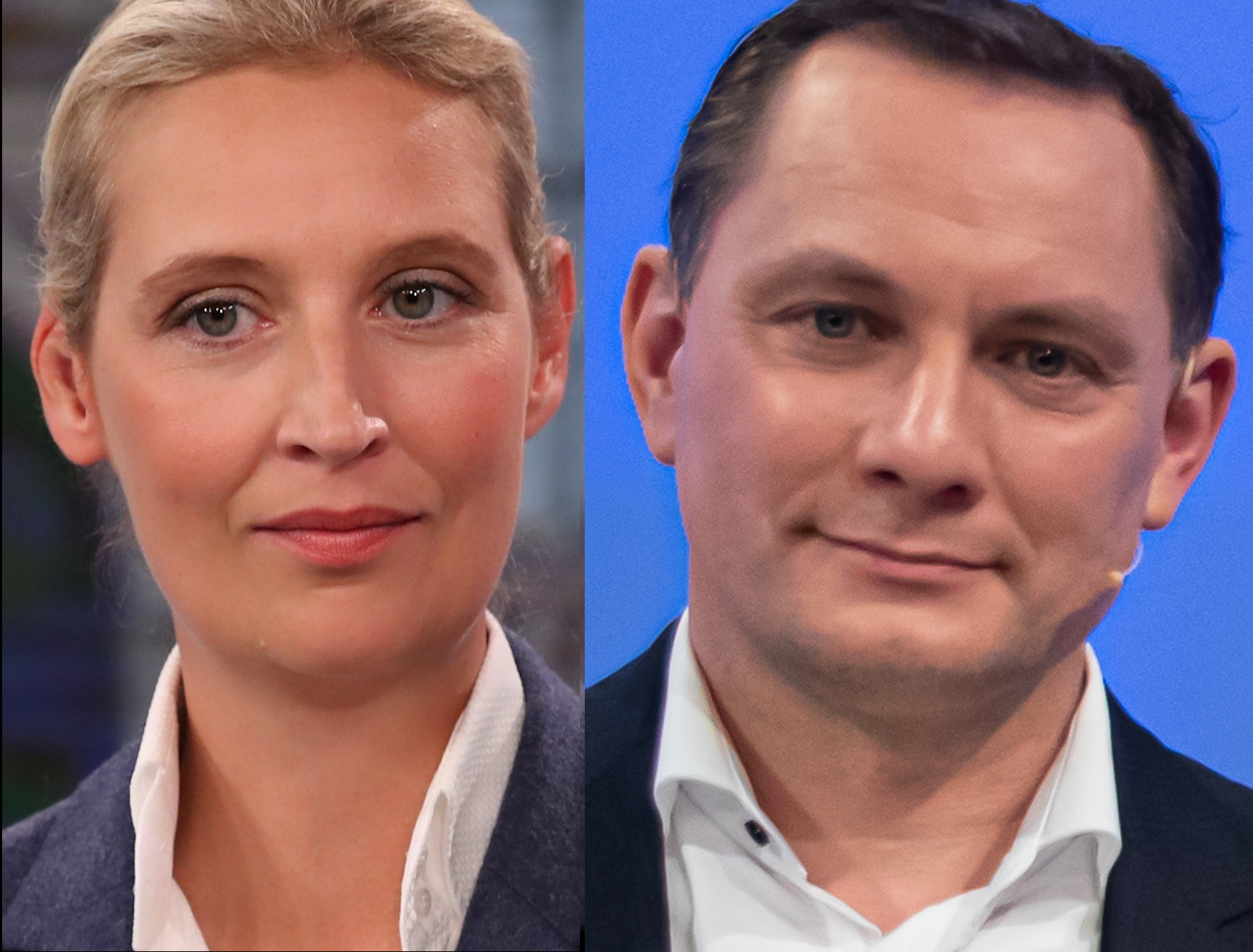 AfD party leaders Alice Weidel and Tino Chrupalla. Source
Taking into account that the most recent election was the party’s greatest success in its history, and that its platform appealed to the largest number of voters by focusing on social policy, taxation, migration, and energy, we will discuss each of these areas in detail below.
The AfD advocates the largest tax cuts, amounting to €181 billion, or around 20% of total tax revenue. At the same time, the party strongly defends the debt brake and voted against amending the Basic Law to establish an infrastructure fund in 2025. The combination of these two positions means that the program can only be implemented if spending is cut on a scale that the party nowhere specifies. The only spending item it explicitly identifies as a first target for cuts is social benefits for migrants, but according to the party’s own estimates, all expenditure on basic income support amounts to only around €51 billion per year. Even eliminating it entirely would therefore cover less than a third of the proposed tax cuts.
The relevance of such a proposal is explained by the state of the German economy, which has effectively not grown since 2022, and by the high cost of doing business, a concern frequently raised by small and medium-sized businesses. The issue is not limited to taxes but encompasses the combined burden of energy prices, labor costs, weak domestic demand, and regulatory uncertainty. Energy and raw material prices, in particular, moved to the top of the list of identified risks in mid-2026, driven upward by rising oil and gas prices.
What matters most, however, is that the niche of fiscal orthodoxy has been vacated by its traditional defenders themselves. The CDU went into the 2025 election promising to preserve the debt brake, yet just weeks later pushed an amendment to the Basic Law through the Bundestag that exempted defense spending from the restriction and established a €500 billion infrastructure fund. The Free Democrats, who had maintained a position of fiscal discipline for decades, failed to enter parliament. The Social Democrats, Greens, and Left openly advocate financing investment through borrowing.
As a result, voters believe the AfD when it promises to keep debt under control because no one else is making that promise anymore. But once this slogan is compared with the rest of the program, it falls apart: cutting taxes while simultaneously increasing pensions is possible only through the same borrowing that the party itself opposes. It is the slogan, rather than the program, that gives the AfD credibility, and the difference between the two will become apparent the moment the slogan has to be put into practice.
The AfD urges for pensions to be raised to 70% of the last net income. The party was inspired by the Austrian system, where pension expenditure amounts to around 14% of GDP, compared with approximately 10% in Germany, a difference of almost €100 billion per year. At the same time, the party opposes any increase in the statutory retirement age beyond 67 and demands that anyone with 45 years of contributions be allowed to retire early without deductions, which currently permanently reduce pension payments for each month of early retirement.
In an internal parliamentary group document from April 2026 outlining the party’s position on social spending, expenditure on basic income support was estimated at approximately €51 billion for 2026. The AfD constructs its argument in a way that frames the social problem primarily as a migration issue. In 2025, around 5.2 million people received Bürgergeld (citizen’s benefit), of whom approximately 46.8% were foreign nationals. Among foreign recipients, Ukrainians constituted the largest group, with more than 670,000 recipients. The demand to cut benefits is combined with classifying them as expenditure on migrants. Thus, reducing the welfare state is presented not as saving money at the expense of German citizens, but as restoring fairness for those who have paid contributions for years.
The problem is that the figures do not add up. Even eliminating basic income support for foreign nationals entirely would free up approximately half of the €51 billion, while the pension promise alone would cost more than €100 billion annually. The relevance of these promises is explained by the fact that the current coalition is moving in the opposite direction. The government commission on pension insurance reform is discussing raising the retirement age and reducing the replacement rate to around 46%, and it is against this backdrop that the demand for 70% sounds like a genuine alternative rather than a fiscal fantasy.
This is where the AfD’s platform is both the most specific and, at the same time, the least feasible: dismantling wind turbines (as a symbol of climate transition policy), returning to nuclear power generation, repairing and restarting Nord Stream 2, abolishing carbon pricing, and withdrawing from the Paris Agreement. The political appeal of these demands lies in the fact that the diagnosis itself is not a marginal one: high electricity prices for industry are identified as a problem by industry associations, economic institutions, and the government coalition itself. The difference lies in the mechanisms proposed to address it.
The party does not propose making the transition cheaper, but rather returning to the price structure that existed before 2022, based on cheap Russian gas and the former nuclear power plants. The problem is that neither source is available anymore. The reactors are being dismantled, expertise and fuel suppliers have been lost, while one of the two pipelines has been damaged and is subject to sanctions. This part of the platform is therefore not intended to be implemented, but to reinforce a convenient narrative in which Germany’s industrial decline is the result of specific political decisions that supposedly only need to be reversed.
Against this backdrop, the difference from the other parties becomes apparent. After 2025, the CDU–SPD coalition has already softened some of its policies and is calling for reductions in electricity taxes and industrial tariffs, moving in the same direction but within the framework of European climate policy. The Greens and the Left, by contrast, are calling for an accelerated transition and compensation for households to offset its costs. Despite their differing approaches, all of them are debating only how the transition should be carried out, while the AfD is the only party rejecting the need for the transition itself. This is precisely why its position cannot be translated into coalition negotiations even with parties that share its assessment of the state of the energy sector.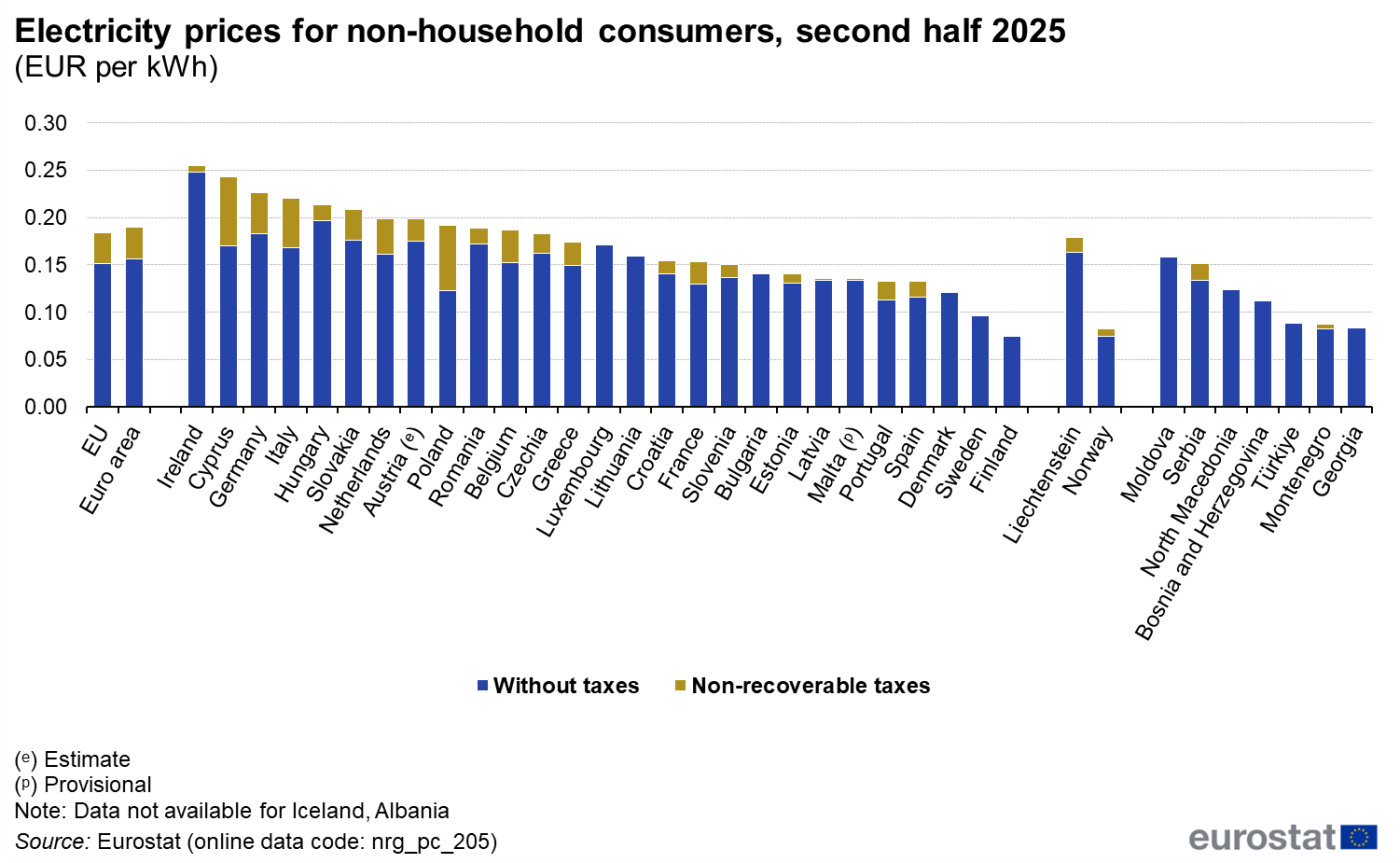 Electricity prices for non-household consumers in the EU. Source
The AfD is not an anti-military party. It urges for a substantial increase in the defense budget, the full equipment of the armed forces, and is the only party advocating the restoration of universal military service. It also urges for the creation of a German general staff and a separate military justice system. The party supports the defense of German territory and Germany’s obligations within NATO, while rejecting foreign missions, joint European defense structures, and military assistance to Ukraine.
This means that defense is the only area in which the party urges for increased government spending, and it is here that its fiscal framework ultimately falls apart. The €181 billion in tax cuts and more than €100 billion in pension expenditure mentioned above are joined by the cost of rearmament, all while the party declares its commitment to the debt brake. Significantly, the AfD voted against the 2025 amendment to the Basic Law that exempted defense spending from the debt limit, effectively opposing the only existing mechanism for financing this part of its platform.
The issue is particularly relevant because Germany plans to raise defense spending to 3.5% of GDP by 2029 and has returned to the debate over conscription. The party’s platform calls for universal military service, and support for conscription is among the highest among its voters. Politically, however, the AfD is campaigning against the government’s proposed model, claiming that conscripts could be sent to Ukraine.
This puts the party in an unusual position on the political spectrum. Typically, the debate over the military divides parties into two camps: those in favor of higher defense spending and those opposed to it. The CDU/CSU, Social Democrats, and Greens support rearmament, while the Left and the Sahra Wagenknecht Alliance oppose it. The AfD fits into neither camp. It is not pacifist, because it calls for a strong military, universal conscription, and a large defense budget, but neither is it militaristic in the sense associated with other advocates of rearmament, because it is categorically opposed to having the German armed forces operate abroad, participate in joint European structures, or support Ukraine.
What emerges is a distinct position that can most accurately be described as armed detachment: building up the military not to participate in the collective defense of Europe, but to keep it confined within Germany’s own borders.
Taking into account that the party emerged as Eurosceptic, its position on the EU has only become more radical over its 13-year existence. In its 2025 platform, one of its major strategic promises was to leave the EU. According to an IW study, the cost of a Dexit would amount to approximately 5.6% of GDP, or €690 billion over five years, along with 2.5 million jobs. It is important to remember that the IW study commissioned by a business initiative, bases its calculations on the British experience, and models a scenario that the party itself does not formally propose, since its platform urges for a referendum and the transformation of the EU into an alliance of nations rather than immediate withdrawal.
Supporters of withdrawal dispute such estimates and point to the British experience. They argue that the UK’s real GDP grew by approximately 6% from its pre-pandemic level at the end of 2019 to early 2026, compared with almost no growth in Germany, and therefore that leaving the EU does not in itself imply economic decline. But this argument is not flawless either. It compares the actual performance of two countries rather than with how the UK would have performed had it remained in the EU. According to CEPR, British GDP would have been 6–8% higher without Brexit than it is today. Moreover, Germany is significantly more dependent on the common European market and the euro than the UK once was on EU membership, so the British experience may only be applied to the German case with considerable limitations.
Withdrawal from the EU occupies a special place in the platform because it is the condition on which the feasibility of all the others depends. Every preceding promise, from abolishing carbon pricing to restoring energy imports and restricting social benefits based on citizenship, runs up against EU law. Withdrawal is the only solution that removes all formal and legal obstacles at once. In this sense, it serves the same function in the platform as migration does in the budgetary section: it provides a single explanation for all failures and a single solution to all challenges.
The demand has gained additional relevance from the broader shift in European political debate toward the language of sovereignty since 2024 and the weakening of the British example as a cautionary tale due to the considerable amount of time that has passed. At the same time, this is the only point in the doctrine on which the party diverges from its own electorate: polls consistently show that a majority favors remaining a member of the EU, even among AfD voters.
The AfD’s foreign policy vision is often analyzed in terms of the powers it favours, but an economic reading is more accurate. The concept of Germany as an axis between the United States, Russia, and China primarily represents an attempt to restore the cost structure that underpinned the German export model from the 1990s to 2022: cheap Russian energy on the input side, access to the Chinese market on the output side, and an exceptionally affordable American security umbrella. Every component of this arrangement is present in the party’s platform: lifting sanctions and restoring pipeline gas supplies, opposing European trade restrictions on China, and rejecting the EU’s common industrial and subsidy policies in favor of returning economic decision-making to the national level.
The position on the Middle East is structured somewhat differently. Its declarative support for Israel is combined with a rejection of any meaningful involvement, and the main motivation for this detachment is less economic than migration-related, since the party primarily views any instability in the region as a source of new refugee flows to Europe. Economic interests are also present, but they extend beyond supplies and ultimately come down to predictable oil prices and the security of trade routes.
The German industrial model was built on a combination in which energy was cheap, export markets were open, and security costs were minimal, with each of these conditions being provided from outside Germany. The AfD’s proposal is to restore these three conditions: lift sanctions because they have increased the energy component of costs; reject trade restrictions on China because they close off the export market; and withdraw from European and overseas security commitments because they shift external costs onto the German budget. This is where the party’s symmetrical distancing from all three centers of power, which it calls sovereignty, comes from.
The relevance of this approach is growing from two directions at once. Domestically, it is driven by the fact that the German economy has shown no growth for several years, while industrial companies have publicly attributed this to energy costs and the loss of the Chinese market. Externally, it is driven by the fact that the American security guarantee is no longer perceived as unconditional, while negotiations on ending the war have brought the issues of sanctions and energy ties with Russia back into the European debate. What was still a marginal position in 2022 is being discussed as a scenario in 2026, giving the AfD an opportunity to present itself as the party that simply said it earlier than everyone else.
For a quarter of German voters, the AfD’s promises look good on paper, but if the AfD were to come to power, putting them into practice could prove far more difficult.
The divergence between the AfD’s economic doctrine and Germany’s current economic model runs along three lines at once. The first is fiscal rules, where the party has remained a defender of the debt brake after the constitutional majority in 2025 exempted defense spending from the restriction and created a separate infrastructure fund. The second is climate policy, where the disagreement concerns the very rationale for carbon pricing and the relevant targets, and where the expansion of the European emissions trading system to transport and heating will make this issue tangible for households in the coming years. The third is the regulatory burden, ranging from the Supply Chain Act to paperwork for small businesses, and this is where the party’s position is closest to the mainstream, as complaints about bureaucracy come from industry associations, economic institutions, and the governing coalition itself.
Withdrawal from the EU is framed as a strategic goal without a deadline, tax cuts can be phased in over time, while the energy promises depend on physical infrastructure, and the previous government can always be blamed for the difficulties in delivering them. The pension promise is different, because it is the only one with a clearly defined group of recipients who will notice if it is not fulfilled in the very first year. A party whose eastern base consists to a large extent of people approaching or already at retirement age has made a commitment costing more than €100 billion a year, while simultaneously promising to reduce tax revenue by roughly one-fifth. Both cannot be fulfilled, and choosing between them would mean a split along the same lines that already divide the party geographically.
A significant part of the doctrine lies beyond the powers of the level of government that the party is actually approaching. Monetary, customs, and foreign trade policy are matters for the federal and European levels, meaning that a state government in Magdeburg or Schwerin would be unable to implement key elements of the platform even with full control over the state budget. At the federal level, the limits are set by directly applicable EU law, the emissions trading system, and the Union’s fiscal rules, none of which can be abolished by a national government acting alone.
This leads to a conclusion that helps explain the durability of this doctrine. It functions as a language of opposition precisely because it cannot be tested through implementation, and every obstacle to implementation would confirm its own claim that the German state lacks sovereignty. This is why the party is described as populist.
The question of what would happen if the AfD came to power is usually framed in terms of the 2029 federal election, but this is the most distant and least informative of the possible scenarios. It is more useful to distinguish between three scenarios according to their degree of plausibility.
The closest and most revealing test will come in autumn 2026, in federal state elections where the party is polling at around 40% in several eastern federal states. Control of a federal state government would mean having a real budget and real responsibility, but none of the tools the party has promised to use to fill that budget. A federal state government does not set taxes, determine migration policy, withdraw from the emissions trading system, or negotiate with Brussels. It allocates transfers, runs schools, police, and hospitals, and operates within the framework set by federal law. A party that has attributed all problems to external causes would, for the first time, find itself in a position where those causes have not disappeared, but responsibility for the outcome has become personal.
The second scenario, a federal coalition, remains improbable, and the reason is structural rather than electoral. The cordon sanitaire (Brandmauer) is a formal CDU decision dating back to 2018 that rules out cooperation with both the AfD and the Left, and its effect works both ways. It not only isolates the AfD but also deprives the Christian Democrats of mathematically straightforward options for forming a majority in the eastern federal states, while for the AfD itself it means that its entire coalition potential is effectively reduced to a single party. German society is not unanimous on this issue: roughly four in ten support completely ruling out cooperation, three in ten are open to considering it on a case-by-case basis, and around a quarter favor actively seeking common ground, meaning that the isolation is more a decision of party leaderships than a demand from the majority.
Yet even if we assume that this wall were to fall, a coalition with the Christian Democrats would not amount to implementing the AfD’s program. The two forces find common ground on only two issues—migration and limiting social spending for foreign nationals. And even here, some common ground is already being reflected in legislation without any coalition. On everything else, the CDU is a party that itself amended the Basic Law to establish an investment fund, remains committed to EU and NATO membership, and has no intention of returning to Russian gas or dismantling the climate policy framework.
This, in fact, is the main conclusion regarding the consequences. Coming to power would mean not the implementation of the AfD’s economic doctrine, but its dismantling. A coalition agreement, budgetary arithmetic, and EU law would force the party to choose between its own two halves: the western wing, which promises €180 billion in tax cuts, and the eastern wing, which promises pensions at 70% of the last income. No fiscal framework could accommodate both promises simultaneously, and choosing either one would mean losing part of the party’s support base. The only part that would remain intact would be the migration agenda—that is, precisely the part that requires no funding and is not economic in substance. In this sense, the doctrine is structured in such a way that being in government would do it more harm than remaining in opposition.
The third scenario is the most probable and the least discussed. The party may never come to power at all and still change Germany’s economic policy by forcing its competitors to move in its direction. This is already evident in migration legislation and in the gradual easing of climate policy measures, and this is where its real line of influence lies. The AfD’s economic doctrine is unviable as a government program, but entirely effective as a source of pressure, and it is in this capacity that it will influence decisions in Berlin in the coming years.
You may be interested