 INTERNATIONAL
INFORMATION AND ANALYTICAL
COMMUNITY


+ Join
Support INTERNATIONAL



Rostyslav Onyshchenko, trainee at the analytical center Resurgam in the field of Central and Eastern European countries analysis.
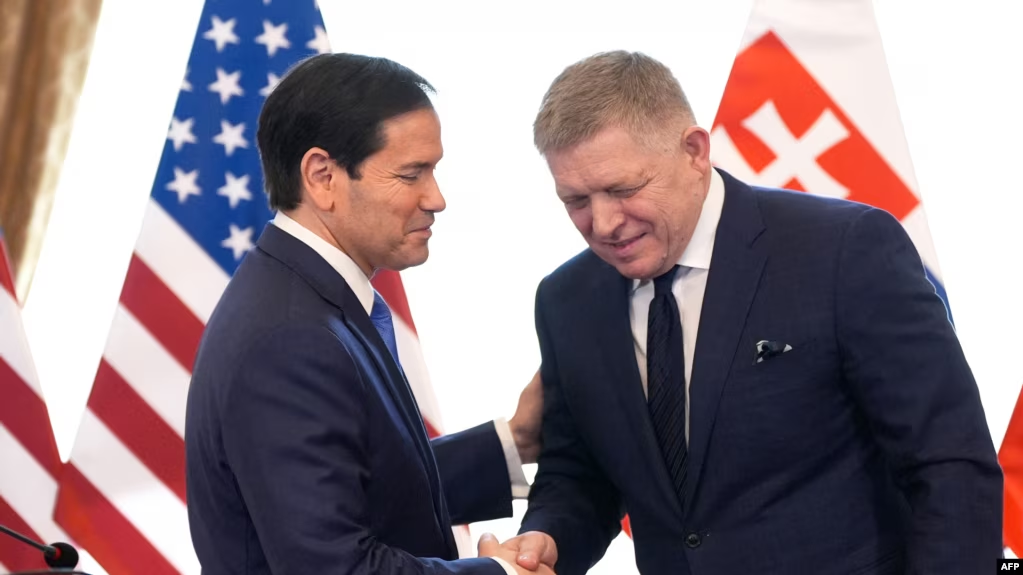 Photo: AFP
With Washington putting pressure on EU countries, announcing in July 2025 an agreement for the European Union to purchase $750 billion worth of American energy over three years, it appears that Robert Fico's government has agreed to cooperate with the US on energy, adapting its concept of a ‘four-way policy’ – a strategy of balancing the interests of Washington, Brussels, Moscow and Beijing.
After the halt of Russian gas transit through Ukraine on 1 January 2025, Slovakia faced a collapse in transportation volumes through its national gas transmission system operator Eustream: from 18 billion m³ in 2024 to a projected 6 billion m³ in 2026. This transformed the company from a major transit hub into a local operator.
Despite the existence of the Polish-Slovak interconnector — a gas pipeline connecting the gas transmission systems of the two countries, which remains almost unused — as well as access to LNG from Croatia and Poland, Bratislava has reoriented itself towards Turkish Stream. In 2025, direct supplies from Gazprom accounted for one-third of total imports. However, the real dependence may be higher, as gas purchased on European hubs is often of Russian origin.
Currently, gas accounts for 9.8% of the country's total electricity generation (compared to 9.9% in 2024 and 14% in 2021). After the full-scale invasion, it fell to 7% and then began to gradually increase, stabilising at current levels.
Tensions between Bratislava and Brussels peaked after the EU countries adopted a plan on 27 January 2026 to completely ban Russian gas imports (LNG from the beginning of 2027, pipeline gas from autumn 2027). Slovakia is currently finalising its lawsuit against the EU Court, while Hungary has already filed a complaint. Brussels has reacted calmly to these steps: European Commission spokeswoman Anna-Kaisa Itkonen stressed that the Commission is ready to defend its position in the EU Court, assuring that the REPowerEU regulation — a plan to reduce the EU's dependence on fossil fuel imports and accelerate the green transition — remains in force.
It is noteworthy that against the backdrop of a 14% decline in transit through the southern branch of Druzhba in 2025, Slovakia is going against the trend. The main factor in the reduction in transit - the Czech Republic's refusal to purchase Russian oil. In March 2025, Prague completely stopped purchases, which halted supplies via the Druzhba pipeline in this direction.
Slovakia, on the other hand, only increased its dependence, remaining the largest importer in 2025 with a figure of almost 4.9 million tonnes (+24% compared to the previous year). This growth was made possible by a new transit scheme: the Hungarian company MOL began to take ownership of oil at the Belarusian-Ukrainian border (MOL changed the terms of its contract with the Russians: namely, the oil is considered sold not at the plant in Slovakia, but at the Belarusian-Ukrainian border), which allowed it to circumvent Kyiv's sanctions restrictions and load the Slovak oil refinery Slovnaft with cheap raw materials. Hungary's imports, on the contrary, fell by 8% to 4.35 million tonnes.
In order not to become the subject of diplomatic distancing by European leaders, as happened with Viktor Orbán, Robert Fico decided to demonstrate his constructiveness in Paris. The French president's description of these talks as a ‘strategic awakening’ signals Bratislava's attempt to show its readiness for dialogue. The visit focused primarily on energy: Robert Fico confirmed talks with representatives of French companies Électricité de France (EDF) and Framatome, as well as participation in the March nuclear summit in Paris. This indicates that Bratislava's goal was to enlist the support of the EU leader in nuclear energy. In addition to ‘smoothing things over’ in relations with Brussels against the backdrop of new restrictions on energy resources from Russia, the visit had the subtext of insuring against the unpredictability of the new American administration.
The changing political landscape in Washington, the departure of Joe Biden's Brussels-friendly administration and the return of Donald Trump forced Robert Fico to reconsider his calculations. This factor, together with the desire to build a more pragmatic format of relations directly with the US, as well as possible changes in Washington's trade policy, has contributed to the rapprochement of Slovakia and Hungary with the United States. The closeness of this trio's policies is evidenced by the exemption from US sanctions that the Hungarian prime minister secured for his country for the import of Russian oil via the Druzhba pipeline. The exemption is intended to extend to the Slovnaft oil refinery in Bratislava, which is owned by Hungary's MOL.
The culmination of cooperation with the US in the energy sector is Fico's visit to Washington on 17-18 January 2026 and the signing of a memorandum of cooperation in the field of nuclear energy with Energy Secretary Chris Wright. The document lays the foundation for Westinghouse to build a new 1,200 MW power unit at the Bohunice Nuclear Power Plant, which is to be commissioned in 2041, and for the deployment of small modular reactors.
This will diversify the country's energy sector and, in the long term, weaken Moscow's leverage, which currently controls the supply of spare parts and servicing of existing nuclear units.
Since 27 January, the transit of Russian oil destined for Eastern Europe through the Ukrainian section of the Druzhba oil pipeline has been suspended due to the Russian attack. During a joint press conference with US State Secretary Marco Rubio, Robert Fico sharply criticised Ukraine: ‘We have information that [the pipeline] should already have been repaired,’ Fico told reporters after the meeting in Bratislava. ‘I regard what is happening today around oil as political blackmail of Hungary because of its uncompromising position on Ukraine's membership in the EU,’ Fico said.
The total share of renewable sources in Slovakia's electricity production reached 24.2% in 2025. Hydropower continues to dominate the generation mix, accounting for approximately 17.9% of the country's total electricity production in 2024. However, the development of this segment has virtually stopped over the past 15 years.
The only segment that has shown rapid positive dynamics in recent years is solar energy, where a capacity increase of 274 MW was recorded in 2024 alone. In 2024, solar generation accounted for approximately 1.4% of the country's total electricity production, which is 0.3 percentage points more than a year earlier. It should be noted that the material and technical basis for this development was the mass import of components from China, a trend characteristic of the entire European Union, where 98% of imported solar panels are of Chinese origin.
Other renewable energy sectors, however, are not showing such rapid development. As of the end of 2024, bioenergy sources provided approximately 207 MW of installed capacity for electricity generation, reflecting a slight increase of 3 MW compared to 2023 (in the same year, bioenergy provided about 4.9% of the country's total electricity generation).
The situation in wind energy appears to be more critical, as it has been in a state of complete stagnation for the past two decades, frozen at the installed capacity of 3 MW without any growth.
However, the further development of the industry faces new challenges due to a review of state policy. The Slovak regulator URSO has announced the termination of all subsidies for renewable energy until 2026, abolishing the mechanism of guaranteed purchase of electricity at fixed tariffs. This decision, which will affect about 600 producers, is officially justified by the need to combat speculators and protect consumers from financing the so-called ‘green ideology’.
The result of these actions will be the transition of the industry to conditions of fierce market competition without any additional financial guarantees, while nuclear energy will remain the priority as the most stable source.
The Fico government is trying to minimise financial losses at the expense of the EU and gain political benefits from Brussels for turning away from Russian fuel. Slovakia will continue to buy oil from Russia until Brussels imposes a complete embargo. For the US, Slovakia will remain a friendly centre in Europe, and cooperation between the governments has every reason to deepen, especially in the energy sector. Bratislava will remain an important logistics hub for Ukraine, but Fico's government will only support joint initiatives in cases where it sees clear political or economic benefits for its country.
Bratislava effectively recognises that there is no alternative to the EU's course and withdraws its lawsuit against the ban on Russian gas. If Brussels introduces a similar total ban on pipeline oil, Fico's government will be forced to comply with the new rules, despite the current contract until 2029. This will start the process of replacing Russian gas with stable supplies from the US, EU countries and their partners. Fico shows voters that he has managed to turn Brussels' tough demands into extra cash for his country. Washington is cementing its position as one of the key suppliers of nuclear technology (along with France) and gas. There will be no significant warming of relations with Ukraine, as Fico is dependent on the mood of his voters, so cooperation will be limited to issues of economic benefit.
Fico's government remains in power and, together with Hungary, is challenging the gas ban in the EU Court of Justice in order to maximise the stakes in exchange for benefits. At the same time, it will try to maintain contacts with the leaders of large European countries to avoid distancing itself and losing financial flows from Brussels. Russian oil will continue to be supplied through Ukraine until the contract expires. Provided there is at least a temporary ceasefire on the front, Fico's government will use this period to legalise trade with Moscow, arguing that it is a return to stability, which will be a convenient cover for Fico to continue purchasing Russian oil. At the same time, Slovakia may use its veto right to slow down Ukraine's accession to the EU, but this is not so much a ‘wall’ as a ‘barrier’ that Fico will only lift after receiving concessions from Brussels.
You may be interested