 INTERNATIONAL
INFORMATION AND ANALYTICAL
COMMUNITY


+ Join
Support INTERNATIONAL


Anatolii Horschkov, especially for the international information and analytical community Resurgam
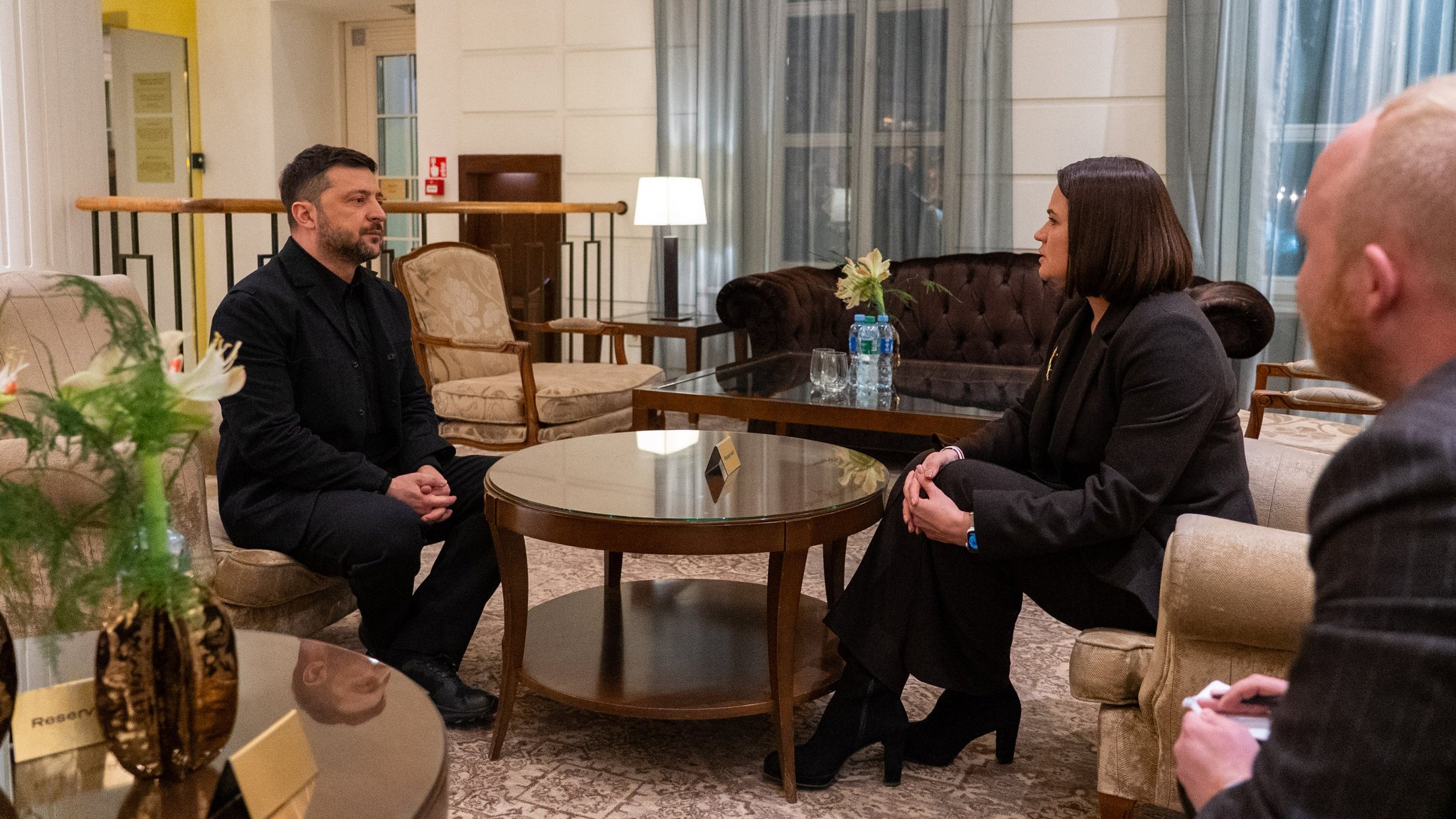 President of Ukraine Volodymyr Zelenskyy (left) and Belarusian opposition leader Sviatlana Tsikhanouskaya in Vilnius, Lithuania, January 25, 2025. Photo: Х/Tsihanouskaya
In recent months, Ukraine has made a notable strategic turn in its policy towards Belarus. After years of a relatively cautious course, Kyiv has shifted to open support for the Belarusian opposition and active pressure on the Lukashenka regime.
On January 25, 2026, Zelensky's first-ever official meeting with Tsikhanouskaya took place in Vilnius. Zelenskyy then devoted part of his speech to the Belarusian topic, saying that the protests of 2020 had to be won so that there would be no threats now. He also invited Tsikhanouskaya to Kyiv.
It is worth noting that these actions are not purely a Ukrainian initiative. They are being carried out in coordination with European countries and various representatives of the Belarusian opposition.
Until recently, Kyiv tried to avoid any actions that could provoke Minsk. In fact, this meant a willingness to put up with the deployment of Russian troops on Belarusian territory and the Kremlin's logistical support, so that only the Belarusian army would not cross the border. It was a kind of unspoken agreement that looked like an acceptable compromise for Kyiv. However, over time, this logic stopped working, and for several reasons at the same time.
Firstly, Minsk, even in such conditions, helps Russia more and more. As of 2025, the Russian war machine is already supported by more than 287 Belarusian enterprises. First of all, they are involved in the production of weapons, components and ammunition.
Moreover, Belarus has allowed the deployment of special mesh-repeaters on its territory that provide guidance of attack drones. They allow you to maintain communication with the drone at much longer distances and directly help Russia attack Ukrainian cities.
On February 23, 2026, Zelensky even publicly confirmed that Ukraine had already neutralized some of these repeaters on Belarusian territory. For Kyiv, official recognition of operations outside its own borders, except for Russia, is rare. Therefore, it can be assumed that Ukraine deliberately chooses public actions and emphasizes the danger from the Belarusian regime.
However, Belarus is becoming a much more acute problem not only for Ukraine, but also for the whole of Europe. Possible nuclear warheads without international verification, Oreshnik missile systems beyond any control, new factories of ammunition and drones involving Iranian technologies – all this is located under the sovereignty of a country that is almost completely controlled by Moscow.
Belarus has lost access to EU and Ukrainian ports, and trade with non-Russian partners is still increasingly carried out through Russia's logistics infrastructure and banking system. Russia's share in Belarusian exports has increased to 90%. In addition, Moscow is de facto the only supplier of energy to Belarus. Minsk receives Russian oil at a 30% discount to the market price, which allows it to save about 2 % of GDP. It is quite difficult for a country whose exports, energy and logistics are completely locked to one partner to pursue an independent policy, and the Kremlin takes advantage of this.
Much more importantly, most of the new military-industrial facilities will be commissioned in 2026-2027, and should reach full capacity by 2027-2029. So, the window for any sanctions or diplomatic actions is almost exhausted.
A separate problem is the rapprochement of the Trump administration with the Minsk regime. Trump's phone call to Lukashenka in August 2025 was the first in 31 years of the dictator's rule. This was followed by visits by the US special envoy and the lifting of sanctions on some Belarusian companies. Lukashenka, on the other hand, released as many as 569 political prisoners during the year. For Ukraine, the problem here is that easing sanctions pressure on Belarus without proper control over re-exports risks turning it into a channel for circumventing sanctions for Russia.
In addition, Washington seeks to use Lukashenka as a mediator in negotiations with Putin, and therefore legitimize him without any significant democratic concessions. After the 2020 protests, Lukashenka's contacts with the West were partially stopped, and now the Trump administration is returning him to the international arena.
Therefore, Kyiv seeks to prevent the rehabilitation of Minsk without taking into account Ukrainian interests. And supporting the opposition is an effective tool for creating an alternative center of legitimacy, which reduces Lukashenka's trade value.
Finally, the new policy is influenced by a purely human factor – the resignation of Andriy Yermak and the appointment of Kyrylo Budanov instead. Yermak adhered to a cautious line towards Belarus, while Budanov, on the contrary, came with a readiness for decisive steps and openness to cooperation with the opposition.
It is important that it was Budanov who brought Zelensky information about the readiness of the Belarusian side to hand over political prisoners. It was he who coordinated the logistics of this operation and personally met the liberated at the border. Tsikhanouskaya thanked him personally.
At the same time, the Belarusian opposition itself is going through a difficult internal period. On the one hand, Lukashenka released a large number of political prisoners. Among other things, the most influential figures came out, whose dismissal at the same time increased the international visibility of the opposition movement.
But on the other hand, there is a paradox in this progress. The dismissal of the most prominent Belarusian oppositionists simultaneously weakens the structural unity of the opposition, ironically. The movement inevitably becomes polyphonic. It now includes Tsikhanouskaya with her office. Tsikhanouski, who is beginning to take over publicity. As well as Babaryka and Kolesnikova, who are inclined to a softer diplomatic line. In particular, to gradual internal changes, rather than external pressure and isolation of the regime. The monolithic format of the "Tsikhanouskaya office", which has been operating since 2020, is now a thing of the past.
In addition, now the so-called Kalinouski Regiment plays an increasingly prominent role in the opposition . Officially, it is a unit of the Ukrainian Main Intelligence Directorate fighting at the front. But unofficially, it can be considered the embryo of the future Belarusian law enforcement agencies. The commander of the regiment, Pavel Shurmey, openly said that his fighters should become "the future elite of the new Belarus" and join the reformed army, special services and police. The regiment has already created its own "Sejm" which is a political body parallel to the military structure. Tsikhanouskaya, on the other hand, did not rule out a forceful scenario of overthrowing Lukashenka with the participation of Kalinouka. This is a significant change of position, because until recently, Tsikhanouskaya consistently avoided any war rhetoric.
Therefore, the Belarusian opposition now also needs to interact with Ukraine, because in this context, Kyiv remains one of the few partners that has both a direct strategic interest in the democratization of Belarus and real levers to support opposition structures in the international arena.
In addition to Zelensky's first-ever official meeting with Tsikhanouskaya and the latter's invitation to Kyiv, on January 27, the Minister of Foreign Affairs of Ukraine announced the appointment of a special representative for contacts with the Belarusian opposition. The candidates are currently being prepared by the Ministry of Foreign Affairs, but the media have already started talking about a possible position for former Foreign Minister Pavel Klimkin.
On February 18, 2026, Zelensky signed a decree on personal sanctions against Lukashenko.
There are moments that may indicate that these are not purely Ukrainian steps, but planned coordination with other players. For example, the meeting on January 25 in Vilnius, which brought together the presidents of Ukraine, Poland and Lithuania. It took place on the same day that Zelensky met with Tsikhanouskaya. This meeting is the closest format to the current trilateral coordination mechanism regarding Belarus.
The fact that it is necessary to act right now is also evidenced by the processes that are taking place in Belarus itself. There, a difficult period is coming for Lukashenka.
The Belarusian economy is now under pressure. Sanctions, economic problems, limited access to foreign markets – all this is only growing, as well as dependence on Russia.
But the problem here is that Lukashenka is gradually losing his monopoly on contacts with Moscow. The Russian ambassador is already making independent working visits directly to Belarusian enterprises, while bypassing official Minsk. Earlier, similar activities of the ambassador angered Lukashenka, and he ensured that everything happened through Minsk.
The Belarusian nomenklatura has also formed direct contacts with the Kremlin. Now even meetings of the Secretariat of the Security Council of Belarus with Russian colleagues have begun to take place as often as meetings between Lukashenko himself and Putin. For the Belarusian elite, the Kremlin has actually become an alternative to Lukashenka. Yes, not a substitute, but not exclusively a single player as well.
This means that Lukashenka is simultaneously facing pressure from the outside and a slow undermining of his monopoly position from inside. He still holds power, but the room for maneuver is narrowing on both sides.
Therefore, it can be assumed that the latest actions against Belarus are still a cautious yet deliberate attempt to turn the "Belarusian issue" into a systemic security strategy. We can now observe how, for the first time since the beginning of the war, a coordinated mechanism appears between Kyiv, Warsaw, Vilnius and part of the opposition.
The effectiveness of all these actions depends on several factors: whether the Belarusian opposition itself can withstand internal tensions, how Washington will behave in its interaction with Minsk, and how stable the regime will remain.
You may be interested