 INTERNATIONAL
INFORMATION AND ANALYTICAL
COMMUNITY


+ Join
Support INTERNATIONAL



Kostiantyn Hlushko, staff analyst and reviewer at the "Resurgam" Center for Northern European Policy
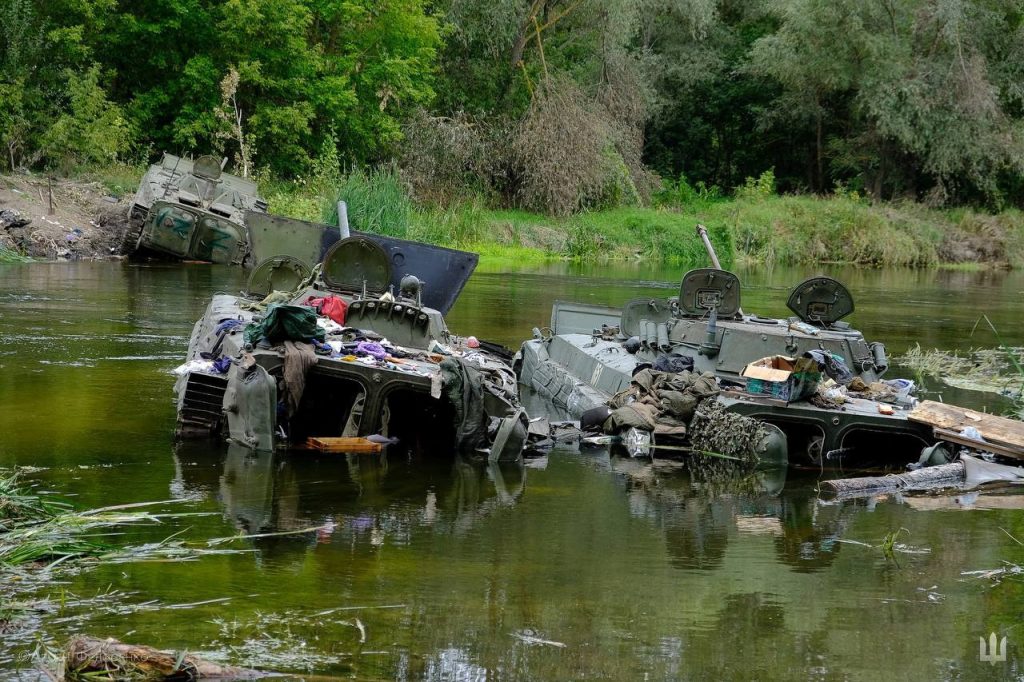 Russian armoured fighting vehicles abandoned in the swamp Source:
On 8 August, the Lithuanian government approved a Defence Ministry plan that provides for the construction of engineered obstacle belts, the digging of anti-tank ditches and trenches, and the restoration of wetlands along the border with Russia. The aim is to complicate a potential Russian invasion. However, Lithuania is not the first country to restore wetlands as an element of natural defense: Finland has been working on such a solution since October 2025, and its plans are far more ambitious.
We examine how landscape modification can be used for defense, what steps the countries plan to take, and how their approaches differ.
The approach to defense that Finland and Lithuania plan to adopt is known as “defensive rewilding.” It entails the long-term modification of the landscape aimed at deterring an adversary by creating enduring natural obstacles, without harming—and in some cases even benefiting—the environment of the country implementing it.
Restoring wetlands can soften the ground to the point where it can no longer support the weight of tanks. Wetlands are often deeper than the depths that logistics vehicles and tanks without specialized modifications can traverse. Although specialized light armored vehicles can traverse such wetlands, they have lighter armor and are therefore more vulnerable to attacks by munitions or drones. Thus, where wetlands are densely distributed, the rate of advance of mechanized units can be reduced by as much as 70%, increasing the amount of time they remain exposed to defensive fire.
At the same time, the approach is not limited to the use of wetlands. Restoring peatlands excessively softens the ground, making it difficult even for light armored vehicles to move, while restoring river meanders and softening their banks makes it more difficult to use floating bridging equipment. Moreover, by increasing the meandering of a river, defenders compel an attacker to cross more waterways. Afforestation, that is, the creation of dense mixed-species forest stands, limits the maneuverability of military vehicles and reduces the effectiveness of reconnaissance and communications systems, including GPS, thermal imaging systems, and radio communications, while also making the use of loitering munitions more difficult.
Creating forest stands along roads or small bodies of water may help defenders set up ambushes and slow the advance of enemy forces.
The application of this approach has benefits beyond defense. From an international relations perspective, this approach allows a country to strengthen its defenses without arousing suspicions in another state that the country is preparing for an attack, as a restored wetland is unlikely to be used to attack another country. Second, it is more cost-effective: according to researchers at the UK’s Royal United Services Institute for Defence and Security Studies (RUSI), establishing a defensive wetland belt costs between £90,000 and £540,000 per kilometer, while one kilometer of concrete anti-tank ditches costs between £1 million and £3 million. Finally, this approach may have a positive impact on the environment by helping reduce the amount of carbon dioxide in the atmosphere and preserve biodiversity.
Following Russia’s invasion of Ukraine, Finland, considering an attack on its own territory a possibility, has spent the past three years gradually and systematically preparing for a potential defensive war. In 2023, it joined NATO, and the following year Finland launched a rail route between the border town of Haparanda and Scandinavia’s largest port, Gothenburg, the strategic importance of which we covered in our article. In 2025, Finland raised the age limit for reservists and signed a memorandum with Ukraine on information sharing and enhancing the interoperability of the two countries’ armed forces. This year, the country decided to establish a drone warning system and began training its military personnel to use interceptor drones.
However, the country’s most fundamental decision was to restore natural obstacles along its border with Russia. Following an analysis, a working group from the Ministries of the Environment and Defence concluded that this approach was appropriate. According to its assessment, the area of wetlands and peatlands whose restoration would strengthen the country’s defensive capabilities amounts to at least 180,000 hectares.
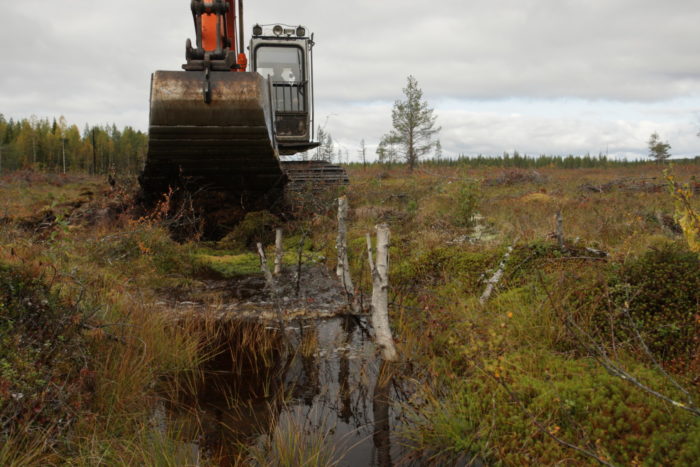 Restoration of a peatland in Finland for environmental reasons, 2021. Photo: Philippe Fayt/Metsähallitus
Taking into account the length of Finland’s border with Russia (1,343 km) and the prolonged weak recovery of the Finnish economy following the 2023 recession, the government decided to integrate the project into the EU’s European Green Belt initiative to attract additional funding by combining environmental protection and defense objectives. The government also plans to attract private investors to help fund the project.
On 2 July this year, the Ministry of Agriculture and Forestry and the Ministry of the Environment published a draft National Nature Restoration Plan through 2050. It provides for measures to restore forests, aquatic and coastal areas. After collecting public comments by 27 August, the plan will be submitted to the European Commission. Its approval may take more than a year. According to the government’s estimate, implementing the plan will require at least €1 billion per year through 2031.
Finland’s willingness to modify its landscape to protect itself from Russia indicates that it perceives Russia as a long-term existential threat. In fact, Finland is looking for a way to secure funding for defense from sources that would not normally be used for this purpose. Amid budgetary pressures, high social spending, and US urging Europe to provide for its own security, this model could serve as an example for other EU and NATO member states.
Lithuania, facing a threat from Russia and Belarus, decided in 2024 to establish a counter-mobility system not only along its borders with these countries but throughout the country. At the time, the plan envisaged creating 27 counter-mobility parks for storing counter-mobility equipment (such as Czech hedgehogs and other obstacles), planting trees along the borders with Russia and Belarus, blocking key roads across the country with reserve barriers, and equipping bridges with special fittings for installing explosives.
In 2025, the government decided to increase the number of such parks to 50 and involve Lithuanian Railways in determining their locations, as a significant share of state-owned land is owned by the company. In 2025, €8.5 million was spent on these measures, while €10 million was allocated for 2026.
The current proposal by the Ministry of Defence significantly expands the scale of the work and adds elements of defensive rewilding. By the end of 2028, a 20-metre-wide belt of engineered obstacles is planned along the borders with Belarus and the Kaliningrad region, expanding to 150 metres in key defensive areas. Instead of planting trees, the plan is to restore wetlands by 2030, as this requires less time. In addition, a network of drainage ditches and streams is to be established in the Vilkaviškis and Šakiai districts, which border Kaliningrad. €50 million is planned to be allocated for these measures from Lithuania’s State Defence Fund in 2026–2030.
Despite the similarity in their underlying concept and shared motivations, Finland’s and Lithuania’s approaches differ significantly. The first difference is the funding model: while Finland seeks to secure at least part of the funding from European funds, Lithuania relies entirely on its own resources.
Finland has chosen the longer route: more than a year to prepare the proposal and potentially another year for the European Commission to review it. Additional negotiations may follow. Lithuania, meanwhile, is allocating funding for implementation immediately and does not need to seek approval from other parties. This may indicate that Lithuania perceives the threat more acutely and that, unlike Finland’s, its economy is growing strongly.
The second difference is the operational depth at which the two countries plan to establish defensive lines. While Finland is focusing on border areas, Lithuania is building this defense system across the entire country. The reason lies in the difference in the size of the two countries and their armed forces. Finland can hold off an enemy for much longer, including along its borders, until allied assistance arrives, than Lithuania.
If Finland succeeds in securing funding from the European Commission in this way, this may establish a new model of defense planning in which the restoration of natural ecosystems becomes one element of deterrence alongside traditional military infrastructure. This may allow some EU and NATO countries, at least those sharing a land border with Russia and Belarus, to significantly reduce spending on defense infrastructure by partially financing projects of defense significance through EU environmental programs, freeing up national resources for the development of high-tech capabilities. At the same time, combining environmental and security objectives may broaden political support for such projects among supporters of green policies, while making it much more difficult for Russia to use them as evidence of alleged preparations for an offensive war.
The Russian-Ukrainian war is forcing European states to reconsider the very concept of defense infrastructure. Preparation for war is increasingly extending beyond the construction of fortifications and the procurement of weapons to the management of territory, natural resources, and civilian infrastructure. If the threat from Russia persists in the coming years, preparing territory for war and modifying the landscape may become as commonplace in European defense planning as maintaining armed forces or procuring weapons.
This will gradually blur the boundaries between military, environmental, and civilian policy: decisions about where to restore wetlands, build roads, or alter river courses may increasingly take into account not only economic and environmental considerations, but also their defense implications.
Kostiantyn Hlushko, staff analyst and reviewer at the "Resurgam" Center for Northern European Policy
You may be interested