 INTERNATIONAL
INFORMATION AND ANALYTICAL
COMMUNITY


+ Join
Support INTERNATIONAL



Anastasiia Krugliak, Student pursuing a Master’s degree in International Governance and Diplomacy at Sciences Po
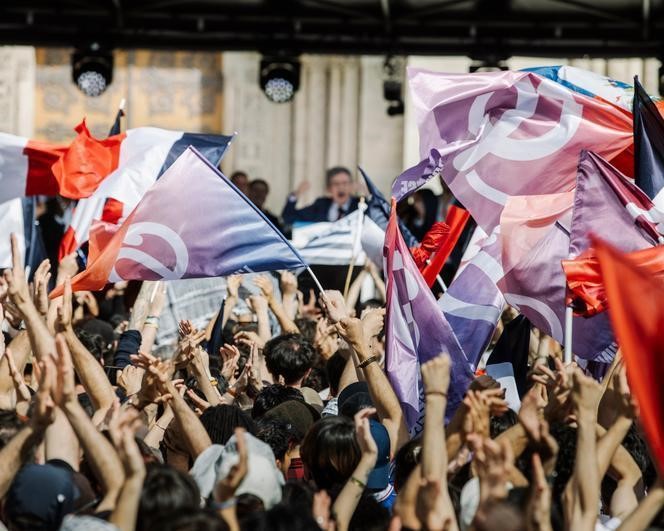 Supporters at Jean-Luc Mélenchon’s first campaign rally in Saint-Denis, where tricolours fly alongside La France Insoumise flags. Source
However, while in most countries today the flag ‘belongs’ to all citizens and coexists with alternative symbols of nationalism, in some countries it has become so closely associated with far-right movements that other political forces effectively refuse to use it. In this article, ‘democratic forces’ refers to parties across the liberal, social-democratic, centrist, and right-wing spectrum that accept existing democratic institutions, while ‘far-right’ refers to radical movements that fall outside the democratic consensus.
It should also be noted that civic patriotism is not automatically synonymous with a liberal or left-of-centre project. A healthy national identity can just as well be built on conservative or right-wing values. The problem this article addresses is not right-wing ideas as such, but specifically the exclusive appropriation of the symbol by radical forces.
This situation complicates the task of building national identity on the basis of civic patriotism and creates a paradox: in seeking to distance themselves from ethnic nationalism, democratic forces often voluntarily cede national symbols to nationalists themselves. This modern trend of certain political forces abandoning the use of flags is undoubtedly dangerous, and precisely for that reason especially important to study.
To better understand this danger, it is worth examining two main paths of development in how the flag is used to encourage patriotic sentiment: the inclusive path (fostering a sense of belonging among all citizens) and the exclusive path (appropriating the symbol to exclude certain citizens).
In the first scenario, the flag is used by virtually all citizens regardless of political views and serves a nation-building function, even though certain political movements tied to a region or ideology also use additional symbols. At the same time, it is important to highlight the postcolonial aspect, since some countries also see the flag as a reminder of their struggle for independence. Ukraine is one example: alongside the ‘neutral’ state flag, there is also the red-and-black flag of the OUN-UPA, as well as regional flags such as the flag of Crimea.
The same can be seen in Romania, where alongside the state flag there is also the flag of Székely Land — a region of Transylvania home to a Hungarian minority. For the residents of Székely Land, this flag is an expression of their identity and their struggle for self-determination, i.e., autonomy; however, flying it on a public building can result in a fine of up to €20,000, turning the symbol itself into a subject of ongoing conflict with the Romanian authorities. Alongside this, Romania also has an opposite pole of symbolic struggle: the Celtic cross, which today is openly used as the main symbol of the far-right movement Noua Dreaptă (neo-fascists who consider themselves heirs of the Iron Guard). In these cases, alongside an inclusive state symbol, alternative flags exist that are used in struggles over regional, ideological, or ethnic identity. However, the state flag does not retain this kind of neutral status everywhere — in some places, events unfold along an entirely different scenario, and the state flag itself becomes monopolised by one political side. That is the scenario we turn to next.
In the alternative model of flag use, the state flag gradually becomes a symbol used predominantly by far-right forces, who use it to encourage blind patriotism grounded in ethnic nationalism. It is important to emphasise that although the phenomenon of one political side appropriating the flag has historical precedents (for example, Weimar Germany or the Confederate flag in the United States), its contemporary form — the systematic refusal of opponents of far-right parties to use the state flag as a reaction to its use by the far right — is a relatively new and still understudied trend. One marker of this trend can be considered the fact that statements on this subject from political scientists, journalists, and politicians are appearing in the media space. Practical steps (legislative and otherwise) taken by various actors to counter this trend can also be treated as markers — for example, the restriction on the use of the flag of England in Oxfordshire, which will be explained later.
It is important to note that this analysis is limited to consolidated Western democracies, since it is precisely here that the combination of a high level of immigration-driven diversity, postcolonial/post-militarist reflection, and a polarised party system creates the conditions for the paradox described. In other regions of the world, the conflict over national symbols follows a different structural logic. Among the Western democracies where a similar ideological radicalisation of the flag by right-wing and far-right groups can be identified are the United States, the United Kingdom, Germany, the Netherlands, Spain, Poland, and France, among others. Some of them merit closer examination.
In the United States, beginning roughly with Trump’s first presidency, the flag has become increasingly associated with conservative circles and Republicans, who use it widely in various contexts. What is more, some evangelical movements have, in a sense, even prayed to it — for example, during weekly prayers in front of the school flagpole. This phenomenon is described by Onishi, a former pastor and contemporary scholar of religion, in his work Preparing for War.
At the same time, precisely because of this trend, a significant portion of American liberals increasingly avoid using the flag, which further reinforces its association with the right. As an illustration, one can point to Democratic Senator Elissa Slotkin, who stated that Democrats currently have an image of being weak ‘woke-ists’ and ‘need to take the flag back’. As television host Bill Maher commented on his show Real Time with Bill Maher, most Democrats are ashamed to be Americans (and thus ashamed of the flag as well). Instead, for their own domestic political reasons, Democrats quite often use the US flag in combination with their party’s flag, or with LGBTQ or Palestinian flags. That is, at present in the United States, hanging the national flag in front of one’s house, or wearing an item featuring the flag, is read as a statement of support for MAGA, whether the person intends it that way or not. At the same time, MAGA and Republicans have plenty of flags of their own, but nonetheless, they have to some extent ‘monopolised’ the US flag. This allows them to position themselves as patriots, in contrast to Democrats.
 A Trump supporter flies a US flag upside down next to a ‘Let’s Go Brandon’ flag in protest against the verdict. Source
As in the United States, some politicians and media outlets are calling on the left to return the flag to its former neutral status. This view is voiced, for example, by the London Economic, in an article titled ‘The far-right has hijacked our flag; it’s time to reclaim it’. Unfortunately, the left and centrists sometimes take a relatively counterproductive approach, restricting the ability of far-right ‘patriots’ to freely display flags — thereby, in effect, making the flag itself a symbol of the far right and its views. This happened, for example, in Oxfordshire, where the county council, made up mostly of Liberal Democrats, decided to restrict the display of English and British flags on lampposts and other road infrastructure.
The flags in Oxfordshire did not appear spontaneously: they were part of an online campaign that, since the summer of 2025, had called for mass displays of the British and English flags on lampposts, bridges, and roundabouts across England. Although the organisers presented the action as an expression of patriotism, a significant portion of observers and sociological research linked the campaign to anti-immigrant sentiment, with much of its coordination and spread taking place through right-wing and far-right networks. The council initially openly described the installation of the flags as ‘an act of intimidation’, creating an unsafe and unwelcoming environment for part of the population. However, when the matter reached the High Court, the argument was narrowed to unauthorised occupation of road infrastructure, risks to traffic safety, and harassment of workers — and it was on these legally acceptable grounds that the court issued a final injunction, valid for one year, in July 2026.
At the same time, some parts of the country where the Reform party won local elections are now flush with these flags, underscoring the contrast between localities. This is a deliberate policy: after winning local elections in May 2025, the party announced that on public buildings under the control of its councils, only the Union Jack, the flag of St George, and county flags would be permitted. All others, including the Ukrainian flag and the Pride flag, are to be removed. This policy has already moved beyond mere declarations: in September 2026, for example, the Reform-led Kirklees council put the corresponding provision into practice, banning Pride flags from council buildings.
Thus, while in some regions the flag is being deliberately narrowed to a single, unified state symbol that displaces any alternative symbolism, in others civil society instead avoids the state flag almost entirely — both extremes equally harm the idea of the flag as a shared, inclusive symbol. The problem is further compounded by the fact that activists who mass-display flags often fail to maintain them afterward: the banners remain hanging even after they have torn, faded, and become soiled. This creates a deeply unflattering visual picture and, as a result, only reinforces the association of the flag with the marginality of the movement using it, rather than with respect for the state symbol.
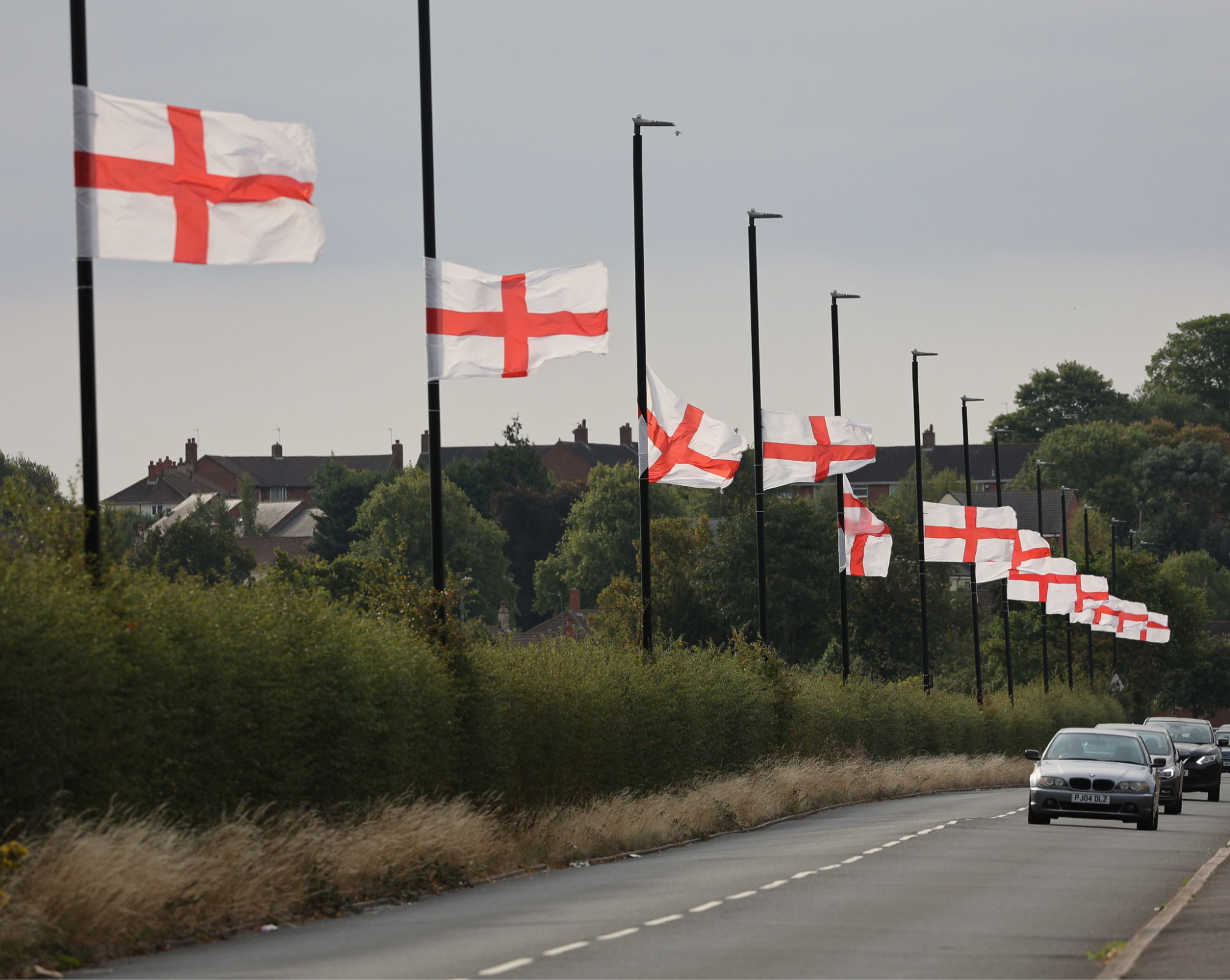 St George’s flags on lampposts along a road in England as part of a campaign to fly them en masse. Source
The dispute over the flag of St George is closely tied to a broader debate about the criteria for English identity itself, which this flag symbolises. Proponents of an ethnic understanding of the nation tend to link belonging to the English community with descent and blood, as a result of which citizens of other ethnic backgrounds are often regarded as British, but not English: that is, as people who formally belong to the state but are excluded from its ‘native’ nation. However, this interpretation contradicts the logic of civic patriotism, on which, by definition, the modern political nation is based: belonging to it is determined not by origin, but by the fact of birth, socialisation, and shared values. According to this principle, a person who was born and raised in England and shares British political values has a full right to English identity on par with British identity. Rishi Sunak is an example of this — he can rightly be considered not only British, but English as well. The question of who has ‘the right to the flag’, then, and the question of who has the right to national identity, turn out to be two sides of the same dispute. The flag can become a shared symbol only when the identity it represents itself becomes shared — that is, open to all citizens, not just the ‘native-born’.
A similar dynamic of the right appropriating the flag, and of opposing attempts to restore its neutral status, can also be observed in France. A telling example was the launch of Jean-Luc Mélenchon’s presidential campaign on 7 June 2026 in Saint-Denis: the leader of La France Insoumise built his speech as a direct response to the National Rally precisely on the terrain of symbols, flags, and slogans, seeking to prove that a vision of France different from the far-right one is equally capable of uniting people. Notably, the rally itself took place against a backdrop of tricolour flags — that is, the movement deliberately appropriated state symbolism rather than avoiding it. In doing so, LFI and Mélenchon declared their intention to ‘reclaim’ national symbols, including the flag, which Marine Le Pen and Jordan Bardella have appropriated, and to rethink the very concept of the French nation (as white, Christian, and so on).
Supporters at Jean-Luc Mélenchon’s first campaign rally in Saint-Denis, where tricolours fly alongside La France Insoumise flags. Source
Overall, it is worth noting a pattern common to all the countries examined: the flag most reliably retains its ‘neutral’ status precisely during sporting competitions — this has become an established tradition. Yet even in this context, some liberal or left-leaning supporters will choose the flag of the national team over the flag of the state as such. Some citizens also deliberately fly their own country’s flag alongside the flag of the EU, or alongside the flags of Ukraine, Palestine, or the LGBTQ community — thereby underscoring that national identity can be combined with other values and forms of solidarity, rather than being monopolised by far-right movements. It is also telling that in some of these countries, particularly the Netherlands, the flags of Palestine, Ukraine, or the LGBTQ community can today be seen in everyday life even more often than the flag of the state itself, which citizens rarely use.
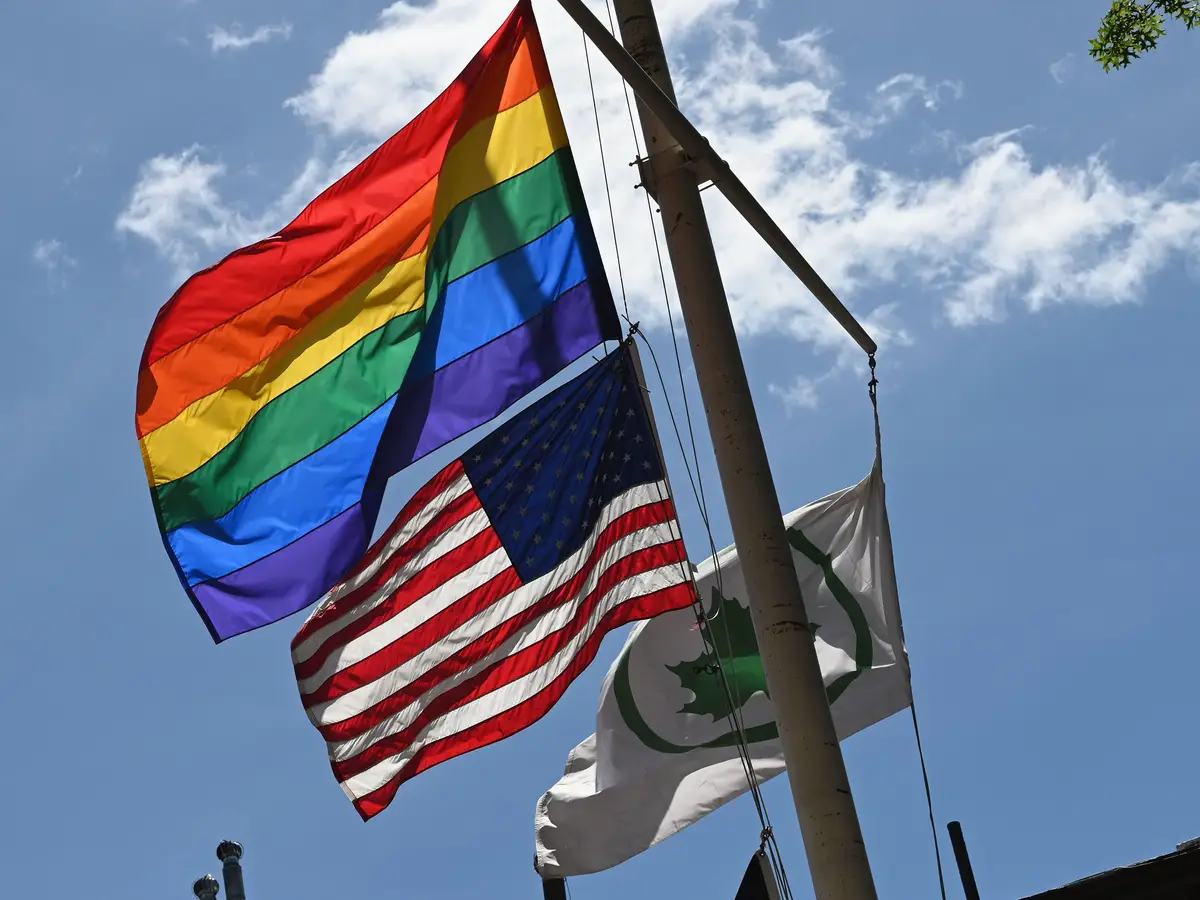 The US flag next to a Pride flag at the Stonewall National Monument in New York. Source
There are two main factors that unite the countries in which opponents of far-right forces refuse to use the flag. The first is a sense of shame (moral responsibility) over the use of violence against others, whether in the past or present. More liberal British and French citizens, for example, feel shame over their countries’ past actions in connection with colonisation, while Americans feel similarly about the wars the United States waged prior to Trump, including the so-called War on Terror, and especially about the controversial actions of the Trump administrations both within the country and beyond its borders (with respect to the EU, Ukraine, and the West). Germany, in turn, wants nothing to do with the legacy of World War II. The second factor is the diversity of their populations. The perception of the ‘native’ population being replaced frightens some voters and leads them to see themselves as the ‘real’ citizens and patriots to whom the flag ‘belongs’, while also fuelling their desire to support far-right populists.
Why, then, is it appropriate to use the word ‘problem’ in describing this situation? As explained earlier, the traditional foundations of political unity are weakening, since religion, language, culture, ethnic origin, and other factors are becoming less and less universal. What remains for building civic patriotism are the constitution, democratic values, citizenship, institutions, and symbols such as the national flag, anthem, coat of arms, and the like. But it is the flag specifically that serves as the universal visual symbol of the political nation. The very existence of political struggle over the flag underscores its importance, just as the absence of a similar struggle over the anthem underscores its lesser importance.
The refusal of opponents of far-right forces to use national symbolism, in a certain sense, deprives them of an ideological tool of nation-building. Nor should one underestimate the significance of classical ethnic nationalism for certain social groups, or the limited appeal that civic nationalism holds for them as an alternative model of identity. It is largely from this deficit in the tool of nation-building that the loss of votes by more left-wing politicians, and the populist wave now sweeping democratic societies, stems.
It cannot be denied that pride in one’s country is a normatively necessary element of a healthy national identity, even while acknowledging its historical and present-day flaws. Pride in one’s country and patriotism, in themselves, are not a ‘left’ or ‘right’ concept. Conservative parties can and should have a legitimate, non-exclusive version of patriotism (as opposed to the far-right kind), just as more left-wing parties can. This is precisely why populist forces gain an electoral advantage: they offer voters a positive emotional experience and a sense of belonging.
Critical reflection and a certain degree of shame over particular historical and present-day actions of the state are, without question, justified; however, when such criticism becomes excessive and total in character, it becomes counterproductive. The far right systematically wins wherever pride and symbolism become electoral issues, because they offer a simple, unambiguous, and more ‘psychologically comfortable’ logic. At the same time, liberal discourse often creates a sense of discomfort among a still predominantly white, post-Christian, heterosexual majority of voters. One consequence of insufficient patriotic mobilisation is, among other things, a lack of willingness among some Europeans to defend their own countries in the face of external threats — from Russia, for example — as numerous polls have shown.
Furthermore, out of fear of being accused of nationalism, opponents of far-right forces effectively cede the right to national symbolism to their political opponents. This is even more problematic than simply abandoning the symbol altogether: such a concession indirectly strengthens the position of the ideological rival and, in certain cases, can lead to the defeat of democratic forces (as has already happened in the United States, and as is potentially possible in the United Kingdom, France, or Germany). As a result, part of the population is effectively deprived of the ability to openly identify as part of society and to display the corresponding symbolism. In this way, more left-leaning forces — Democrats in the United States, or Labour (and the broader left) in the United Kingdom, for example — inadvertently create the impression that they lack patriotic feeling, which does not correspond to reality, while at the same time losing a portion of their electoral support. What is more, a persistent asymmetry emerges: the far right increasingly gains a monopoly on the right to speak on behalf of the nation as a whole, while other forces are forced to justify themselves or to speak only on behalf of part of society.
It must be acknowledged that some national flags carry an ambiguous historical legacy — the flag of England is a telling example, since the cross of St George originated as a religious symbol of the era of the Crusades. It was subsequently appropriated and reinterpreted repeatedly by different (at times opposing) political and social forces: from the British Empire to football fans, from the far-right movements of the late 20th century to today’s proponents of English (as opposed to broader British) nationalism. Yet a logical question arises: what alternative exists? Introducing a new national symbol is a practically unfeasible task. A state functioning without any unifying symbolism seems impossible, so the existing symbolic resource remains what it is. It should also be taken into account that most of the population is not familiar with the detailed history of the symbol, and thus, like any other sign, it can be filled with new meaning according to the current social context — for this is precisely how symbolism functions in general: we are constantly filling symbols with meaning depending on the situation in which they are used.
A similar ambivalence is inherent in the symbolism of many countries: for example, the modern Russian tricolour was used (alongside other flags) between 1941 and 1945 by collaborationist formations under General Vlasov’s command, while under Stalin’s USSR the very same flag was punishable by execution. Yet in contemporary Russian society, this historical contradiction is largely unreflected upon, and the symbol itself functions as an object of state pride. This confirms a general pattern: the historical ambiguity, or even contradictory origin, of a national symbol is not a problem unique to any single country, but is rather the rule more than the exception.
Analysis of the cases discussed makes it possible to outline several practical directions that do not fully solve the problem but can mitigate the paradox described.
First, the experience of Oxfordshire shows what should be avoided: banning or restricting the flag through legal means does not restore its neutrality, but only confirms the far right’s narrative that the flag ‘was taken from them’. A more effective approach is the opposite one — the active ‘reclaiming’ of the symbol by opponents of the far right. Mélenchon’s example, in which he deliberately built his speech against a backdrop of tricolour flags rather than avoiding them, demonstrates exactly this strategy: democratic forces need to appear alongside the flag just as often and naturally as the right does, rather than ceding the public space of symbolism without a fight.
Second, the example of the bishops of the Church of England, who publicly spoke out in defence of the flag’s neutrality, is instructive. Similar statements from institutions, opinion leaders, sports federations, and educational establishments can weaken one side’s monopoly on the symbol, reminding society that the flag belongs to everyone.
Third, a practical technique worth noting is the pairing of symbols: flying the national flag alongside the flag of the EU, Ukraine, Palestine, or the LGBTQ community, as some citizens of the Netherlands, France, the United States, and other countries already do. This is not a ‘solution’ in the sense of a law or an institutional reform, but rather a grassroots, visual way of showing that national identity does not necessarily contradict other values or forms of solidarity — and, accordingly, is not the exclusive property of ethnic nationalists.
Finally, the example of sporting competitions — the one context in which the flag most reliably retains a neutral status across all the countries examined — suggests a possible benchmark: a public atmosphere in which displaying the flag is perceived as a natural rather than a politically marked act is entirely achievable under certain conditions. The task for democratic forces is to deliberately recreate these conditions (shared celebrations, state ceremonies, school traditions) beyond the realm of sport.
None of these steps eliminates the structural causes of the problem — neither the sense of historical guilt nor the demographic anxiety of part of the electorate. But together, they offer a path towards gradually restoring the flag to the status of a shared symbol rather than an appropriated one — a path of fighting for the narrative, rather than surrendering to it.
The paradox of modern democracies lies in the fact that, in seeking to distance themselves from exclusive ethnic nationalism, some countries frequently and voluntarily forgo the alternative, inclusive use of their own national symbols in the work of nation-building. This ‘retreat without a fight’ opens up space for the appropriation of symbols by radical political forces, and it is precisely here that the paradox closes in on itself: the attempt to avoid nationalism ultimately hands the nation over to those who define it in its narrowest and most aggressive terms. The flag should not be a symbol of blood, ethnicity, or exclusion, but should remain a symbol of the political nation — that is, of a community of citizens united not by origin, but by values, institutions, and responsibility for the state. The task, therefore, is not to abandon the flag, but to fight for its inclusive meaning: whoever controls the symbol controls the narrative about the nation, and with it, how resilient democratic institutions will remain in the face of populist and far-right pressure.
You may be interested