 INTERNATIONAL
INFORMATION AND ANALYTICAL
COMMUNITY


+ Join
Support INTERNATIONAL



Potapchuk Ivan, intern at the “Resurgam” Center in the field of North American countries analysis
 Photo: Victor J Blue/B/Bloomberg via Getty Images
The total number of migrants in Minnesota is quite small, especially compared to southern states. The number of illegal migrants in the state is about 1.5–1.6% of the total population, while in Florida this figure is about 3.4% and in California — 5%. Therefore, Operation Metro Surge, which initially focused on the cities of Minneapolis and St. Paul and later spread throughout the state, was difficult to explain from the perspective of combating migrants. It was more likely a politically motivated action. The operation was accompanied by an escalation in ICE's tactics, intimidation and threats against community observers. The campaign also led to the arrest of about 3,000 people, including US citizens.
During the operation, federal agents killed two ordinary US citizens, Renee Good and Alex Pretti. Another person detained by ICE died while in custody. The operation destabilised Minnesota's economy and civil life: schools switched to remote learning, and the arrests of migrants disrupted normal economic processes. In response, thousands of Minneapolis residents came out in mass protests against ICE's activities. The protests were not limited to one city but spread across the country. Protesters demanded the abolition of ICE and the removal of federal officers from their states, highlighting the crisis in immigration policy — until recently one of the Trump administration's strongest points.
One of President Trump's priorities is the issue of migration, especially illegal migration. The president has chosen ICE as the tool for implementing his commitments — a structure that can quickly achieve its goals through presidential executive orders. Utilising a federal agency allows the president to bypass the lengthy legislative process in Congress and ensure immediate action.
Ten years ago, the agency's budget was less than $6 billion — significantly less than other agencies within the Department of Homeland Security. As a result of executive orders, ICE has been given expanded powers and increased funding. It is now the most heavily funded law enforcement agency in the United States, with $85 billion at its disposal.
Because ICE reports directly to the president, it is often likened to a ‘private army’ that bypasses the country's traditional law enforcement mechanisms. Congressman John Mannion, a Democrat from New York, called ICE ‘the president's personal military unit.’ Journalist Radley Balco, author of a book on the militarisation of the American police, claimed that President Donald Trump used this structure ‘the way an autocrat uses paramilitary forces — to settle personal scores, inflict pain, violence and discomfort on people he considers his political enemies.’ In their book “How Democracies Die,” Steven Levitsky and Daniel Ziblatt show that the existence of such paramilitary formations is often considered one of the key features of an authoritarian regime.
The political reaction to the crisis was mixed. Senator Tim Walz, a former Democratic vice-presidential candidate in the 2024 election, and Minneapolis Mayor Jacob Frey demanded that ICE cease operations in the state. The president's administration long denied the existence of a crisis and defended ICE officers, calling the dead protesters terrorists, but later changed the leadership of the operation and, on 13 February, ended the entire operation, declaring that all objectives had been achieved.
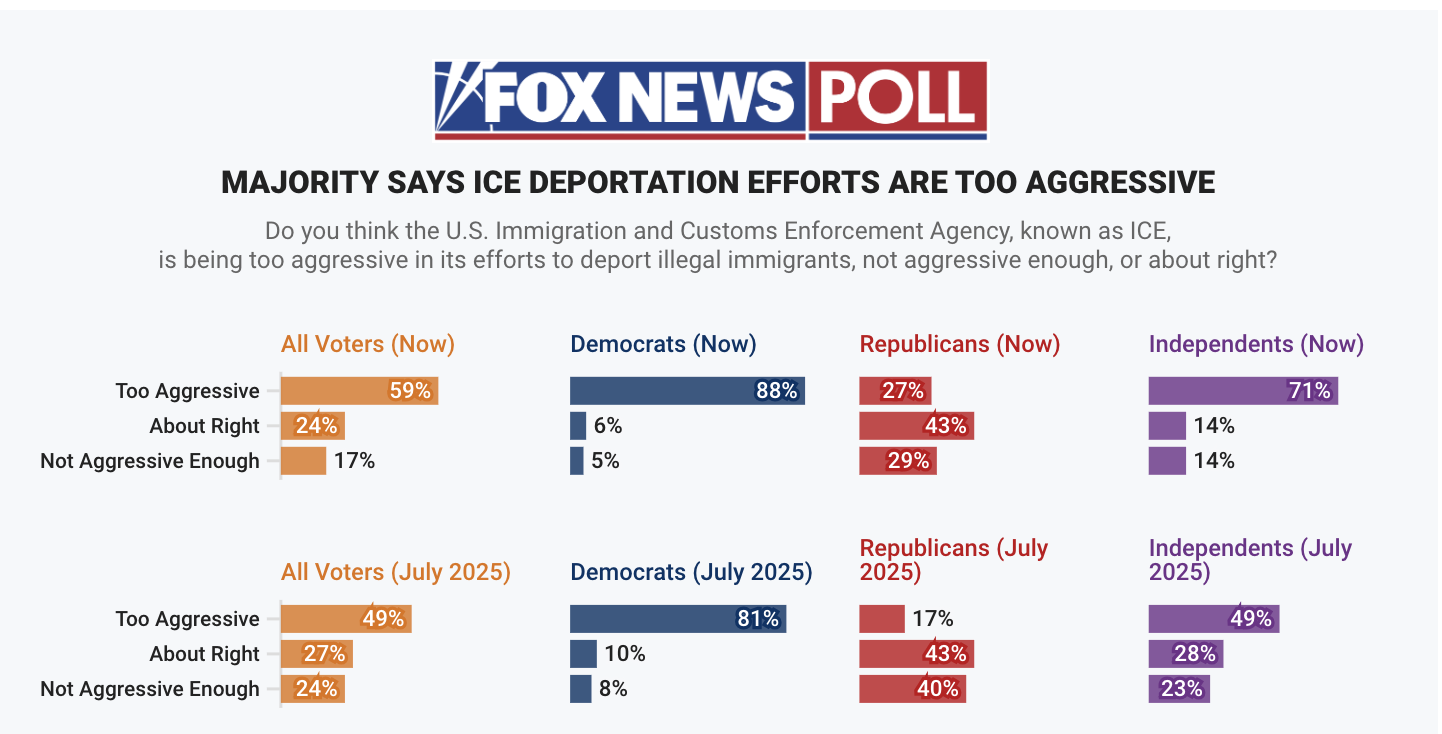
Trump was the answer to society's demand for change in immigration policy, but after recent events, voters' views have begun to change. Fifty-nine per cent of those surveyed believe that ICE's actions are too aggressive, which is 10 points more than in July 2025. Independent voters played a key role, with 71% now calling the policy too extreme. Support for abolishing ICE has doubled since 2018, from 18% to 36%.
Remarkably, this increase is provided precisely by Trump's supporters. 29% of moderate Republicans consider the approach to deportations too harsh, while 43% support the campaign's goals but not the way they are implemented.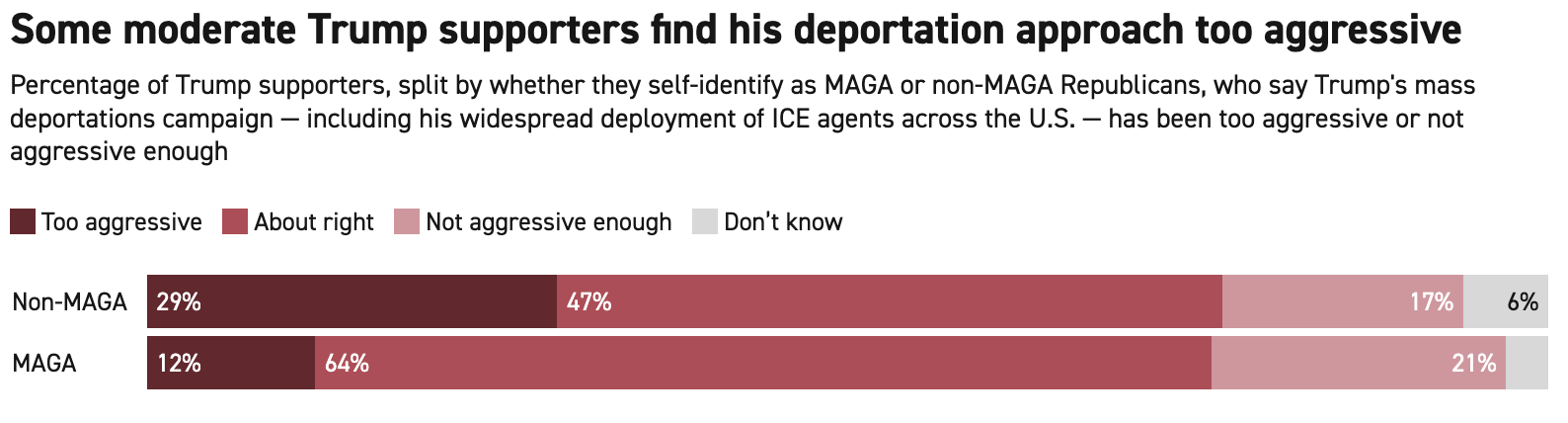 Source: https://www.politico.com/news/2026/01/24/poll-republicans-ice-immigration-deportations-00744668
Migration policy has always been a trump card for Trump and the Republican Party, but now we are seeing a crisis even in this area. This gives the Democratic Party a chance to strengthen its position ahead of the midterm elections in November 2026, where the Democrats are already considered favourites.
In the US House of Representatives, Republicans find themselves in a situation where, in order to retain control of the lower house, the party can afford to lose no more than two seats. According to the latest analysis of the political composition of the districts, 27 out of 435 are considered ‘undecided.’ Most of the districts considered competitive are currently controlled by Republicans — 15 out of 27 (the remaining 12 are controlled by Democrats). This means that the party will have to spend enormous resources to defend current lawmakers in traditionally Democratic states such as California and New York. Also, due to the decline in support for ICE's actions, the party is forced to spend enormous amounts of money to defend current lawmakers in suburban areas, where the immigration issue previously helped Republicans but now works against them.  Seat distribution schedule in the Chamber based on potential winners. Source: https://www.politico.com/news/2026/01/24/poll-republicans-ice-immigration-deportations-00744668
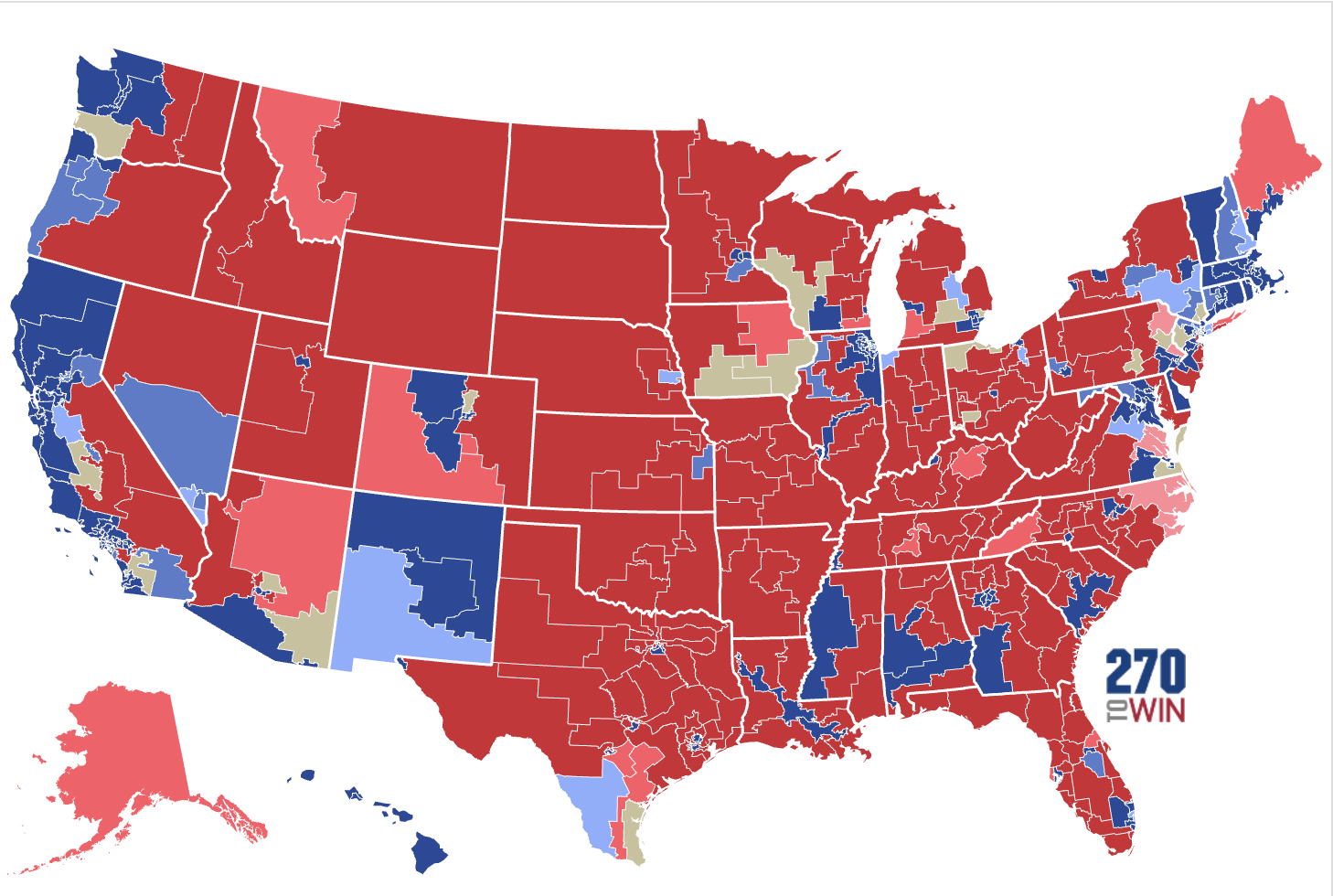 2026 House of Representatives Election Map Safe — Safe (one party has a clear advantage); Likely — Likely (a fairly high probability of victory); Leans — Leaning towards... (a slight advantage); Toss-up — Undecided (both candidates have equal chances, 50/50). Source
Republicans have an advantage in the Senate election cycle: although they have to defend 22 seats against only 13 for the Democrats, the strategic advantage still remains with the conservatives due to the specifics of the electoral map. During midterm elections, unlike the House of Representatives, only one-third of Senate seats are up for re-election.
Most of the Republican seats that are up for re-election are located in so-called ‘deep red’ Republican states such as Idaho, Wyoming and Mississippi, where the incumbent legislator's victory is considered almost guaranteed in the absence of extraordinary scandals. Democrats, on the other hand, despite having fewer seats up for re-election, find themselves in a vulnerable position as they are forced to defend critically important ‘swing’ states, particularly Georgia and Michigan, where every percentage point of the vote can shift the balance of power. The only serious challenge for Republicans in this cycle remains the defence of moderate Susan Collins in the traditionally liberal state of Maine and the fight for a vacant seat in North Carolina. Thus, despite the statistical imbalance in the number of seats at stake, the Democrats' chances remain slim.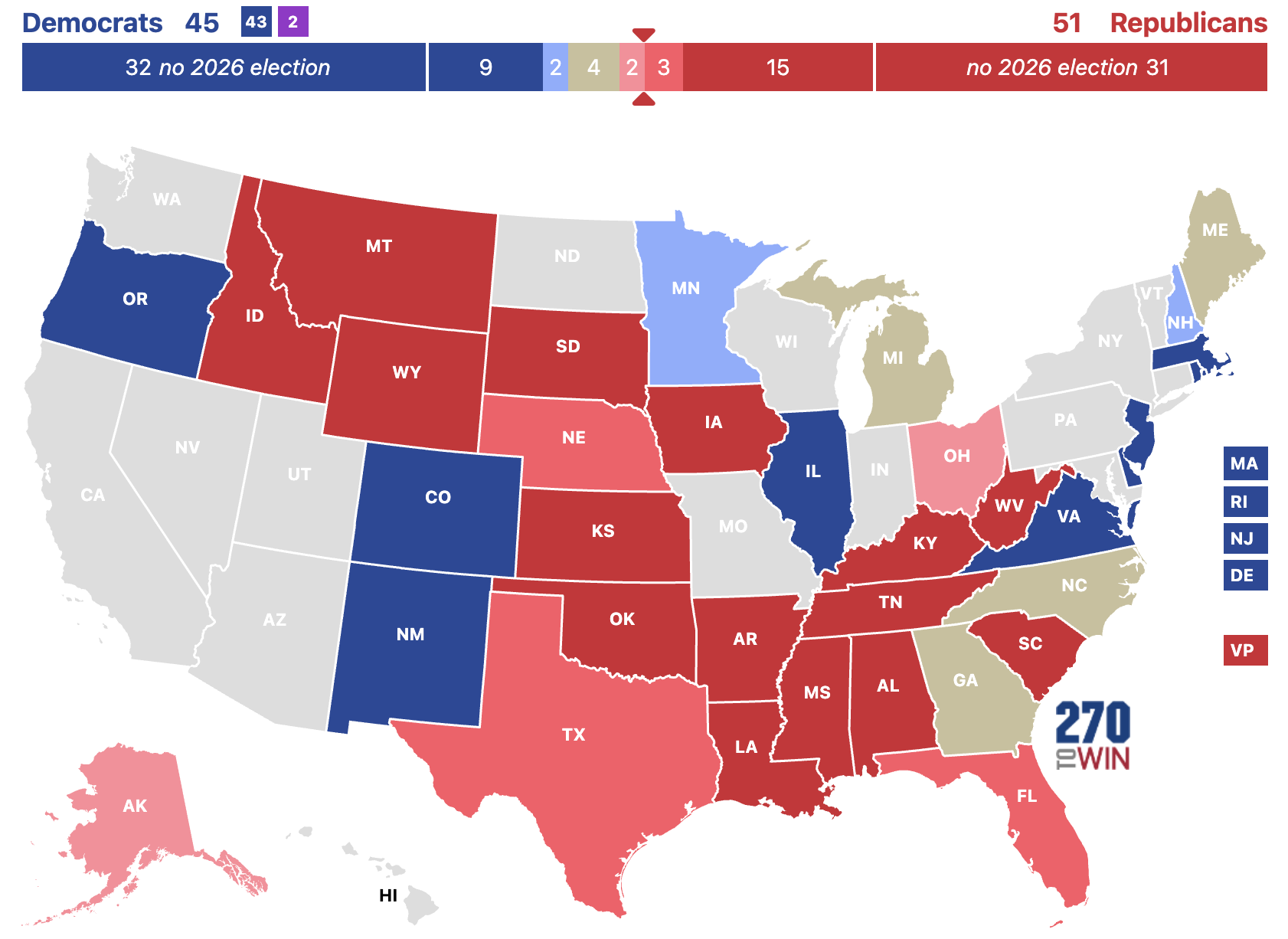 Election map for the 2026 Senate elections, above is a chart showing the distribution of Senate seats based on projected winners. Sourse: https://www.270towin.com/2026-senate-election/
The end of the war in Ukraine could serve as another peacekeeping ‘success’ for Trump, which is why the US wants it to happen as soon as possible — by the end of the summer. Ukrainian President Zelensky understands this and has confirmed it:
"Why this summer? We understand that their internal issues in America have an impact and will probably become even more relevant for them. They will probably just have a different priority — Congress."
A likely Democratic victory in one house will limit Trump's power and complicate the next two years of his term. In this case, the scenario of the 2018 midterm elections will repeat itself, when the Democrats gained an advantage only in the House. The most notable change at that time was the use of the House's subpoena power, which was used to initiate an investigation into the President's tax returns, his business transactions, and how the administration handled access to state secrets. It should be recalled that this parliamentary oversight culminated in Donald Trump's first impeachment at the end of 2019. This happened after a whistleblower reported a phone call with the President of Ukraine, in which the US President pressured Zelensky to cooperate in investigating the actions of Joe Biden, the Democratic Party's candidate for president in the 2020 election. Also, after the 2018 midterm elections, the House began to block Trump's legislative proposals.
At the same time, it is worth noting that during his second term, the US president has relied much more on executive orders: in just over a year, he has signed 239 orders — more than during his entire first term, when there were 220.
So will the new Congress lobby for decisions that benefit Ukraine, or will it focus on the domestic crisis?
Unlike previous elections, these elections are not of fundamental importance for Ukraine. Even if the Democrats win, the role of the US in supporting Ukraine will gradually decline due to a shift in focus to domestic politics and the implementation of the ‘Monroe 2.0’ doctrine. However, in the short term, the renewal of the House of Representatives is still important: it will create a system of checks and balances for the Trump administration, allowing it to balance its decisions and avoid radical shifts.
You may be interested