 INTERNATIONAL
INFORMATION AND ANALYTICAL
COMMUNITY


+ Join
Support INTERNATIONAL



Alyona Chudnovets, Junior Analyst at the analytical center “Resurgam” specializing in African countries’ policy.
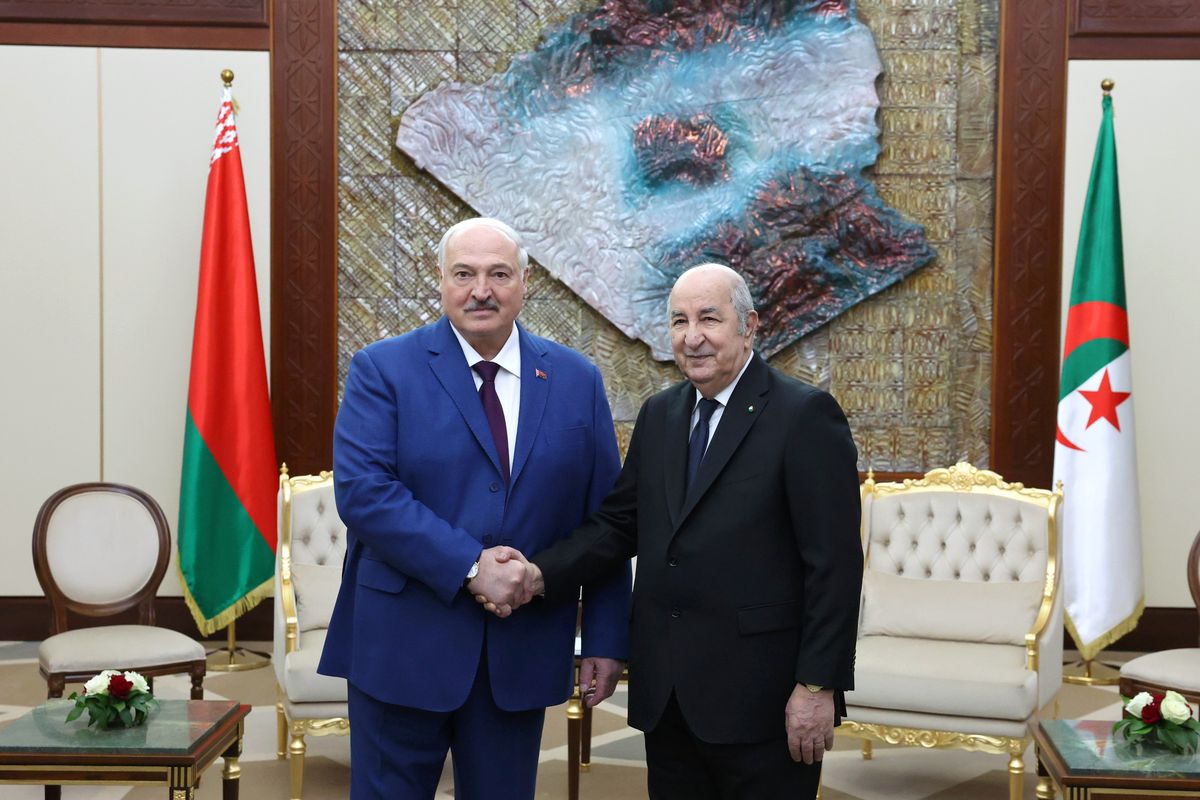 On 1 December 2025, a bilateral business forum was held in Algeria, resulting in the signing of seven commercial documents. As a follow-up, on 2-3 December, Belarusian President Alexander Lukashenko arrived in the country on his first state visit, holding separate meetings with the President of the Council of the Nation, the Speaker of the National Assembly, the Prime Minister and the President of Algeria.
Following the last meeting, the signing of a package of documents was announced, including: a roadmap for commercial, economic and scientific-technical cooperation for 2026-2027, an agreement on military-technical cooperation, as well as a number of memoranda on scientific, academic and industrial cooperation, joint priorities in food security, rural development and mutual standardisation and accreditation.
Until 2020, Belarus pursued a foreign policy of balancing, strengthening ties with China, Southeast Asian countries, and Latin America. The suppression of protests and subsequent participation in the war unleashed by the Russian Federation in Ukraine led to the isolation of Belarus through sanctions. In the context of prolonged economic stagnation and debt pressure, reliance on Russia's system of political and economic contacts in the Global South proved to have no alternatives. From 2022, Minsk made fragmented attempts to strengthen bilateral relations, copying and reinforcing the corresponding course of the Russian Federation. In November-December 2025, Lukashenko's foreign trip for the first time combined previously scattered efforts into a new geopolitical doctrine.
The conceptual framework for the trip was set by his first visit to the Kyrgyz Republic, where on 26-27 November, at the CSTO summit, Russia took over the chairmanship of the organisation, and Vladimir Putin announced the priorities for the new political cycle: “...the tasks of promoting the interests and initiatives of CSTO member states on the world stage are becoming increasingly important.”
Within this framework, Minsk's actions demonstrate the crystallisation of Belarus' unified approach to the Global South: in 2024, the country's trade turnover with Myanmar increased by 1.9 times, with Oman by 2.2 times, and with Algeria by 15 times compared to 2023. Moreover, visits to all three countries were accompanied by a typologically identical package of measures: a business forum, the approval of a roadmap, and the conclusion of agreements in similar sectors, which indicates the creation of a unified practice.
During his visit to Algeria, the Belarusian president directly identified the African region as a priority area for the country's new foreign policy, stating: ‘Africa for us today is like China 30 years ago.’ Algeria, as the largest country on the continent and its ‘northern gateway,’ has land borders with six countries and an extensive coastline on the Mediterranean Sea, covering a critical logistics route between Europe, Africa and the Middle East.
The December Algerian campaign was the first real breakthrough after years of unsuccessful attempts to revive bilateral relations. It is notable in this context that the joint trade commission, established in 2018, held its first meeting only in 2025. Success was ensured by Russian protection. Algeria is Russia's second largest trading partner in Africa, with 73% of its weapons in 2018-2022 coming from Russia. The country also received unprecedented assistance in supplying Algerian gas to Europe. Nevertheless, it is logical to assume that Moscow's concessions of this kind took place solely because of the perception of Algeria as a ‘controlled option’.
This dependence, reinforced by multidimensional cooperation with Belarus, determines Algeria's foreign policy activity and has a destructive impact on Ukraine's international positioning. Despite its declared policy of ‘non-alignment,’ Algeria has already taken demonstrative steps in support of the Russian Federation, including the announcement of joint ‘Desert Shield’ exercises in April 2022 and the visit of President Abdelmadjid Tebboune to the Russian Federation. In addition, all four countries visited by A. Lukashenko abstained from voting on Ukraine's latest UN resolution of 3 December 2025 ‘On the return of Ukrainian children’.
It should be noted that Africa remains the largest regional bloc in the UN (54 countries) and is characterised by a high degree of coordination of activities in international organisations. Accordingly, the establishment of Algeria as a reliable bastion for the expansion of the influence of aggressor countries on other African countries, which is a key goal of Belarus within the framework of this cooperation, poses a threat to Ukraine's ability to promote its interests in the international arena.
Throughout 2025, there is an escalation of the conflict in Western Sahara, with Morocco being supported by a number of countries in Europe, the Middle East (primarily the UAE) and South Africa. In this context, Alexander Lukashenko visits the El Mujahid Martyrs Museum, a monument to French colonialism in the country. Belarusian Foreign Minister M. Ryzhenkov says: ‘...the question of European countries’ responsibility for colonialism and genocide is also one of the key elements of our common policy’. Accordingly, the Russian Federation's formulated course towards a ‘fair multipolar world order’ has become the red thread of Belarusian presence in Algeria.
Moreover, Belarus is trying to use the opportunity for geopolitical reorientation to create a joint project between Belarus, Algeria and Oman for the production of complex NPK fertilisers. A. Lukashenko emphasises Algeria's particular interest in the proposal, which is most likely linked to the desire to challenge the Moroccan OCP Group, which controls 70% of the world's phosphate reserves, mainly from Western Sahara. The African region has 60% of the world's arable land, much of which is in critical need of fertiliser. This is why Belarus is stepping up its efforts in this market. Yet, the country's economic situation doesn't allow for investing in long-term high-risk projects, so there's a real chance that Lukashenko's personal assets or co-financing from Russia will be used.
It is important to note that, as part of its foreign policy balancing strategy, Belarus had already established close relations with Venezuela, the Latin American oil leader under President Hugo Chávez. Belarus counted on Venezuela as an alternative option during the ‘oil wars’ with Russia. The regime's personal loyalty to Lukashenko was beneficial for Belarus, while Venezuela received agricultural equipment. As a result, the change of regime nullified all trade and left Belarus with a debt of $1.5 billion. It is also noteworthy that Russia, which now provides its political protectorate, played a key role in Belarus's ‘defeat’ in Venezuela.
Thus, a stable bloc is being formed between Oman, Algeria and Belarus, which involves the economic and geopolitical interests of the parties and is coordinated by Belarus in accordance with the foreign policy strategy of the Russian Federation. This strengthens Moscow's ability to create a favourable international environment for continuing the war.
The vast majority of agreements signed as a result of the visit to Algeria concerned agriculture. Algeria is completely self-sufficient in meeting its domestic needs, but faces a grain shortage, which is currently being fully covered by the Russian Federation. This is the main area of Ukraine's efforts to promote itself in the Global South, as evidenced by the presidential initiative ‘Grain from Ukraine,’ under which approximately 66 million tonnes of food were delivered to 18 countries around the world. The current trend in Africa is a shift from conventional grain consumption to the creation of a full production cycle on its own territory. In response, Ukraine will reconceptualise the food forum into ‘Food from Ukraine’ in 2025, a transformation that Y. Svyrydenko comments as follows: ‘We are no longer just exporting grain. We are ready to share agricultural technologies, approaches to irrigation and processing.’ The forum was also combined with the AGROEXPO exhibition of Ukrainian agricultural machinery.
That is where Belarus's expansion into Algeria poses a challenge to Ukraine: establishing production facilities in African countries is economically irrelevant, yet Belarus does exactly that. Since 2022, Belarusian agricultural modernisation programmes have been implemented in Zimbabwe, Equatorial Guinea and Kenya. Since the Prime Minister of Algeria himself has agreed to serve as a ‘springboard’ for Belarusian expansion in Africa, it can be said that the country is implementing a policy that increases its dependence on Belarusian technologies and at the same time undermines Ukrainian efforts in the region.
The declared absence of taboo topics in cooperation with Algeria creates a factor of personal loyalty of undemocratic regimes to Belarus. Belarus' willingness to assist in any matter is of particular interest to authoritarian and transitional regimes, creating a high degree of dependence on it. Thus, A. Lukashenko ensured international legitimacy for the military junta in Myanmar on the eve of elections against the backdrop of an ongoing civil war that has taken the lives of more than 75,000 people. At the same time, the desire to conclude agreements in all possible areas is based on the need to increase economic presence. The announced increase in trade turnover between Belarus and Algeria to $500 million within two years (compared to an indicator of $49.13 million for 2024) is fuelling the desire to expand cooperation indiscriminately.
Under sanctions pressure, Belarus has done a lot to build its international position, with the success of the Algerian campaign being a key indicator of this. Its main goal is to open up broader African markets for Belarusian goods and services, within which both the willingness to provide any agricultural technologies and the trilateral fertiliser initiative create a basis for rapidly increasing influence in the region. At the same time, dependence on the political and economic protectorate of the Russian Federation continues to significantly limit the autonomy of the foreign policy decisions of Alexander Lukashenko's regime.
The momentum achieved and the expected consolidation of efforts within the CSTO under the chairmanship of the Russian Federation indicate that a qualitatively new milestone in the battle for the Global South can be expected in 2026. Through Belarus, the Russian Federation is testing a doctrine whereby states loyal to it not only enjoy the benefits they receive, but also avoid the consequences on the international arena resulting from the establishment of the Russian Federation's ‘fair multipolar world order’. Thus, Belarus' actions are fully integrated into the broader Russian geopolitical doctrine and have a coordinated destructive impact on Ukraine's international positioning and, therefore, its military abilities.
You may be interested