


 INTERNATIONAL
INFORMATION AND ANALYTICAL
COMMUNITY


+ Join
Support INTERNATIONAL


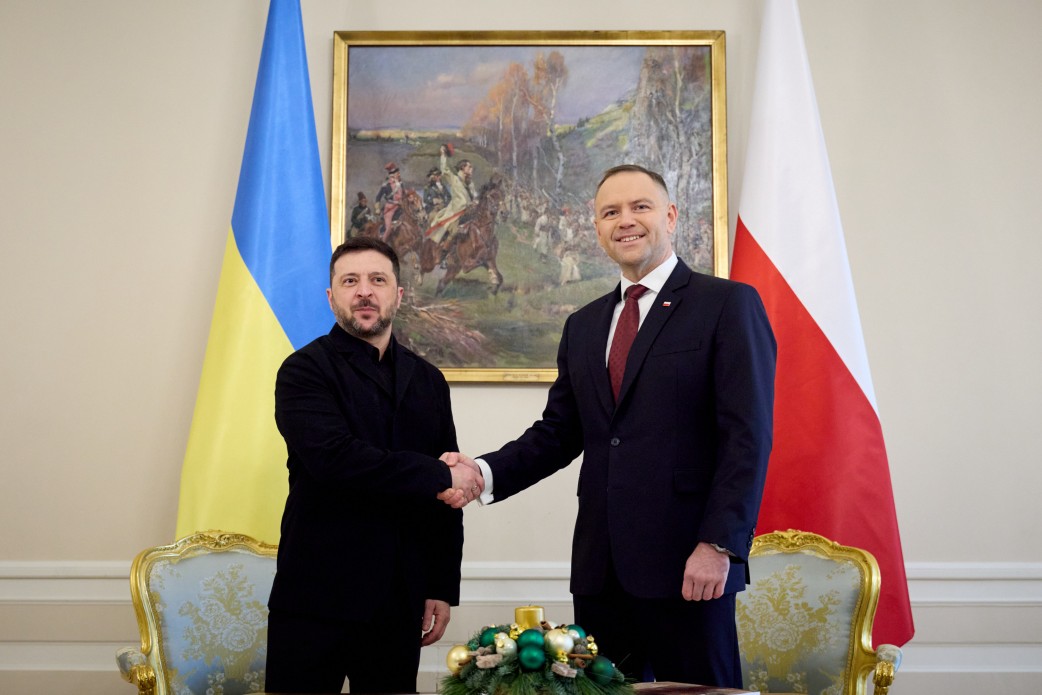 Photo: president.gov.ua
Despite the seemingly constructive atmosphere surrounding these meetings, Polish–Ukrainian relations in the coming years will probably remain marked by high levels of competition and conflict. These relations are cyclical, as Poland and Ukraine are mutually dependent. Each country pursues its own national interests, which are often fundamentally incompatible.
In this context, it is worth remembering that in December this year Poland received an invitation from the United States to participate in the G20 summit. Although Warsaw will attend as a guest rather than a member, this is a significant step for a country seeking to secure its place among the world’s leading economies.
The argument behind the U.S. invitation was that Poland’s economy crossed the symbolic threshold of one trillion US dollars in 2025. Thus, the country entered the group of the world’s twenty largest economies.
It is worth emphasizing that the ambitions of Poland’s political elite extend far beyond economic growth only. To provide broader context, it is useful to recall how Poland’s contemporary geopolitical role in Europe was formed. The so-called Weimar Triangle was established in 1991 as an informal group of Poland, Germany, and France, with the goal of assisting Poland in joining the European Union and NATO. At that time, Germany and France acted as mentors and sponsors of Poland’s transformation.
At the same time, Germany used Poland as an ally in its struggle with France for informal leadership in Europe. With Poland on its side, Berlin gained additional votes in European decision-making and strengthened its influence in Central and Eastern Europe.
Today, however, the situation is different. Poland’s economy has grown to the point where the country now seeks to become an independent and influential geopolitical actor in its own right.
Within these ambitions, Ukraine is assigned a role similar to the one Poland once played for Germany. Warsaw seeks to use Kyiv as a partner to amplify its own influence in the region and as additional political weight in debates over European affairs.
However, there is a fundamental difference between the way Germany treated Poland and the way Poland approaches Ukraine. While Berlin used Poland in its geopolitical calculations, it also actively invested in the Polish economy.
It is worth noting that Poland simultaneously pursued successful reforms that laid the foundation for its economic “miracle.” Nevertheless, EU funding and direct German support ultimately proved decisive.
In the case of Polish–Ukrainian relations, the situation is fundamentally different. Ukraine itself may become a potential competitor to Poland among the countries of the region. Several factors contribute to this, ranging from territorial size, population, and resource potential to military and geopolitical weight.
Therefore, although Warsaw’s attempts to use Kyiv for its own ambitions superficially resemble the strategy once pursued by Germany toward Poland, in substance they are radically different.
Instead of investment and assistance in development, Warsaw seeks to impose historical guilt on Ukraine. The Volhynia tragedy remains a convenient pretext used by the Polish government to justify actions aimed at concealing its true motives in regional competition. The recognition of unilateral guilt for the Volhynia tragedy is viewed by the Polish authorities as a key instrument of future control.
Through this mechanism of traumatized relations, Poland seeks to keep Ukraine in the position of a junior, dependent partner—one compelled to constantly justify itself and apologize, rather than develop relations on an equal footing.
Balancing relations between the two countries, in reality, lies in deepening Ukraine’s relationship with Germany. Friedrich Merz, who became Germany’s chancellor in May 2025, represents a new approach to the country’s foreign policy. Under his leadership, what some describe as a German “awakening” is taking place.
Merz is a convinced supporter of Ukraine and has repeatedly criticized his predecessor, Olaf Scholz, for indecisiveness in supporting Kyiv. The new chancellor advocates a more autonomous role for the European Union and closer cooperation with Paris and London.
Germany is more removed from Ukraine, resulting in fewer fundamental points of tension than with Poland. At the same time, it has the resources and capacity for truly equal exchanges. Ukraine may provide Germany with what Poland once did, but in a modern context and with new emphases.
First, this concerns the strengthening of continental influence. Partnership with Ukraine would allow Germany to increase its weight in European politics, particularly in matters of security and energy. Ukraine could become a key ally for Berlin in shaping a new European security architecture after Russia’s full-scale war.
Second, Kyiv may become a platform for strengthening Germany’s image. Just as support for Poland once helped Germany launder its historical reputation after the Second World War, support for Ukraine gives Berlin an opportunity to present itself as a reliable partner standing on the side of democracy and international law.
Moreover, Kyiv acts as a deterrent to Russia. A strong Ukraine integrated into European structures becomes a natural barrier to Russian aggression. For Germany, this means greater security along the eastern border of the European Union.
Paradoxically, the deepening of Ukrainian–German relations represents the Polish political elite’s worst nightmare. These relations may, in turn, help balance and sustain the partnership between Ukraine and Poland.
In case Ukraine has Germany as a strong alternative partner, Poland will be compelled to cease efforts to dictate terms and move toward a genuinely equal dialogue.