INTERNATIONAL
INFORMATION AND ANALYTICAL
COMMUNITY


+ Join
Support INTERNATIONAL



Danylo Moskalenko, junior Analyst at the Resurgam Center for Asia-Pacific Affairs
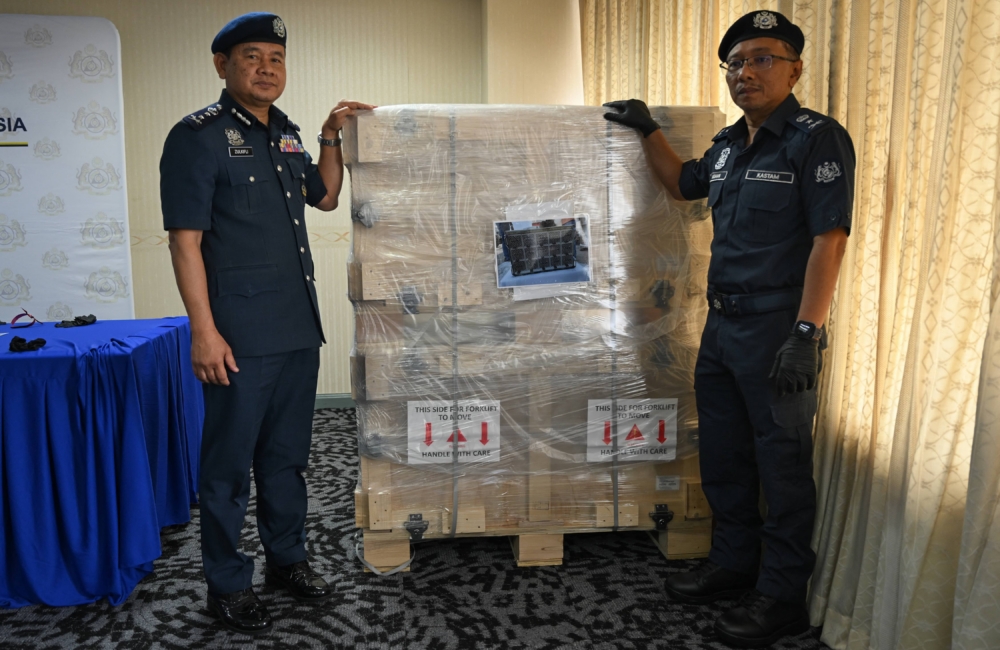 Members of the Royal Malaysian Customs pose for photographs with computers equipped with AI chips confiscated during a press conference in Sepang on June 26, 2026. Фото: Mohd Rasfan / AFP
Since at least the fall of 2022, the United States has used a combination of export and investment restrictions to limit China’s access to advanced semiconductors and AI technologies. However, by using the territories of Southeast Asian countries, particularly Malaysia and Singapore, the Celestial Empire has found ways to circumvent these restrictions.
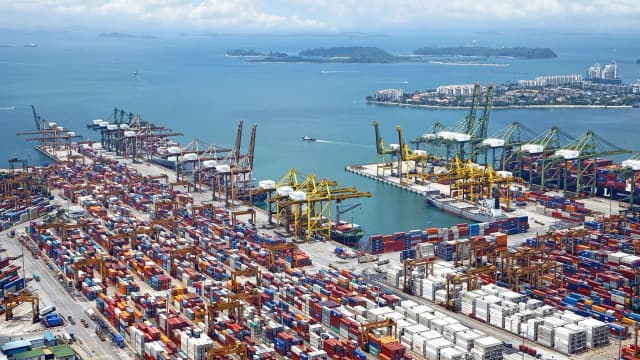
Southeast Asia has emerged as a major hub for China to circumvent U.S. export restrictions on advanced semiconductors and artificial intelligence equipment. As direct shipments of U.S. equipment to China have declined sharply, regional intermediaries have increasingly used free trade zones, designed to facilitate the rapid re-export of goods, as cover for illegally rerouting restricted technologies.
Other common methods include falsifying documents, such as declaring chips as different products, making transit routes more complicated, and using shell companies. The scheme involving shell companies is particularly interesting because they can be registered online within a few hours for a few thousand dollars, allowing them to use licensing exemptions such as the U.S. LPP (Low Processing Performance) rule. It allows companies in countries with partial export restrictions to purchase up to 1,700 AI chips per year without a special license. Intermediaries buy the chips for legitimate local use and then divert them to China through middlemen and distributors.
As a result, more than $1 billion worth of sanctioned Nvidia B200, H100, and H200 processors reached China during a three-month period in 2025, with most of them routed through Southeast Asian logistics networks.
The scale of these illegal flows is illustrated by a number of high-profile criminal cases and arrests carried out by local and U.S. authorities. In Singapore, for example, authorities launched a high-profile investigation into the management of local server reseller Aperia Group, who are accused of misleading U.S. suppliers about the end users of servers containing Nvidia chips that were actually destined for China. As part of the investigation, Singaporean police froze luxury properties worth around $42 million.
 Alan Wei Zhaolong, CEO of Aperia Group, arrives at the State Courts on July 6, 2026. Source
Particularly notable is the scheme involving the physical dismantling and smuggling of server equipment that, according to U.S. sources, was used by the Chinese company DeepSeek. Chinese developers set up front companies with no apparent links to China and arranged for servers equipped with advanced Blackwell chips to be purchased through authorized distributors and delivered to data centers in Southeast Asia. Once the equipment had been installed, representatives of companies such as Nvidia, Dell, and Super Micro would personally visit the sites to conduct compliance checks and verify adherence to U.S. export rules. However, immediately after the official inspection was completed, the servers were dismantled, their components were smuggled into China using false customs declarations, and later reassembled and installed directly in Chinese data centers.
Beyond the physical movement of hardware, there is another important route: the so-called “cloud loophole.” U.S. export controls have traditionally focused on the physical shipment of chips and their ownership, leaving remote access to computing power over the internet largely outside the scope of strict regulation. Chinese tech giants such as Tencent, Alibaba, and ByteDance, along with startups such as Moonshot AI, actively rent access to advanced Nvidia chips in data centers in Malaysia, Thailand, Japan, and elsewhere in the region, without purchasing the accelerators themselves. In some cases, to get around network bandwidth constraints, Chinese companies simply shipped physical hard drives containing large datasets to Malaysia, trained AI models on Nvidia-equipped servers there, and then brought the drives containing the finished model weights (what the AI has learned) back to China. This allowed them to avoid formally violating rules on the cross-border movement of controlled goods, since none of the sanctioned chips ever left the third country.
Renting computing capacity is often arranged through complicated legal structures involving multiple partners. For example, ByteDance used Singapore-based cloud company Aolani to access Nvidia chips in Malaysia and also worked with U.S. cloud provider Oracle through DayOne, the international arm of Chinese data center operator GDS Holdings. Much of Oracle’s computing capacity in Southeast Asia was in fact being used by ByteDance, which was simultaneously investing billions of dollars in its own infrastructure in Malaysia, including a major AI hub in Johor.
Another tech giant, Alibaba Group, has gained access to Nvidia’s latest processors in Malaysia through Singapore-based Megaspeed International, using a complex ownership structure that links the Singaporean company to a Cayman Islands entity ultimately owned by Alibaba. Megaspeed quickly became one of Nvidia’s largest customers in the region, importing more than 136,000 GPUs, including chips based on the latest Blackwell architecture, worth at least $4.6 billion. During an unannounced inspection by Nvidia representatives, however, they found only a few thousand chips on site, prompting U.S. regulators to investigate whether the processors had physically crossed the border into China.
An interesting part of the investigation into the Megaspeed case has been examining the company’s links to Chinese business, particularly through its founders and funding structure. Investigators found that Megaspeed was effectively spun off from the Chinese gaming company 7Road, while its founder, Huang Le, had previously been questioned by Singaporean police. Analysts also found that renderings of a data center included in Megaspeed’s investment materials bear a striking resemblance to a project in the Yangtze River Delta near Shanghai involving major Chinese technology companies, including Tencent. They also uncovered traces indicating that the project was financed by a holding company that had previously been owned by Huang Le himself.
The Chinese telecommunications giant Tencent has also secured access to 15,000 Blackwell B200 GPUs through Japanese data center operator Datasection, signing a three-year, $1.2 billion contract. The deal helped the Japanese company to cover the enormous upfront costs of building the computing cluster.
In July 2026, a White House official accused the Chinese company Moonshot AI of using Nvidia’s latest GB300 chips through a data center in Thailand to train its open-source Kimi K3 model.
U.S. sanctions have also fundamentally reshaped the geography of semiconductor manufacturing equipment supplies. In 2025, direct imports of such equipment from the United States to China fell by more than 34%, to $2 billion. At the same time, China’s purchases from Singapore rose by 17%, to $5.7 billion, while imports from Malaysia doubled to $3.4 billion. This reflects the growing role of Singapore and Malaysia for semiconductor equipment manufacturers that maintain close ties to U.S. technologies, software, and compliance standards. In 2025, the share of revenue that the three leading U.S. semiconductor equipment manufacturers — Applied Materials, Lam Research, and KLA Corporation — derived from the Chinese market remained high, at 30%, 34%, and 33%, respectively. Their combined revenue from China reached approximately $19 billion.
China has successfully rerouted its supply chains to source spare parts and components, as well as chip assembly, testing, and advanced packaging services, through these intermediaries. While they formally operate within the law, in practice they help keep China’s domestic semiconductor industry to run.
The United States is countering efforts to circumvent technology restrictions by overhauling its export control system, strengthening physical oversight of shipments, and developing legislative tools to close digital loopholes.
In November 2023, the United States introduced mandatory licenses for the export of advanced computer chips and technologies, restricting their supply to specific end users. In January 2025, these rules were updated to extend restrictions on certain types of chips to entire countries around the world, rather than limiting them to individual customers. Then, in mid-2026, the U.S. Department of Commerce’s Bureau of Industry and Security (BIS) issued guidance clarifying the application of export restrictions to any foreign subsidiaries whose ultimate parent companies are based in China or Macau, in an effort to prevent precisely these kinds of circumvention schemes. This move shifted the focus of compliance checks from the physical destination of the chips to their ultimate owner, blocking Chinese affiliates from purchasing advanced equipment.
It is also worth mentioning the Cloud Act, adopted in 2018, which under certain circumstances allows U.S. law enforcement authorities to access data held by foreign subsidiaries of U.S. companies.
To close the aforementioned “cloud loophole,” the House of Representatives passed the Remote Access Security Act (RASA), which is awaiting consideration by the Senate. The bill would treat remote cloud access to controlled technology as equivalent to a full physical export. For cloud service providers, this would significantly complicate compliance with export control requirements, obliging them to implement Know Your Customer (KYC) and user verification procedures.
In May 2025, the Chip Security Act was introduced. The bill would require manufacturers to integrate security mechanisms into advanced computing chips that automatically verify their geolocation before the equipment is exported, re-exported, or transferred within a foreign country. Any person or company licensed to conduct transactions involving such chips would be required to immediately notify the BIS if they received information that a device had deviated from its original route, had been diverted from its destination, or had been subject to unauthorized tampering. The bill would also grant the Department of Commerce authority to conduct enforcement checks on the owners and actual geographic location of chips abroad. However, the bill has not yet been passed by either chamber of Congress.
The United States is also turning its attention to the logistics companies responsible for transporting the shipments. According to reports, U.S. authorities are investigating Singapore-based logistics company Apex Logistics, a subsidiary of Japan’s Kintetsu World Express, over its alleged involvement in the illegal shipment of NVIDIA AI chips to China. If the allegations are confirmed, the case would mark the first time U.S. authorities have taken enforcement action directly against a logistics operator, rather than against an end user or direct exporter in the semiconductor supply chain. This would signal a significant expansion of Washington’s efforts to control the flow of advanced technologies to China.
In addition to routine border controls aimed at detecting circumvention schemes, Malaysia has introduced a range of measures to counter efforts to circumvent U.S. export controls on advanced AI chips. The strategy is intended to protect the country’s reputation as a neutral technology partner, prevent its territory from being used as a transit route for the illicit movement of technology, and avoid the risk of secondary sanctions.
Malaysia’s main instrument in this effort was a decision by the Ministry of Investment, Trade and Industry (MITI) on July 14, 2025, to introduce Directive No. 1/2025, requiring the declaration of certain goods that are not included in the official Strategic Items List. The directive is based on an “end-use control” mechanism, which allows the government to regulate the export, transit, or transshipment of certain technologies even when they have not yet been formally placed on the list of goods subject to export controls.
The new rules cover three main categories of goods containing high-performance chips: the integrated circuits themselves; computers, electronic units, and components containing such chips; and information security systems and equipment that uses them. If an exporter, transit operator, or transshipment party knows or has reasonable grounds to believe that the technology could be used for a “prohibited activity,” they must submit a special AI Chip Assessment Form to the Strategic Trade Secretariat (STS) at least 30 days before the transaction. “Prohibited activity” includes, among other things, assisting in the development, stockpiling, or proliferation of weapons of mass destruction, as well as conducting transactions with persons involved in such activities. After reviewing the application, the STS determines whether the specific transaction requires a Strategic Trade Permit. If one is required, moving the goods without a permit is illegal. Violations of these rules are subject to substantial fines and criminal penalties.
At the same time, Malaysia seeks to maintain a technology-neutral approach to its technology policy, working with both U.S.-based NVIDIA and China’s Huawei while developing its own capabilities. Kuala Lumpur continues negotiations with the United States on a Reciprocal Trade Agreement and is working with Washington to strengthen the resilience of semiconductor supply chains.
 Investment, Trade and Industry Minister Datuk Seri Tengku Zafrul Aziz urged APEC member economies to harness the momentum of digital transformation and artificial intelligence to drive inclusive and sustainable growth across the region. Source
Singapore does not have the same broad range of legislative initiatives aimed at countering the circumvention of U.S. export restrictions. Instead, its law enforcement agencies prosecute these cases as fraud and money laundering charges against specific individuals, as in the aforementioned Aperia and Megaspeed cases, in which Singaporean authorities played an active role. They also investigate companies directly involved in transporting the goods. In such cases, Singaporean law enforcement and regulatory authorities coordinate their investigations with U.S. and Malaysian authorities. Singapore has also introduced severe penalties for such forms of falsification, including up to 20 years in prison and substantial fines.
Singapore is taking part in uncovering these circumvention schemes because it wants to protect its status as a trusted global financial and logistics hub, while also maintaining deep defense and technology ties with the United States. As a result, large-scale evasion of U.S. controls through Singaporean companies could lead to diplomatic tensions and fragmentation of regional logistics networks.
Their proximity to China and balanced foreign policies have made Southeast Asian countries some of the main transit hubs for advanced U.S. technologies. At the same time, maintaining a balance between China and the United States in the technology sector has become part of their broader policy approach. Singapore and, above all, Malaysia, which is seeking to develop its own technological infrastructure, may benefit from serving as intermediaries for China through investment, job creation, and technology transfers. At the same time, they need to work with the United States and coordinate measures to prevent violations of its export controls, as being placed under export restrictions themselves would cut off their access to advanced U.S. technologies and damage the region’s reputation.
Moreover, the system for detecting and preventing circumvention schemes is not yet sufficiently effective. These schemes are often uncovered only after the fact and on the ground — at the border, during random spot checks, or through unrelated cases, such as the discovery of offshore assets acquired with proceeds from the illegal trafficking of technology. Preventive controls remain underdeveloped, although institutional capacity is improving as the issue receives greater attention. For now, it seems that the sheer scale of these schemes — which eventually becomes impossible to overlook — is one of the main factors that leads to their detection.
Another weakness in efforts to prevent the illicit transit of U.S. technologies is that regulation struggles to keep up with new ways of circumventing export controls. By the time Congress passes legislation through both chambers to close a loophole that has already been identified, companies have often moved on to other ways of evading the restrictions. While U.S. laws are still focused on regulating the physical shipment of chips, the industry is already shifting toward cloud-based access, where computing power can be accessed remotely without transferring the physical hardware itself. Companies on the ground can move faster than regulators in Washington, allowing them to exploit gaps in existing rules and adapt quickly to new restrictions.
You may be interested