 INTERNATIONAL
INFORMATION AND ANALYTICAL
COMMUNITY


+ Join
Support INTERNATIONAL



Diana Shevchenko, Intern at the Resurgam Analytical Center
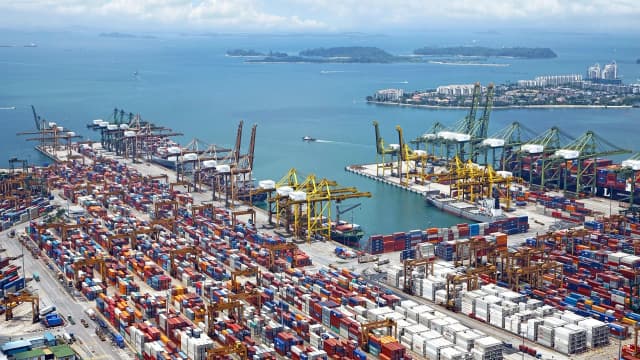
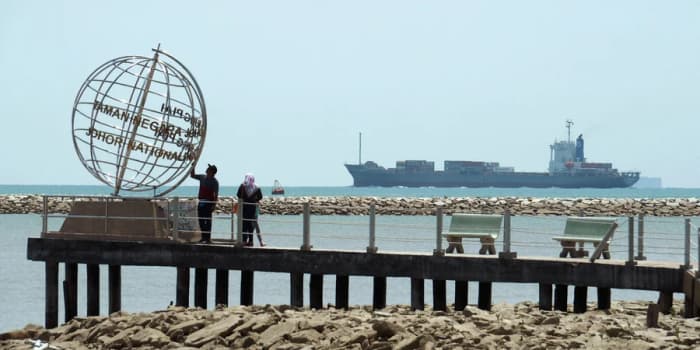 A container ship enters the Singapore Strait, heading toward the Strait of Malacca. Tourists stand beside a symbolic sign marking the southernmost point of Asia in Johor, Malaysia. Photo: REUTERS/Henning Gloystein/File Photo
This issue is particularly relevant in the case of the People’s Republic of China, whose economic development depends to a significant extent on the stability of maritime transportation. The concentration of a substantial share of China’s energy imports and foreign trade along a single maritime route has created a set of risks known as the “Malacca dilemma.” Despite the implementation of large-scale infrastructure and security projects, this issue remains relevant. On the contrary, the deepening strategic rivalry between the United States and China, as well as growing tensions over Taiwan, have given it new geopolitical significance.
Running along the Malay Peninsula and connecting the Indian and Pacific oceans, the Strait of Malacca is one of the most important maritime routes in the Asian region. It is one of the shortest routes used to transport goods from the Middle East to East Asia. In the first half of 2025 alone, 23.5 million barrels of oil per day passed through the strait, making it one of the world’s major chokepoints — narrow passages that are critical to global energy trade.
The strategic significance of the Strait of Malacca is determined not only by the volume of traffic passing through it, but also by the lack of equivalent alternatives in the event of its closure. If the strait was blocked, ships would have to use the Lombok or Sunda straits, increasing the distance by between 1,700 and 2,900 km, depending on the route and destination. This would result in longer transit times, higher fuel consumption and increased shipping costs, which, in turn, would drive up energy prices.
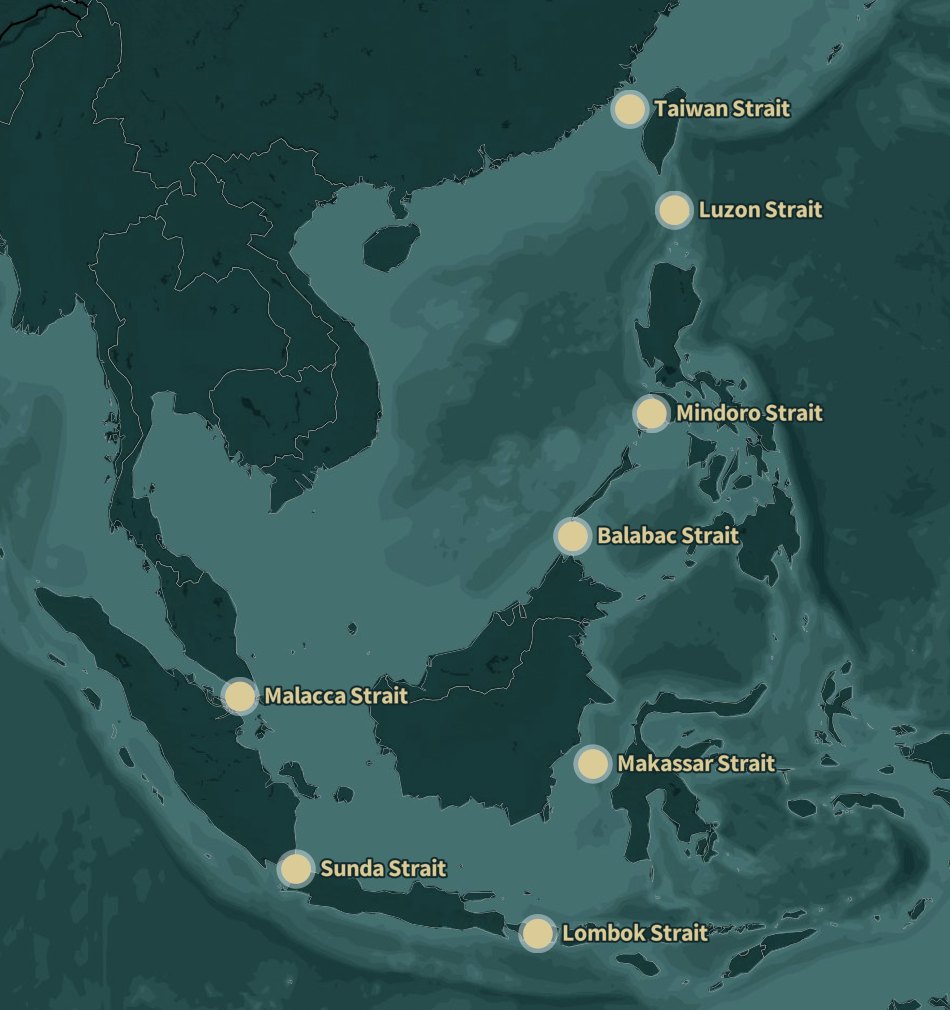 Malacca, Sunda, and Lombok straits. Source
The importance of this issue was underscored in 2026 amid the worsening security situation around the Strait of Hormuz and Iran’s intention to impose transit fees on ships. Indonesia’s finance minister Purbaya Yudhi Sadewa proposed introducing a transit fee for vessels passing through the Strait of Malacca at a financial symposium in Jakarta, but quickly abandoned the idea, stressing that Indonesia would not seek to monetize international shipping routes simply because it had the ability to do so.
Singapore’s foreign minister Vivian Balakrishnan said that the countries bordering the strait share a strategic interest in keeping it open, and assured that the right of passage is guaranteed to all and that Singapore would not participate in any blockade of the strait or impose transit fees. Malaysia has taken the same position. Malaysian foreign minister Mohamad Hasan also stated that unilateral decisions regarding the strait cannot be made.
This situation demonstrated that even the coastal states have limited powers over the strait, but this does not prevent it from being a space where their interests intersect. For Singapore, Malaysia, and Indonesia, the most important thing is for the strait to remain open and safe, with the countries cooperating to combat piracy and maintain the safety of navigation.
For extra-regional powers, particularly the United States, the strait plays an important role, as it is one of the key elements of the Indo-Pacific region’s maritime communications network. U.S. strategy calls for maintaining regional security, freedom of navigation, and open sea lanes. This is why Washington has consistently expanded military and political cooperation with the states that control the strait over the past several decades.Long-term defense agreements with Singapore, deeper cooperation with Malaysia and Indonesia, and a broad network of regional allies give the United States the ability to influence the security environment around one of the world’s most important maritime hubs. Although such cooperation does not amount to direct control over the Strait of Malacca, it significantly expands Washington’s strategic options in the event of a crisis.
However, it is for the People’s Republic of China that the Strait of Malacca is of greatest importance, as it represents an energy security risk: 80% of the crude oil passing through the strait is transported to China. It is precisely this disproportionately high dependence on the uninterrupted operation of the Strait of Malacca that gave rise to the concept of the “Malacca dilemma,” which has become one of the key elements of contemporary Chinese strategic thinking.
Since the establishment of the People’s Republic of China in 1949, the country has undergone a prolonged period of economic transformation. The most significant changes took place following the launch of the reform policy in the late 1970s and the opening of the Chinese economy to global trade, which led to increased energy consumption. In 1993, the PRC became a net importer of oil, while its accession to the World Trade Organization in 2001 significantly accelerated the integration of the Chinese economy into global production chains. Rapid growth in industrial production led to a sharp increase in demand for energy resources.
Although China has significant domestic oil reserves, its domestic production has been unable to keep pace with consumption, making the People’s Republic of China dependent on foreign sources of supply. As the world’s largest oil consumer, China is also the world’s largest oil importer.
The possibility of disruptions to energy supplies passing through the Strait of Malacca became one of the factors shaping China’s perception of its own vulnerability. For this reason, from the mid-2000s onward, one of the priorities of China’s foreign and economic policy was to seek alternative routes for energy imports and develop transport infrastructure capable of reducing its dependence on the Strait of Malacca. This policy was a response to the “Malacca dilemma,” which was first publicly articulated by Hu Jintao, General Secretary of the Central Committee of the Communist Party of China, in 2003, when he highlighted China’s strategic vulnerability stemming from its dependence on this maritime route.
At the beginning of the 21st century, China still lacked sufficient naval capabilities to secure its own maritime routes and lines of communication far beyond its coastal waters. Despite the modernization of the People’s Liberation Army, its navy remained primarily focused on coastal defense and was not capable of providing sustained escorts for merchant vessels or maintaining a permanent presence in the Indian Ocean. In addition, China lacked an extensive network of overseas naval bases and logistical facilities needed to conduct operations at a considerable distance from its own territory.
By contrast, the United States already possessed the world’s most powerful navy and maintained an extensive network of allies and partners in the Indo-Pacific region, giving it significant capabilities to influence the security of key maritime lines of communication. Under these circumstances, Beijing recognized that the uninterrupted operation of the route through the Strait of Malacca depended to a significant extent on factors beyond its direct control.
In November 2003, Chinese leader Hu Jintao delivered a speech in which he stated that certain major powers were seeking to control the strait. The statement came against the backdrop of an increased U.S. naval presence in the strait. The United States justified its presence in the waters of the Strait of Malacca by its efforts to keep the route open and combat piracy, as the strait had long been subject to periodic pirate attacks.
The issue of piracy was critical, prompting Singapore, Indonesia, and Malaysia to begin cooperating to address it. The United States, together with Japan and India, in turn joined the coastal states in conducting exercises and sharing intelligence. Chinese security analysts accused the United States and Japan of using the threat of terrorism and piracy as a pretext for expanding their naval presence in and around the strait.
The growing presence of India also raised concerns, particularly due to the modernization of military facilities on the Andaman and Nicobar Islands, located near the northern entrance to the Strait of Malacca. Meanwhile, the U.S. revival of the International Military Education and Training program in Indonesia was described by a Chinese newspaper as “control over China in the Pacific.” Under these circumstances, Beijing began to view the presence of U.S. naval forces in the vicinity of the Strait of Malacca as a potential source of vulnerability and an instrument of economic and political pressure.
After recognizing its vulnerability, China began developing a comprehensive strategy to reduce its dependence on energy supplies passing through the Strait of Malacca by diversifying routes, developing transport infrastructure, and strengthening its own naval capabilities. The main objective of these measures was to reduce the risks associated with potential disruptions to shipping along the main maritime route between the Indian and Pacific oceans.
The first area of development was the expansion of overland routes for energy imports. For this reason, China significantly expanded its network of pipelines with neighboring countries. One of the first directions was Kazakhstan, which has the largest oil reserves and production levels among the countries of Central Asia. In May 2004, a framework agreement was signed on cooperation between the Republic of Kazakhstan and the People’s Republic of China in developing bilateral relations in the oil and gas sector. In December 2005, the first Atasu–Alashankou oil pipeline was commissioned. Stretching 965 km, it diverts around 20 million tonnes of oil per year. Later, in 2007, a project for a new Kenkiyak–Kumkol pipeline, 794 km long, was presented. Its construction was completed in 2009, and it diverts around 10 million tonnes of oil per year.
The second partner country was Russia. The East Siberia–Pacific Ocean oil pipeline is one of the longest pipelines, stretching 4,770 km and transporting oil from fields in Eastern Siberia to the Kozmino seaport terminal, from where it is exported to Asian markets (China, Japan, South Korea). Most of the flow is directed toward the Pacific Ocean, but there is a key section known as the “Russia–China” oil pipeline, consisting of two parallel branches: the first was built in 2011, and the second in 2018. Together, the two branches supply around 30 million tonnes of crude oil per year. In 2019, the Power of Siberia gas pipeline was commissioned, supplying China with 38.8 billion cubic meters of gas (as of 2025).
The third, but no less important, partner country for China is Myanmar. Two pipelines run between the countries: one gas pipeline from the port of Kyaukpyu and one oil pipeline from Madae Island. The pipelines enter China through Ruili in Yunnan, with their respective endpoints extending to Chongqing in the southwest of the country and the Guangxi coastal autonomous region in the south. The gas pipeline began operations in July 2013, while the oil pipeline began trial operations in January 2015 and was restarted in March 2017. Each year, they supply China with 22 million tonnes of crude oil and 12 billion cubic meters of gas, bypassing the Strait of Malacca.
The second area that the PRC began to pursue was the development of an alternative route to the Indian Ocean. Since most oil imports come from the Middle East, it was important for Beijing to have the ability to receive shipments before vessels entered the Strait of Malacca. For this reason, China began building a network of ports along the Indian Ocean coast. This effort is being pursued through the Belt and Road Initiative, introduced by Xi Jinping in 2013.
Although its official primary objective is to promote international trade and economic cooperation, in geostrategic terms it is aimed at reshaping China’s transport routes. Through the construction of railways, highways, pipelines, logistics hubs, and seaports, Beijing seeks to create a network of alternative routes that would reduce its dependence on a single critical maritime route.
A particularly important role is played by the 21st Century Maritime Silk Road, under which China invests in port infrastructure from Southeast Asia to East Africa and the Mediterranean. Key projects include the port of Gwadar in Pakistan and the port of Kyaukpyu in Myanmar. Kyaukpyu has effectively become the terminal point of the oil and gas pipelines, allowing energy resources to be delivered directly to China and shortening the maritime leg of the route by almost 1,200 km. At the same time, Gwadar, a key component of the China–Pakistan Economic Corridor, is regarded as a prospective logistics hub for importing energy resources from the Persian Gulf and developing transport links with China’s western provinces.
The development of the “Polar Silk Road” initiative as part of the Belt and Road Initiative is also noteworthy. After joining the International Arctic Science Committee in 1996, Beijing began actively participating in Arctic Council activities and scientific research. Although China does not have open access to the Arctic Pole (the closest point to the North Pole is located in Mohe county, 1,400 km from the Arctic Circle), this did not prevent China from publishing a white paper on “China’s Arctic Policy” in 2018 and establishing the Yellow River Station research station in the small settlement of Ny-Ålesund on the Norwegian Svalbard archipelago.
The country’s interest in the Arctic region is driven by melting ice, which could facilitate the use of Arctic maritime routes for transporting goods between Europe and Asia, cutting travel time by half. The white paper also recognizes that the Arctic shipping routes of the Northeast Passage along the Russian coast, the Northwest Passage along the coast of Canada, and the Central Passage through the North Pole are likely to become important transport routes for international trade. Therefore, China hopes to work with all parties to build a “Polar Silk Road” and develop Arctic infrastructure.
In addition to external projects, the PRC places considerable emphasis on developing its own naval forces to protect maritime lines of communication. In 2015, China released a defense white paper that included a strategy for military development and the concept of Far Seas Protection.
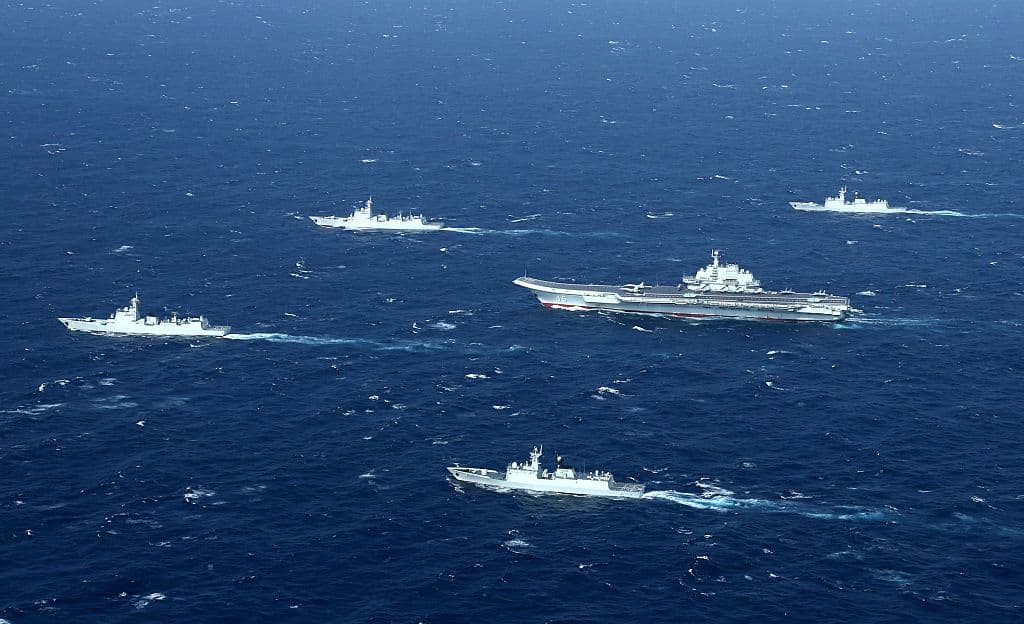
Under this strategy, China significantly modernized its navy, built several aircraft carriers, increased the number of ocean-going destroyers and frigates, and established its first overseas naval base in Djibouti in 2017. Located near the entrance to the Red Sea, it provides logistical support for Chinese ships conducting anti-piracy operations in the Gulf of Aden and escorting merchant vessels in the Indian Ocean. The expansion of its naval presence has significantly enhanced China’s own capabilities to protect maritime lines of communication and reduced its dependence on security guarantees from other states.
Despite the implementation of large-scale projects, none of them has been able to fully eliminate China’s dependence on supplies passing through the Strait of Malacca. This is because the volume of energy resources that can be transported overland is significantly lower than the needs of the Chinese economy. Pipelines from Kazakhstan, Russia, and Myanmar have only partially diversified supply sources; however, their combined capacity of around 82 million tonnes per year accounts for only about 15% of the volume of energy resources transported to China by sea through the Strait of Malacca, approximately 550–570 million tonnes per year.
It is also important that alternative routes face their own geopolitical constraints. The China–Myanmar corridor passes through an area marked by domestic political instability. The China–Pakistan Economic Corridor faces security challenges in Balochistan, where attacks on Chinese facilities and personnel occur regularly. Moreover, despite significant Chinese investment, the port has not yet reached its planned cargo throughput, while the lack of a completed transport connection with China’s western regions limits its role as a full-fledged alternative to the maritime route through the Strait of Malacca.
At the same time, the effectiveness of these measures depends largely not only on their scale but also on the pace at which they are being developed. China is gradually expanding its transport infrastructure and naval capabilities, but the United States and its allies are likewise increasing their security activities in the Indo-Pacific region. This means that the process of reducing dependence on the Strait of Malacca is taking place amid ongoing strategic competition, with both sides simultaneously adapting their respective approaches.
Despite significant progress in diversifying supply routes, the Strait of Malacca still represents a source of vulnerability for China. Under current conditions of US–China rivalry, the question arises as to whether this maritime passage could become a flashpoint for conflict between the two countries. This question is particularly relevant taking into account the confrontation over Taiwan, which is currently the main point of tension between Beijing and Washington.
From the perspective of international law, a scenario involving the blockade or closure of the strait is unlikely. Under the United Nations Convention on the Law of the Sea, the Strait of Malacca is an international strait through which the right of transit passage applies. Moreover, any attempt to completely block the strait could have serious consequences not only for China but also for Japan, South Korea, India, and ASEAN member states, for which the strait is likewise an important maritime route for the transportation of goods and energy resources. Any prolonged disruption of shipping would lead to a sharp increase in maritime transport costs, a spike in oil and liquefied natural gas prices, disruptions to global supply chains, and significant economic losses.
However, the practical implementation of international legal norms may become more difficult in the context of armed conflict. Events surrounding the Strait of Hormuz demonstrate that the legal status of a strait does not guarantee the absolute safety of navigation. Although the Strait of Hormuz also has the status of an international strait and is subject to the regime of transit passage, its periodic closure by Iran, as well as the detention and shelling of oil tankers, have repeatedly led to increases in global oil prices and vessel insurance costs. Therefore, in a crisis, political will may become a key factor, in which case even a blockade of the Strait of Malacca could become a viable instrument of pressure, regardless of international obligations.
However, some American analysts suggest that one of the most probable scenarios would be the gradual depletion of China’s economic potential through control of maritime lines of communication. According to their assessments, in the event of a war over Taiwan, the United States could restrict energy supplies to the PRC not by physically blocking the Strait of Malacca, but by controlling major sea lanes, creating high risks for shipping, and restricting the passage of certain merchant vessels in the Indian Ocean and adjacent chokepoints. Such assessments are based on the superiority of the United States and its allies in naval power, as well as their extensive network of military bases and partnerships across the Indo-Pacific region.Under such a scenario, the United States would be highly likely to deny China the ability to use maritime routes without hindrance to sustain its economy and military capabilities.
Thus, the significance of the Malacca dilemma lies primarily in the fact that it reflects China’s continued critical dependence on maritime lines of communication. This dependence continues to shape the strategic thinking of the Chinese authorities, driving changes in supply routes, the modernization of naval forces, and the search for alternative logistics corridors. In the context of a possible escalation over Taiwan, the Strait of Malacca remains one of the key factors that will affect the strategic resilience of the Chinese economy and the security of external supplies.
The Strait of Malacca is not only a key artery of global trade but also one of the most important factors shaping the modern strategy of the People’s Republic of China. China’s rapid economic growth and the concentration of maritime traffic through a single narrow passage gave rise to the “Malacca dilemma,” which remains one of the central elements of Chinese strategic thinking to this day.
Over the past two decades, Beijing has taken extensive measures to reduce its strategic vulnerability by developing pipeline infrastructure, establishing new international transport corridors, implementing the Belt and Road Initiative, expanding its network of ports in the Indian Ocean, and modernizing its naval forces. At the same time, none of these projects has been able to fully replace the Strait of Malacca. Therefore, in the near term, China is most likely to focus on further developing and strengthening the diversification network it has already established.
At the same time, another area is gaining increasing strategic importance: the transformation of the energy sector. The national renewable energy development plan presented in 2026 envisages a large-scale expansion of solar and wind power, the development of energy storage systems, the electrification of transport, and the gradual reduction of fossil fuel use. Although the primary goal of this policy is to facilitate the energy transition and achieve climate targets, in the long term it may also have a significant geopolitical effect.
Despite international legal guarantees of freedom of navigation, contemporary geopolitical developments show that the security of maritime lines of communication depends to a significant extent on the overall level of international stability. In the event of an escalation of US–China rivalry, particularly over Taiwan, the Strait of Malacca is unlikely to become the site of a direct military blockade, but it could become an important instrument of economic and strategic pressure through disruption of maritime lines of communication. Therefore, ensuring the resilience of logistics routes and reducing dependence on a single critical maritime passage will remain among the key priorities of China’s foreign, economic, and security policy in the coming decades.
You may be interested