 INTERNATIONAL
INFORMATION AND ANALYTICAL
COMMUNITY


+ Join
Support INTERNATIONAL



Dmytro Ananiev, staff Analyst at the “Resurgam” Center for Western and Central European Policy
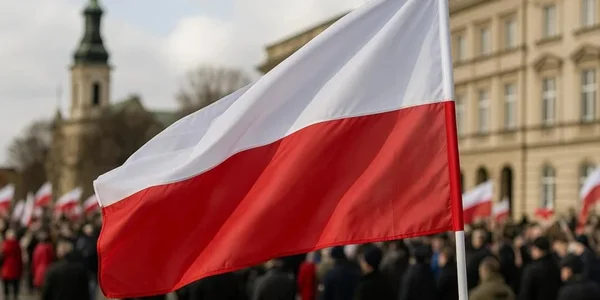
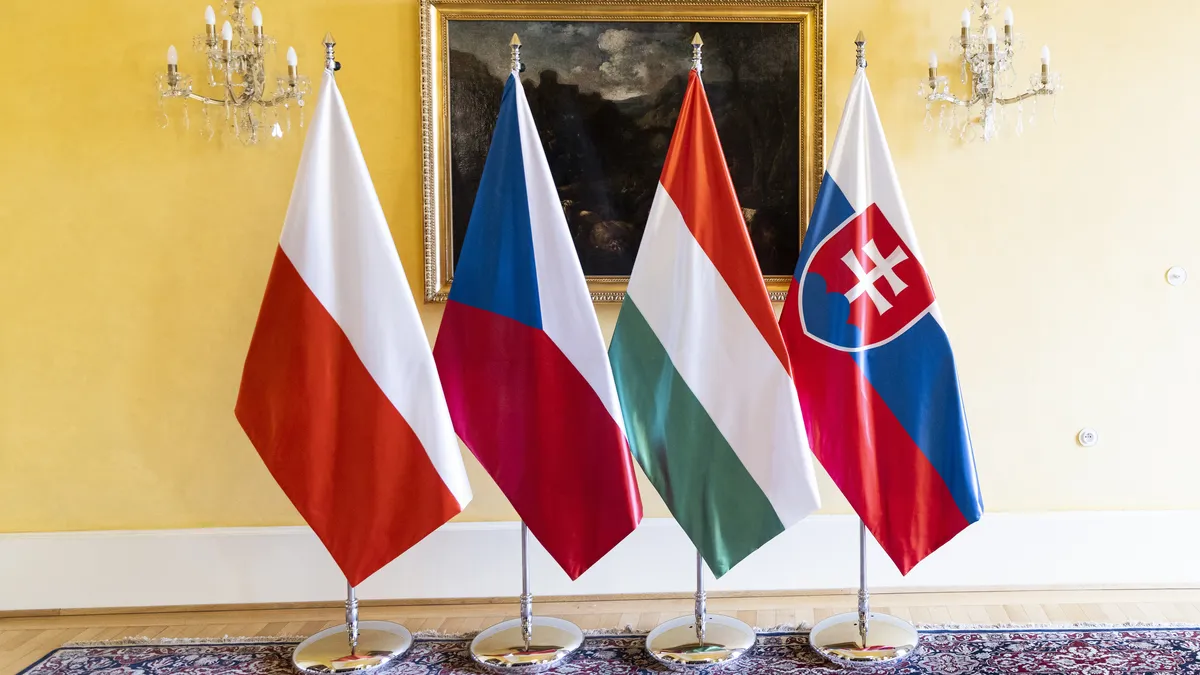 Flags of the Visegrád Four countries. Source
At the same time, even extensive constitutional powers do not necessarily translate into real influence if the head of state lacks parliamentary support. Therefore, to understand who actually shapes the domestic and foreign policy of Central and Eastern European countries, it is not enough to know their form of government. It is also necessary to examine how governments are formed, to whom they are accountable, and which decisions can be blocked by the president or parliament.
This article examines the specific features of the systems of government in these countries.
In all Visegrád Four countries, the government depends on parliamentary support. Therefore, winning an election or being able to form a coalition afterwards is the main prerequisite for gaining executive power. However, the same principle of “the majority forms the government” works differently across these countries. In one, the election winner gains almost all the political leverage; in another, an independently elected president retains the ability to block some of the government's decisions; while in a third, the head of state gains additional room for manoeuvre only when the parliamentary majority itself proves unstable.
A parliamentary victory carries the greatest weight in Hungary. The prime minister is elected by the National Assembly (parliament), while the president is subsequently elected by parliament itself. When there is a clear parliamentary majority, the president effectively formalises a political outcome that has already been determined by that majority. At the same time, the country's electoral system allows a single party to secure a constitutional majority in a nationwide election. Such a majority enables the ruling party to elect the president independently, amend the Constitution and revise the rules governing the functioning of key state institutions.
Following Tisza's victory, this very configuration allowed the new parliamentary majority not only to form Péter Magyar's government but also to introduce constitutional amendments and appoint the president.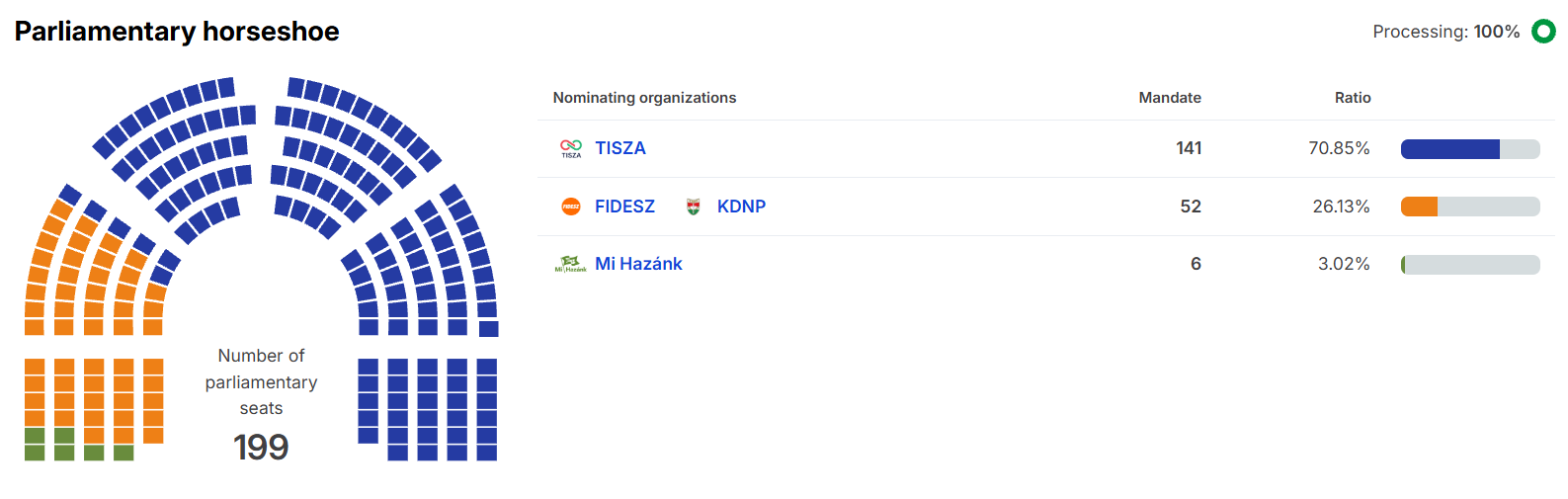 Composition of the Hungarian National Assembly following the 12 April 2026 election, by party. Source
At this level, Poland and Hungary occupy opposite ends of the spectrum. In Hungary, a sufficiently large parliamentary majority is able to bring both the government and a significant part of the mechanisms for appointing other state bodies under the control of a single political centre. In Poland, even a stable governing majority must coexist with a president who has an independent electoral mandate and his own instruments for blocking decisions. A parliamentary victory in the first case may mean a concentration of power, while in the second it means control over the government and a legislative majority only.
Slovakia occupies an intermediate position. As in Poland, the president is elected by the public, meaning that the parliamentary majority does not control the presidency. At the same time, the presidential veto is weaker, and a stable coalition with an absolute majority can override it by passing legislation again. Under normal circumstances, the government and the National Council (parliament) therefore remain the main centres shaping the country's political course. The president may publicly oppose the cabinet, challenge individual appointments or return legislation to parliament, but their room for manoeuvre remains significantly limited as long as the coalition retains its majority.
However, Slovakia's political system changes significantly when this majority collapses. Unlike in Poland and Hungary, parliament may dismiss the government without simultaneously appointing its successor. If MPs are then unable to form a new cabinet, the president's influence increases: the head of state gains control over certain decisions made by the caretaker government and may assume a key role in forming a transitional cabinet.
A similar balance exists in the Czech Republic. The parliamentary majority also determines which government can secure a political mandate, while the president cannot govern the country indefinitely through a cabinet that lacks parliamentary support. However, before a government secures a vote of confidence, the head of state has greater procedural leeway than his counterparts in the Visegrád Four. The Czech president plays a key role in the first two attempts to appoint a prime minister. This gives the president influence over the pace and conditions of cabinet formation, particularly when election results do not produce an obvious majority. During the formation of Andrej Babiš's government, for example, Petr Pavel used the appointment process to obtain an explanation of how the future prime minister's conflict of interest would be addressed. Once a parliamentary majority had emerged, however, the president could not impose a different candidate on it.
The Czech parliamentary majority also faces another constraint that does not exist in Hungary. Control over the Chamber of Deputies does not mean control over the entire legislative system. The permanent Senate does not participate in government formation, but it has the power to block constitutional and electoral changes.
The Czech Senate's particular significance lies in its permanent status: it cannot be dissolved, and only one-third of its members are replaced every two years. In the case of electoral and constitutional laws, the Chamber of Deputies cannot simply override the Senate's objections by voting again. Such legislation must be approved by both chambers in identical wording. This makes the upper house a long-term institutional safeguard, as even a governing coalition with full control over the lower house does not automatically gain control over the rules governing the system without Senate support.
Thus, in Hungary, a parliamentary victory may bring control over more than just the government. A constitutional majority gives the ruling party the power to change a significant part of the system's rules. In Poland, it leaves a powerful, independently elected president in place, who is able to systematically block the government's decisions. In Slovakia, the president has limited influence while the parliamentary majority remains stable, but their role expands considerably after it collapses. In the Czech Republic, parliament ultimately determines who governs the country, but the president enjoys the greatest procedural leeway during the transfer of power, while the Senate separately limits the majority's ability to change the constitutional framework.
In all four countries, the government is accountable to parliament. In Poland and Hungary, the government is protected against parliamentary crises differently than in the Czech Republic and Slovakia.
Poland and Hungary have a constructive vote of no confidence. Parliament cannot simply vote against the incumbent prime minister. A majority seeking to remove him must simultaneously agree on a new head of government. As a result, the existence of a majority opposed to the government does not necessarily mean that there is a majority capable of taking power.
Under the constructive vote of no confidence procedure, it is not enough for the opposition to rally ad hoc support against the incumbent cabinet. MPs must simultaneously nominate a specific successor as prime minister who has the backing of an absolute majority in the Sejm or the National Assembly. This protects the country from an institutional vacuum — a situation in which the incumbent prime minister has been removed but no new majority has yet been formed — and prevents the opposition from triggering a crisis for its own sake. This arrangement strengthens cabinet stability and prevents the opposition from creating a political vacuum simply by voting to dismiss the government.
In Slovakia and the Czech Republic, the government may be removed without an agreed successor. A parliamentary majority against the cabinet is enough. This strengthens parliament's oversight of the government, but also creates the possibility of a situation in which the incumbent prime minister is gone while no new majority exists.
This is where the two models differ fundamentally. A constructive vote of no confidence safeguards the continuity of the parliamentary majority. A regular vote of no confidence allows parliament to remove the cabinet more quickly, but the president may then gain some of the political initiative.
The most illustrative example was the government crisis of 2022–2023. After Eduard Heger's cabinet lost parliament's confidence, MPs were unable to form a new majority. Initially, the government continued to operate with limited powers. In May 2023, President Zuzana Čaputová appointed a technocratic cabinet led by Ľudovít Ódor to ensure the functioning of the state until early elections. The president's role thus became significantly more important because parliament had lost the ability to form a stable executive on its own.
Poland has the strongest permanent presidential safeguard among the Visegrád countries. To override a presidential veto, the Sejm must secure a three-fifths majority. A coalition may therefore have enough MPs to form a government and pass ordinary legislation, but not enough votes to pass it again over the president's objections.
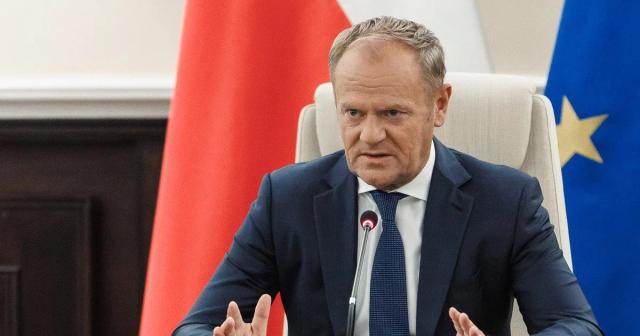
A striking example of this confrontation is the standoff between President Karol Nawrocki and Donald Tusk's government. Since taking office in August 2025, Nawrocki had vetoed 37 laws passed by parliament under Tusk's coalition government by 11 June 2026.
Фото
Cumulative number of vetoes issued by each president by year in office, as of 11 June 2026. Source
A striking example of this deadlock was the dispute over Poland's participation in the EU's SAFE defence programme, under which Donald Tusk's government planned to secure up to €43.7 billion in preferential loans to modernise the armed forces. President Karol Nawrocki vetoed the legislation, arguing that it posed a threat to Poland's sovereignty and would create financial dependence on EU institutions. The veto compelled the government to seek an alternative legal route. The Council of Ministers therefore adopted a separate resolution authorising the relevant ministers to sign an agreement with the EU directly, enabling Poland to receive its first payment of €6.6 billion. The case demonstrated that although an opposition-aligned president may block the formal legislative mechanism, they are unable completely halt or obstruct the government's activities.
In Slovakia and the Czech Republic, the presidential veto is weaker. A stable absolute majority is able to pass legislation again with its own votes. The president may therefore delay a decision, compel MPs to reconsider it and bring the conflict into the public arena. However, when a cohesive coalition is in place, the veto generally does not amount to a prolonged legislative blockade. In the Czech Republic, Petr Pavel's use of this instrument has also been selective rather than systematic.
Hungary has the weakest presidential legislative veto. Parliament may pass a returned bill again with the majority required for the relevant type of legislation. With a stable governing majority in place, the veto therefore serves primarily as a mechanism for delaying legislation and reopening debate, rather than as a genuine obstacle to the government's political agenda.
In all four countries, foreign policy is shaped primarily by the government. It controls the diplomatic service, relevant ministries and the country's day-to-day engagement with the EU and NATO. At the same time, the president represents the country abroad and may therefore provide a separate political voice.
The greatest risk of dual representation arises where the president has an independent popular mandate. In Poland, a conflict between the president and the government may spill over into the international arena. The president does not determine foreign policy instead of the cabinet, but may hold separate meetings, issue independent statements and put forward different political ideas. A telling example was the crisis in Polish-Ukrainian relations, when the president, backed by right-wing forces, made statements opposing Ukraine's domestic political decisions, invoking sensitive issues of historical memory. By contrast, Donald Tusk's pro-European government advocated reducing tensions in bilateral relations.
A similar issue may arise in the Czech Republic. The dispute between Andrej Babiš's government and Petr Pavel over the president's participation in the delegation to the NATO summit demonstrated that international representation remains one of the areas in which the boundaries between presidential and government powers may become the subject of an open constitutional conflict.
In Slovakia, the president also has an independent mandate and is able to represent a different political position. However, the practical conduct of foreign policy remains largely under government control. When the president and the cabinet are politically aligned, the potential for competing voices is greatly reduced. The relationship between Peter Pellegrini and Robert Fico's government demonstrated this through their publicly stated alignment on foreign policy.
Hungary offers the least scope for an independent presidential foreign policy. The president has no separate popular mandate and largely represents the country's foreign policy course, which has already been set by the government and the parliamentary majority.
War or a major domestic crisis poses a serious challenge to a parliamentary system. The president's formal status as commander-in-chief may create the impression that, in times of emergency, the centre of power automatically shifts to the head of state. However, this does not happen in the Visegrád countries. The introduction of a special legal regime may expand the powers of state authorities and allow certain rights to be restricted, but it does not turn the president into the sole head of the government or the armed forces.
In Poland, the president plays a significant role in formally declaring an emergency regime, but cannot do so independently. The president declares martial law or a state of emergency at the request of the Council of Ministers, and the relevant decision must be submitted to the Sejm within 48 hours, which may revoke it. Even in wartime, the president does not assume independent operational command of the armed forces. In peacetime, the president exercises the role of commander-in-chief through the minister of national defence, while in wartime they appoint the Commander-in-Chief of the Armed Forces at the request of the prime minister. Only if the Sejm is unable to convene during martial law the president may, at the government's request, issue regulations having the force of law, which must subsequently be approved by parliament. Thus, even in a crisis, the Polish model preserves the division of decision-making powers between the president, the government and the Sejm, and the head of state does not gain the ability to govern the country single-handedly.
The shift in the balance of power towards the executive is most pronounced under an emergency regime in Hungary. The Fundamental Law provides for three forms of special legal regime: state of war, state of emergency and state of danger. In such circumstances, the government is empowered to issue emergency decrees, suspend the application of certain laws, derogate from their provisions and introduce other special measures. Parliament retains oversight and may repeal such government decrees, while the Constitutional Court continues to operate. The president remains commander-in-chief, but the management of defence and the armed forces is carried out through the government system, with the minister of defence serving as a member of the government responsible for military aspects of crisis management and the command of the armed forces. Thus, under the Hungarian model, a crisis primarily strengthens the government, not the president.
The president of Hungary may assume an additional reserve role only when parliament itself is physically unable to make the necessary decisions. Under such circumstances, the head of state may, among other things, declare a state of war or a state of emergency. However, once parliament resumes its work, the National Assembly must review the legality and justification of the president's decision. Thus, even this emergency power is a mechanism for ensuring continuity of government, not a shift to presidential rule.
In Slovakia, the balance of power also remains collective. The president is commander-in-chief and formally exercises some key military powers, but remains dependent on other institutions: a declaration of war requires a decision by the National Council, while mobilisation and the deployment of armed forces under special legal regimes require a proposal from the government. The constitutional law on state security explicitly assigns the government responsibility for the country's defence and security, as well as for defining the basic framework of defence policy. Thus, the role of commander-in-chief gives the president an important constitutional function but does not transfer day-to-day management of defence to the head of state.
The introduction of a special legal regime strengthens the president least in the Czech Republic. A state of emergency is declared by the government or, in urgent circumstances, by the prime minister, subject to subsequent government approval. The Chamber of Deputies may revoke it. A state of threat to the state, by contrast, is declared by parliament on the government's proposal. The president formally remains commander-in-chief, but their relevant decisions require the countersignature of the prime minister or an authorised member of the government, who bears political responsibility for them. The Czech Ministry of Defence explicitly emphasises that the government, not the president, is responsible for preparing and ensuring the country's defence.
Moreover, during a state of threat to the state or martial law, certain presidential checks and balances are weakened. The government may ask parliament to fast-track bills, and the president no longer has the right to return legislation passed under this procedure. Thus, a major security crisis in the Czech Republic strengthens the government and parliament at the president's expense.
Thus, war or a state of emergency does not change the fundamental nature of government in the Visegrád Four countries. The president may acquire additional formal or reserve powers related to the declaration of a special legal regime, mobilisation or military appointments. The most significant shift, however, takes place within the parliamentary system itself. An emergency regime strengthens the executive's ability to act swiftly while retaining parliamentary or government safeguards against the concentration of military power in the hands of the president.
All four countries remain parliamentary republics. Under normal circumstances, the government cannot govern without parliamentary support, while the president is unable to manage the day-to-day affairs of the state independently. However, the degree to which power is concentrated around the parliamentary majority varies.
The Hungarian model is the most parliament-centred. Parliament elects both the prime minister and the president, the presidential veto is weak, and a constitutional majority allows the governing party to change the very rules of the system. As a result, when it holds a two-thirds majority, the party controlling the National Assembly wields virtually absolute power.
Poland has the strongest permanent constraint on the parliamentary majority. The separately elected president has an independent political mandate and strong veto powers. The president cannot govern instead of the prime minister, but is able to remain an independent counterweight to the government throughout the entire period of cohabitation with an opposition-led government.
Slovakia and the Czech Republic occupy intermediate positions, but their systems differ. The Slovak president is relatively weak when faced with a stable parliamentary majority, but gains significantly more influence after a government falls. The Czech president has the greatest scope for manoeuvre in the process of forming a new cabinet, while a stable parliamentary majority is further constrained by the independent Senate.
Thus, the main difference between the Visegrád Four countries lies in how their political systems are able to constrain a parliamentary majority once it has gained power. Hungary has the fewest independent checks on the majority, Poland retains the president as a permanent competing centre of power, while in the Czech Republic and Slovakia the president's additional powers become most pronounced when the parliamentary system itself loses stability.
You may be interested