 INTERNATIONAL
INFORMATION AND ANALYTICAL
COMMUNITY


+ Join
Support INTERNATIONAL



Daria Honcharenko, Junior Analyst for the Balkan Region at the Resurgam Analytical Center
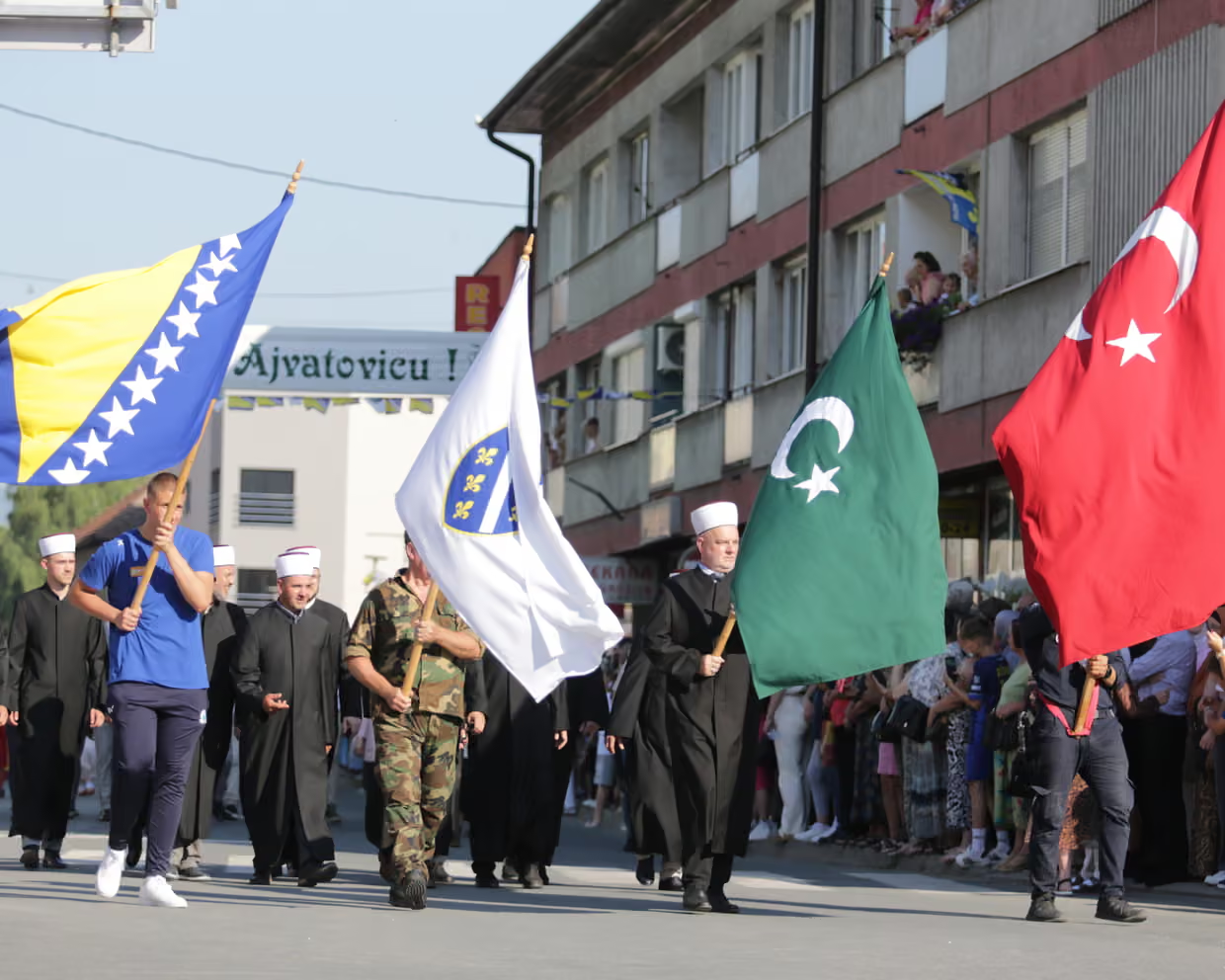 Photograph: Anadolu/Getty Images
One of the key elements of this system remains the institution of the High Representative. Initially, its role was to oversee the implementation of the Dayton Peace Agreement and support post-war stabilisation. Over time, however, the office evolved into an important instrument of international influence over the country's political processes.
A turning point came with the resignation of High Representative Christian Schmidt in May 2026. According to Schmidt, his decision was made under considerable pressure from the United States amid disagreements over the future role of the international community in Bosnia and Herzegovina and the implementation of the Southern Interconnection energy project. In the aftermath of his resignation, the member states of the Steering Board of the Peace Implementation Council (PIC) failed to reach a consensus on the appointment of his successor.
Today, the role and appointment of the High Representative increasingly reflect divisions among Western allies over the future of the international approach to Bosnia and Herzegovina. The absence of a common position between the United States and the EU has weakened external influence over the country's political elites and increased the risks to the stability of the region as a whole.
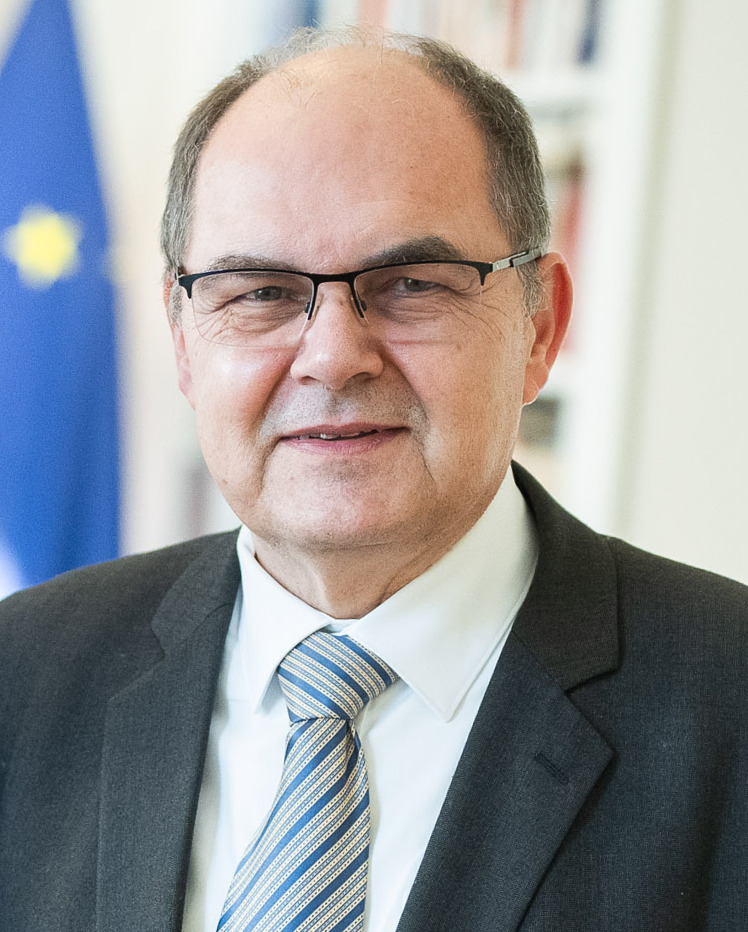 Christian Schmidt, High Representative for Bosnia and Herzegovina (2021–2026). Sourse
The Dayton Peace Agreement, signed on 14 December 1995, brought the 1992–1995 war in Bosnia and Herzegovina to an end and established the country's current constitutional order. It preserved Bosnia and Herzegovina as a single sovereign state while dividing it into two entities: the Federation of Bosnia and Herzegovina and Republika Srpska. The Brčko District was subsequently granted a separate status. Although this system was designed to ensure a balance among the country's three constituent peoples, its complex distribution of powers and frequent political deadlocks created the need for international oversight of the implementation of the Dayton Peace Agreement.
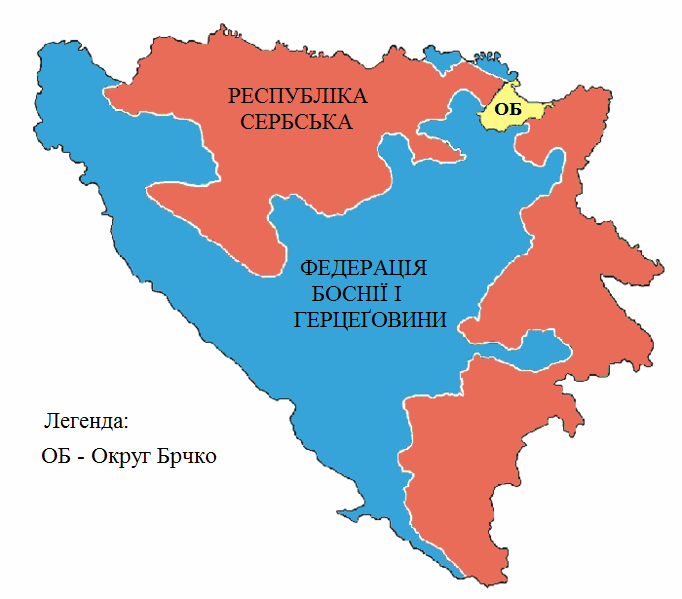 Administrative division of Bosnia and Herzegovina. Source
Since then, the High Representative has been empowered to intervene when the functioning of state institutions is obstructed. The High Representative may adopt decisions that are legally binding on all levels of government, repeal or amend legislation that is incompatible with the Dayton Peace Agreement, and remove public officials who obstruct its implementation. In practice, the High Representative serves as an international arbiter responsible for safeguarding political stability in Bosnia and Herzegovina.
For the EU, the United States, and the other members of the PIC Steering Board, the institution of the High Representative remains essential for the implementation of the "5+2 Agenda", adopted by the PIC Steering Board in 2008. Its primary objective is to create the political and legal conditions necessary for the closure of the Office of the High Representative and the transfer of full responsibility for governing the country to the institutions of Bosnia and Herzegovina.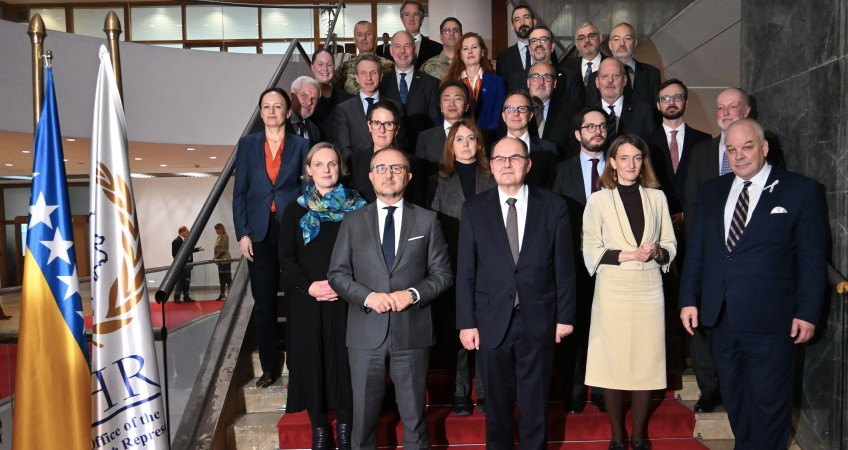 PIC Steering Board meeting in Sarajevo, December 2024. Source
Despite its important role in maintaining stability in Bosnia and Herzegovina, the institution of the High Representative remains a source of controversy because of its extensive powers to intervene in the functioning of public authorities. The leadership of Republika Srpska has been the most consistent opponent of the institution. Serb political leaders argue that the High Representative's extensive powers undermine the sovereignty of Bosnia and Herzegovina and violate the principle of independent political decision-making.
At the international level, this position is supported by Russia and China. Following the appointment of Christian Schmidt in 2021, Moscow and Beijing argued that his appointment should have been separately approved by the UN Security Council. In the absence of such a decision, Russia and China do not recognise his legitimacy and continue to call for the early closure of the Office of the High Representative. This position also reflects Moscow's and Beijing's broader efforts to weaken international oversight of developments in Bosnia and Herzegovina and expand their opportunities to advance their own political interests in the region.
However, disagreements over the office also emerged among Western countries. Christian Schmidt's resignation in May 2026 exposed, for the first time in many years, deep divisions between the United States and its European allies over the future of the international governance of Bosnia and Herzegovina. At a meeting of the PIC Steering Board, the parties failed to reach a consensus on the appointment of a new High Representative. Washington backed the Italian diplomat Antonio Zanardi Landi, while most European countries supported the French diplomat René Troccaz.
The differences between the two candidates largely reflected their professional backgrounds. Antonio Zanardi Landi had spent many years working on both Balkan and Russian affairs and was therefore associated with a more pragmatic approach that placed greater emphasis on dialogue and negotiation. By contrast, René Troccaz specialised specifically in the Western Balkans and possessed extensive knowledge of the region's political system and its key stakeholders, making him an advocate of a more active role for the Office of the High Representative in preventing political crises.
Washington has increasingly favoured reducing international involvement and transferring greater responsibility to local institutions. Most EU member states, by contrast, argue that, given the persistent political deadlock and interethnic tensions, any premature reduction of the High Representative's powers would create additional risks to the country's stability.
These disagreements stem from a broader shift in US foreign policy priorities. Following declarations that the "era of US-led nation-building" had come to an end, Washington has increasingly focused on pragmatic partnerships and transferring greater responsibility to its European allies, placing greater emphasis on burden-sharing. For Brussels, by contrast, the priorities remain overseeing the completion of democratic reforms, ensuring the effective functioning of state institutions, and preparing Bosnia and Herzegovina for future EU membership.
Previously, the unified position of Western partners was one of the main factors in containing political crises. Today, however, the absence of a consensus on the role of the Office of the High Representative has created additional room for divergent actions by local political elites.
The leadership of Republika Srpska has been the primary beneficiary of these divisions, continuing to challenge the authority of the state-level institutions and the High Representative. The absence of such a stabilising institution under Western oversight provides the leadership of Republika Srpska with greater opportunities to advance separatist initiatives and pursue an anti-European agenda.
At the same time, divisions among Western allies may weaken the coordination of international policy towards Bosnia and Herzegovina. This may slow the implementation of reforms required for the country's European integration. Moreover, the erosion of international consensus increases the risk of internal destabilisation in Bosnia and Herzegovina. A political crisis could spill over into the security domain, while Republika Srpska's efforts to expand its autonomy further increase the risk of escalation. Despite criticism of its intervention in the functioning of public authorities, the institution of the High Representative remains the principal mechanism for containing political crises in Bosnia and Herzegovina.
These disagreements become particularly acute in the context of the upcoming elections. The general elections in Bosnia and Herzegovina, scheduled for 4 October 2026, will take place amid one of the country's most severe political crises in recent years. The lack of consensus between the United States and the EU on the appointment of the High Representative weakens the credibility of international oversight precisely at a time when it has traditionally played an important role in containing political escalation.
Elections in Bosnia and Herzegovina are held at multiple levels. Voters simultaneously elect the members of the Presidency, the House of Representatives of the Parliamentary Assembly, and the authorities of their respective entity. At the same time, the Bosniak and Croat members of the Presidency are elected exclusively by voters in the Federation of Bosnia and Herzegovina, while the Serb member is elected exclusively by voters in Republika Srpska.
These elections may significantly reshape the domestic balance of power. For the Alliance of Independent Social Democrats (SNSD), which advocates greater autonomy for Republika Srpska and reduced powers for the state-level institutions, the outcome will determine whether the party retains control of the entity's government. Against the backdrop of declining public support, the divisions between the United States and the EU provide the SNSD with an opportunity to reverse this trend and intensify its separatist and anti-Western rhetoric.
In the absence of strong Western oversight, the election campaign may increase the risk of interethnic tensions. The use of nationalist rhetoric and constitutional disputes to mobilise the electorate could further exacerbate relations among Bosnia and Herzegovina's three constituent peoples—Bosniaks, Croats, and Serbs.
The disagreements between the United States and the EU provide local political actors with greater room to pursue their own interests. As a result, unless the international community adopts a unified position, the influence of the High Representative may be significantly weakened, while political confrontation may intensify.
The disagreements between the United States and the EU ahead of Bosnia and Herzegovina's general elections create additional opportunities for Russia to expand its influence in the country. Moscow has refused to recognise the legitimacy of High Representative Christian Schmidt. It also advocates the closure of the Office of the High Representative and exploits divisions within the West to promote the narrative that the system of international oversight is ineffective.
The leadership of Republika Srpska remains Russia's key partner in Bosnia and Herzegovina. Through it, Moscow is able to influence the country's political processes. Russia therefore supports Milorad Dodik and his allies, who advocate greater autonomy for Republika Srpska, criticise the state-level institutions and the Office of the High Representative, and seek to reduce their authority. If this rhetoric translates into concrete action, it would enable Moscow to undermine the influence of Western countries and expand its own political influence in the region.
The weakening of transatlantic unity also creates greater opportunities for information operations and the further destabilisation of the country's political environment. In the longer term, if international oversight continues to weaken, Russia's influence may deepen the institutional crisis, strengthen separatist movements in Republika Srpska, and further complicate Bosnia and Herzegovina's path towards European integration.
The future course of events will largely depend on whether the United States and the European Union can restore a common approach to international governance in Bosnia and Herzegovina. If disagreements over the future of the Office of the High Representative persist, the ability of the international community to influence domestic political processes in the country will gradually decline.
Against this backdrop, the October elections will determine the future course of Bosnia and Herzegovina. If the Peace Implementation Council fails to reach a compromise on the appointment of a new High Representative or if his powers are significantly limited, this may further undermine confidence in the legitimacy of the appointment process itself and provide local political elites with greater opportunities to exploit constitutional disputes for their own interests.
Under these circumstances, support for pro-European political forces may weaken. Ahead of the elections, these forces have their best opportunity in years to strengthen their position in Republika Srpska amid declining support for the SNSD.
At the same time, the absence of a unified Western position may weaken voters’ confidence in the European path and provide additional political arguments for forces advocating greater autonomy for Republika Srpska and a reduction of international oversight.
The probable scenario for the coming years remains one of prolonged political instability. The persistence of interethnic tensions, disagreements among Western partners, and active Russian influence will create ongoing risks for the stable functioning of the state.
The dispute over the appointment of a new High Representative has gone far beyond a personnel issue and has become a reflection of changing Western approaches towards Bosnia and Herzegovina. The lack of a common position weakens the effectiveness of international pressure on political forces that systematically obstruct the functioning of state institutions. Above all, this creates additional opportunities for the leadership of Republika Srpska to more actively pursue greater autonomy, while allowing Russia to strengthen its political and information influence in the region.
With the SNSD recording its lowest approval ratings in years, there is a real possibility of pro-European forces strengthening their position in Republika Srpska. This could reduce the influence of pro-Russian political actors, weaken separatist rhetoric, and create more favourable conditions for implementing reforms.
At the same time, the election campaign may be accompanied by a sharp escalation of political and interethnic disputes, particularly if pro-Russian forces attempt to mobilise voters through constitutional disputes and issues related to the status of Republika Srpska.
For this reason, the coming months will be decisive not only for the domestic politics of Bosnia and Herzegovina but also for the entire architecture established after the Dayton Agreement. If the United States and the EU fail to restore a coordinated policy, the risks of prolonged political instability will remain high even without a transition to open armed conflict.
You may be interested