 INTERNATIONAL
INFORMATION AND ANALYTICAL
COMMUNITY


+ Join
Support INTERNATIONAL



Mykhailo Mazur, Graduate of CEVRO University, Intern at the Resurgam Analytical Center
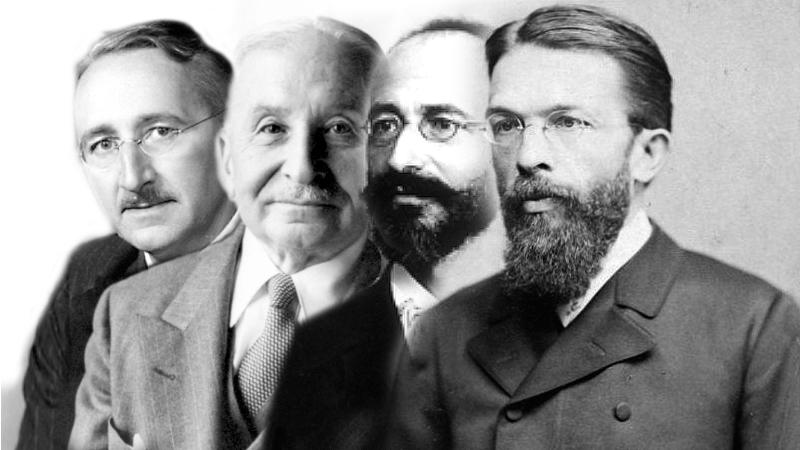 The most influential Austrian economists from past centuries. From left to right: Carl Menger, Eugen von Böhm-Bawerk, Ludwig von Mises, and Friedrich Hayek. Source
A similar dynamic, albeit in a different form, may be seen in Poland, where Confederation (Konfederacja) has steadily expanded its electoral support. Unlike the Austrian FPÖ, it has neither won a parliamentary election nor entered government. In the 2023 parliamentary election, the party won around seven percent of the vote and secured eighteen seats. Since then, however, its support has risen to approximately thirteen percent, making it the country's clear third-largest political force.
What these parties have in common is their commitment to closed borders, protectionism, and the nation-state. At the same time, much of their economic agenda draws on the ideas of the Austrian school of economics. The school's leading thinkers viewed the free market not merely as an efficient economic mechanism, but as a precondition for political freedom.
The article examines how an idea rooted in individual liberty became the intellectual brand of people seeking to place far-reaching restrictions on that very freedom.
At its core, the Austrian school opposes a large state apparatus, government spending, and government subsidies. With regard to central planning, its proponents argue that no government possesses sufficient knowledge to make decisions instead of individuals, and that this is precisely what makes central planning inefficient.
This also explains the Austrian school's criticism of central banks, which control the money supply and can expand or contract it at any moment, as well as its criticism of fiat money, whose value rests solely on public confidence and on the state's ability to require taxes to be paid in it. This critique readily lends itself to narratives of a globalist conspiracy: once one assumes that someone is pulling the strings behind this invisible centre and deliberately eroding people's savings, the image of an enemy almost creates itself.
These methods are currently proving to be quite effective because anti-vaccination and, more broadly, conspiracy theories gained significant traction during the COVID-19 pandemic and the period of mandatory vaccination. Moreover, through their criticism of regulation, government spending, and taxation, Austrian school ideas appeal both to lower-income voters and those living in rural areas, as well as to higher-income voters and those living in cities. At the same time, the growing number of wars and crises around the world is increasing uncertainty, which has historically radicalised voters and led them to demand more radical ideas.
The combination of these factors makes the Austrian school an ideal foundation for right-wing populist parties.
The result is the emergence of political programmes built on distrust of the state and on the arguments of the Austrian school. However, this borrowing is selective. These parties embrace the anti-state dimension of the Austrian school while quietly discarding its other half—open borders and the free movement of people—because they themselves advocate closed borders and oppose immigration. It is precisely this contradiction between borrowed rhetoric and actual policy that we will examine in the following sections, using the examples of Austria, Germany, and Poland.
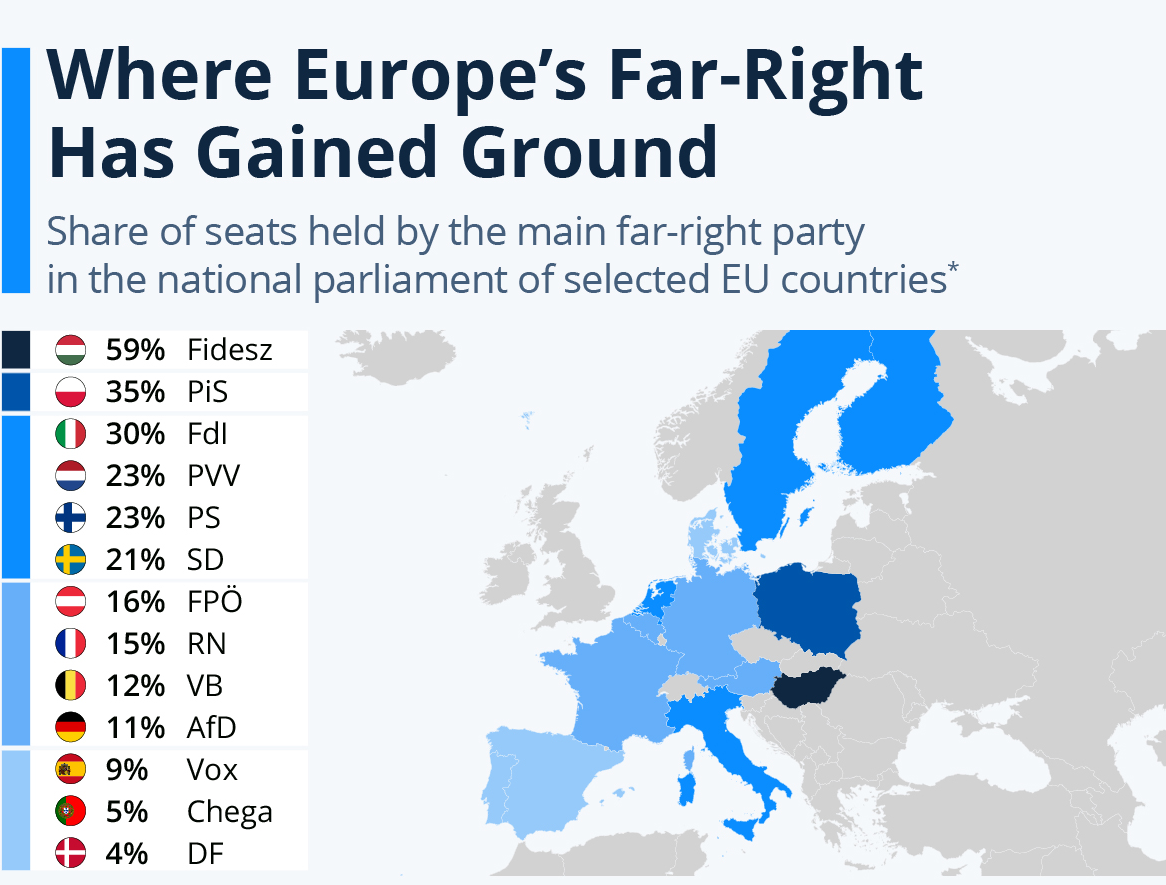 The share of seats held by far-right parties in European national parliaments as of 2023. Source
The first thing that stands out in the Austrian case is the coincidence of names. The Austrian school was born in Vienna, and the same country gave rise to the Freedom Party of Austria (FPÖ), which readily speaks the language of liberty and the free market. The FPÖ traces its roots to the so-called national-liberal camp, where a distinct classical liberal current once existed. As a result, the party has some historical grounds for appealing to the liberal tradition. More broadly, the German-speaking world is home to a wider intellectual community that promotes the ideas of Mises and Hayek—from institutes bearing their names to right-libertarian circles—and this community overlaps ideologically with part of the party's right-wing electorate.
The problem is that there is a wide gap between this rhetoric and the FPÖ's actual policies. Under the leadership of Herbert Kickl, the party has built its appeal not on reducing the size of the state, but on what is commonly known as welfare chauvinism—that is, the promise to preserve and even expand social spending. The defining feature of this approach, however, is that these benefits are reserved for the native population, while immigrants are excluded from them. This is the exact opposite of what the leading thinkers of the Austrian school, Mises and Hayek, advocated. The Austrian school recognises no distinction between "us" and "them"; in its view, state intervention is harmful in itself.
The same contradiction can be seen in the issue of borders. The Austrian tradition supports the free movement not only of goods and capital, but also of people. The FPÖ, by contrast, has made closed borders and opposition to immigration the central pillars of its programme. As a result, the Austrian school's principles serve the FPÖ only as a lightning rod. They answer the question of "who is to blame," but not "what should be done." Distrust of the state and the central bank is easily turned into political slogans and fits neatly into the image of distant bureaucrats spending other people's money. Yet the part of Austrian thought that deals with actual policy—open borders, free trade, and the rejection of social spending—would require the party to abandon the very positions on which its electoral appeal depends. Its selective use of Austrian school ideas is therefore no accident: it borrows from the theory only as much as it can without undermining its own electoral base.
The German case is interesting because, although the AfD's economic policy initially resembled that of the Austrian school, it was in fact rooted in a completely different school of economic thought. The AfD was founded in 2013 amid criticism of the eurozone and the common currency, and its founder was the economist Bernd Lucke. The immediate catalyst was the Greek sovereign debt crisis and the bailout packages that Berlin supported to preserve the eurozone. Lucke and his associates argued that it was unfair for German taxpayers to bear the cost of rescuing other countries' debts and that the very design of the euro was fundamentally flawed.
It is important not to confuse these two distinct traditions. Economically, the early AfD was rooted not in the Austrian school but in ordoliberalism—a German school of economic thought that emerged in Freiburg during the interwar period. Ordoliberalism also values the free market, but unlike the Austrian school, it assigns the state an important role as the guarantor of the rules within which the market operates. This is almost the opposite of the Austrian school's distrust of the state as such. In fact, the two traditions share only one area of common ground: scepticism towards central banks as institutions and towards money creation. This is where the AfD derives its monetary vocabulary, as well as its critical rhetoric towards the European Central Bank.
After 2015, when the migration crisis moved to the centre of public attention, the party underwent a sharp process of radicalisation. Lucke and other founders from the ordoliberal wing left the AfD. Economic policy gradually took a back seat to nationalist rhetoric, in which economic issues became secondary to questions of identity, migration, and sovereignty. The elements of the party's economic programme that remained increasingly shifted towards protecting the domestic market and national interests—that is, towards protectionism, which is characteristic of neither ordoliberalism nor, even less so, the Austrian school.
The Polish case stands apart because, here, the appeal to the Austrian school is not merely a cover but a genuine conviction, at least for part of the movement. While the FPÖ and the AfD adopt the language of the Austrian school only to depart from its economic principles, Poland's libertarians genuinely seek to achieve the goals the Austrian school values: low taxes, deregulation, and a state that stays as far away from the economy as possible.
To understand these roots, it is worth recalling the figure of Janusz Korwin-Mikke, who, since the fall of communism, has consistently promoted radical economic liberalism in Poland and directly referred to the thinkers of the Austrian school. It was from this tradition that the New Hope party emerged, now led by Sławomir Mentzen, an economist and tax adviser. Mentzen has made tax cuts and the fight against bureaucracy his trademark and gained enormous popularity among young people, especially young men who link their own economic difficulties to excessive state intervention.
Unlike the Austrian and German cases, here these ideas can be judged by concrete policies. Mentzen does not offer a slogan about a "smaller" state, but a clear plan: a flat tax, the abolition of some contributions, and simplified reporting requirements for small businesses. This is something Mises would have endorsed without reservations, and something that would cost the party votes among public-sector workers and pensioners. However, the willingness to pay this political price is precisely what distinguishes genuine conviction from borrowed rhetoric.
However, this is where the main contradiction lies—one that is different in nature from the Austrian and German cases. Konfederacja combines a libertarian economic agenda with strict social conservatism, nationalism, and a religious outlook. Paradoxically, the same force that calls for maximum freedom for entrepreneurs and minimal state involvement in the economy also advocates state control over private life, a complete ban on abortion, a traditional family model, and strict limits on migration, especially from Ukraine. The result is an incomplete construction in which the market is free, but the individual is not. For Konfederacja, libertarianism is not a universal principle for organising society. Instead, it is largely limited to the economic sphere, while on issues of culture, migration, and family policy the party, by contrast, supports an active role for the state. As a result, freedom is no longer an imperative for the party but becomes a selective tool applied only where it aligns with its political agenda.
The core of Konfederacja's electorate consists of young men from smaller towns, entrepreneurs, and the self-employed, who primarily experience the state through tax and bureaucratic pressure, while at the same time not being among the groups affected by restrictions in the private sphere. Freedom for oneself and control over others form a perfectly consistent worldview for such a voter. In this sense, the Polish case mirrors the logic of the FPÖ. The Austrian party divides people into "us" and "them" in terms of access to social spending, while the Polish party does the same in terms of access to freedoms. In practice, both take a universal principle and narrow it down to the group that votes for them.
It is worth noting that Konfederacja itself is not a homogeneous movement. Its libertarian core is represented by Mentzen's New Hope, alongside the nationalist National Movement, while until recently the coalition also included Grzegorz Braun, who was closer to Catholic traditionalism than to the free market and eventually broke away to form a separate political force. Therefore, when we speak of genuine "Austrianism", we are referring primarily to Mentzen's wing rather than the entire movement, in which economic liberalism is only one of several competing voices.
If we look at the three cases as a whole, it becomes clear that the adoption of ideas from the Austrian school is selective everywhere, although the degree of divergence varies. The best way to demonstrate this is by examining several areas that are fundamental to the school itself.
Let us begin with migration. The Austrian tradition supports the free movement of people. All three parties take positions that are directly opposed to this principle. The FPÖ has made opposition to migration the cornerstone of its programme, the AfD urges the closure of borders and even emigration, while Konfederacja demands a sharp reduction in the inflow of foreigners, primarily Ukrainians. In this area, the divergence from the principles of the Austrian school is complete and identical in all three cases.
The second area is free trade. The FPÖ and the AfD lean towards economic nationalism and the protection of the domestic market. Poland's Konfederacja is closer to the Austrian school in this regard: its libertarian wing generally supports free trade, although with nationalist reservations. In other words, the overlap is only partial and exists only in the Polish case.
The third area, monetary policy, turns out to be the only field of genuine agreement among all three. Each of the parties readily repeats the Austrian school's warnings against central banks and money creation. For the AfD, criticism of the European Central Bank was even one of its founding motivations; the FPÖ builds a significant part of its rhetoric around the devaluation of ordinary people's money, while this criticism occupies a central place in the programmatic texts of Polish libertarians. The reason for such unanimity is simple: this topic fits perfectly into the narrative of distant and faceless officials who supposedly control the money of an entire nation.
The fourth area—the role of the state in the economy—again separates our cases. Here it becomes clear that the FPÖ and the AfD support a smaller state in words only. The FPÖ builds its appeal on the promise of preserving and expanding social spending, but directing it towards the native population, which directly contradicts the Austrian school's opposition to redistribution. The AfD declares its ordoliberal heritage, but in practice it is drifting towards economic nationalism. Only part of Konfederacja, represented by Mentzen's wing, genuinely seeks minimal state involvement, low taxes, and deregulation, thus truly aligning with the Austrian school.
The fifth area that remains is one that the Austrian school considers inseparable from the previous one: the role of the state in private life. This is where the Polish case diverges most sharply. The same Konfederacja whose libertarian wing advocates maximum economic freedom simultaneously urges state control over private life, a complete ban on abortion, the promotion of a traditional family model, and a religious agenda. The FPÖ and the AfD are also conservative, but for them this is not the central contradiction, because they are already far removed from the Austrian school in economic terms as well.
This leads to an intermediate conclusion. Regardless of which party we examine, its overlap with the Austrian school is based essentially on a single point: monetary criticism. Everything else is adapted by each party to its own agenda, which is “non-Austrian” in spirit. The FPÖ and the AfD diverge from the school primarily in the economic sphere, rejecting free trade and a minimal state. Konfederacja is much closer to the Austrian school economically, but it diverges most sharply where freedom concerns not money but private life.
Monetary criticism is the only part of Austrian thought that comes at no political cost. Demanding free trade means clashing with farmers and industrialists who benefit from tariff protection. Demanding cuts to the state apparatus means withdrawing state support from one's own voters. Demanding open borders means undermining the core of one's own identity. Criticism of central banks, however, does not affect any domestic interest group; its target is always external and always impersonal—places like Frankfurt, Brussels, and global financial elites. This is the only part of the Austrian programme that can be proclaimed every day without risking a single vote.
So far, we have seen that right-wing radicals take only one narrowly focused element from the “Austrian school” — monetary criticism — while rejecting the rest. This, however, raises a logical question. There is more than one market-oriented liberal school of economics, so why did the Austrian school become the banner, rather than, for example, the far more influential Chicago school? The answer says less about economics itself and more about the nature of right-wing populism.
First, it is worth explaining why the Chicago school is relevant for comparison here at all. Both schools—the Austrian and the Chicago schools—belong to the broader neoliberal tradition. The difference is that the Chicago school emerged later but was incomparably more successful. Its leading figure, Milton Friedman, became the intellectual inspiration behind the economic policies of Ronald Reagan in the United States and Margaret Thatcher in Britain, and it was largely Chicago monetarism that shaped the face of global neoliberalism from the 1980s onward. Against this background, the Austrians remained a rather marginal, almost sect-like current.
Yet the far right chose not the winner, but the marginal player. The first reason is that the Chicago school is too technocratic and too closely associated with globalisation. It speaks the language of models, statistics, and efficiency, relies on academic research and international institutions—in other words, it embodies precisely the kind of experts against whom populism rebels. Turning to the Chicago school would mean aligning oneself with the establishment, and that would undermine the entire anti-system rhetoric.
The second reason lies in monetary theory. The Austrian school offers the most radical critique of the modern monetary system among the major economic traditions. Its argument is not limited to the claim that a central bank may make mistakes with interest rates or print too much money. The deeper objection is that, for Austrians, the very ability to create money through institutional decisions is a source of systemic harm. The monetary system should not be improved but removed from state control altogether, returning to sound money whose value does not depend on anyone's decisions. It is precisely this uncompromising position that makes Austrian monetary theory so suitable for political mobilisation. It provides exactly what is needed for a narrative about abstract officials. Chicago monetarism, by contrast, is almost useless for political mobilisation.
The third reason lies in language. The foundation of the Austrian school is not formulas, but categories: freedom, knowledge, spontaneous order, power, and coercion. This is a language that is poorly suited for scientific calculations but ideal for political platforms. It gives the far right a rare combination: the intellectual respectability of recognised thinkers combined with a rebellious, anti-expert tone—something that the dry academicism of the Chicago school cannot provide.
For completeness, it is worth mentioning German ordoliberalism as well, since, as we have seen, the AfD emerged from this tradition. It too remains unsuitable as a broader European banner, but for the opposite reason. Ordoliberalism assigns the state too large and positive a role as a guarantor of rules, and, above all, it is deeply pro-European, as it is historically linked to the very construction of the common market and European institutions. For a force that builds its identity around sovereignty and opposition to Brussels, this makes ordoliberalism just as inconvenient an ally as “technocratic Chicago”.
To sum up, the choice of the Austrian school is not accidental. Turning to the Austrian school is a purely political choice. It simultaneously provides intellectual legitimacy to the criticism of central banks, allows these parties to position themselves against the political establishment, and offers a language understandable to voters who distrust experts. Neither the globalist Chicago school nor pro-European ordoliberalism offered such a combination, and this is precisely why the theories of the Austrian school became the banner.
The FPÖ has already been part of governing coalitions in Austria in the 2000s and in 2017–2019, but only as a junior partner. Neither of these coalitions resulted in a radical reduction of the state apparatus, deregulation, or cuts to social spending. The main changes brought by the FPÖ were the redistribution of spending based on an “us versus them” logic, stricter migration controls that narrowed the labour market, and conflicts with Brussels that created investment uncertainty.
However, if the FPÖ manages to lead a coalition government in the future, and this coincides with the rise of radical right-wing parties to power in other EU countries, it could become a challenge for Brussels and the ECB. This is because the EU’s overall political direction may shift from a neoliberal-centrist model towards a radical right-wing one, increasing pressure from members of the European Parliament and national leaders on the European Commission.
As of July 2026, the AfD is the leading party in Germany in terms of polling and, if nothing changes, will most likely win the largest number of seats in the Bundestag in the 2029 election. However, it will not be able to lead the government, because even a victory with 30% support would give it only around 210 seats, which would not be enough for an absolute majority. Forming a coalition would also be impossible due to the boycott by other parties, the violation of which would amount to political suicide in the next election.
Because the AfD will remain isolated from power at the federal level, its rhetoric cannot be tested in practice, which only strengthens voters’ belief in the party and its programme. At the same time, the party’s current programme calls for Germany to leave the EU, abandon the euro, withdraw from the Paris Climate Agreement, and lift sanctions against Russia. Its migration policy also defines Germans by blood and ancestry rather than citizenship, which contradicts Article 1 of the Basic Law—the most protected provision of the German constitution, which cannot be amended even by a constitutional majority. This makes the implementation of one of the party’s most important electoral promises impossible.
Unlike the FPÖ and the AfD, Konfederacja has the most realistic path to power, despite having the lowest level of support among the three. Polls consistently show that no Polish bloc can secure an outright majority of 231 seats, and the only realistic governing arrangement after the 2027 election is a PiS–Konfederacja coalition, whose combined support exceeds 40%. The party has already played the role of kingmaker in the 2025 presidential election, when around 87% of Mentzen’s voters backed Nawrocki in the second round and effectively determined the outcome.
But this very path to power is also a trap for its economic programme. PiS is the party of the largest social redistribution in modern Polish history, with programmes such as “Family 500 Plus” and thirteenth pensions. A government with PiS would therefore force libertarians to choose between abandoning the flat tax and deregulation or breaking up the coalition. Konfederacja’s leaders currently publicly insist that there will be no deal with PiS, and Mentzen has made Kaczyński’s and Morawiecki’s withdrawal from politics a precondition even for discussing cooperation. Yet the structure of the choice is already clear: entering government is possible only at the cost of compromising on the programme.
Moreover, the erosion of this programme began even before any coalition talks. Mentzen and Bosak have built their campaign against assistance for Ukrainian refugees around the argument that the state should not put foreign citizens above its own. A consistent Misesian would argue that the state should not put anyone above anyone else, because it should not engage in redistribution at all. Once the argument begins to divide people into “us and them” in terms of access to state resources, it ceases to be Austrian and becomes the same welfare chauvinism we saw in the FPÖ, only at an earlier stage.
Thus, the Polish case, the most sincere of the three, is already demonstrating the direction of drift that the Austrian and German cases have followed to its conclusion.
 The “Euro” sculpture near the former ECB headquarters in Frankfurt am Main. Source
Having analysed the three cases, we may return to the question with which we began. How did thinkers who opposed nationalism and defended open borders become the intellectual brand of parties advocating closed borders and the nation-state? The answer is that these parties took not the theory from the Austrians, but their vocabulary. The theorists Mises and Hayek are needed by them not as a guide for policy, but as a source of legitimacy—a way to give anti-establishment and anti-bureaucratic rhetoric the appearance of a respected intellectual tradition.
We have seen that the actual intellectual borrowing is repeatedly reduced to a single point: criticism of central banks and fiat money. Everything else that forms the core of Austrian thought—free movement of people, open markets, and consistent distrust of the state regardless of whom it benefits—is either quietly discarded or directly contradicted. The FPÖ advocates social spending for its own people, the AfD is drifting towards economic nationalism, and Konfederacja demands state control over private life. In each case, what remains of the Austrians is merely the name and a few convenient slogans, while the substance is replaced by an agenda that runs counter to the spirit of the tradition.
Thus, in this interpretation, Hayek and Mises have been transformed into symbols detached from what they actually advocated. Their names function as a mark of quality, a seal of intellectual respectability placed on a programme with which the authors themselves would have disagreed on almost every point. This is not a dialogue with the tradition or its development, but selective quotation, in which only those elements of a complex and internally connected system are taken that can be turned against a common enemy.
The broader question that follows from this concerns not economics, but the nature of right-wing populism itself. The fact that these parties have needed a façade of classical liberal theory at all reveals a certain weakness rather than strength. They are not content with simply appealing to emotions, fears of migration, or distrust of elites; they need intellectual cover that can make their slogans appear like a coherent doctrine. The Austrian school became a convenient supplier of such cover because it offered a rare combination of respectability and rebellion. But the very need to market one set of practices under the banner of an opposing theory says a great deal about the nature of this political phenomenon. It is a movement that still lacks its own fully developed economic thinking and therefore has to borrow someone else’s, rejecting everything within it that proves inconvenient.
You may be interested